Bernadette Spofforth was not exactly a household name until, that is, she was arrested and spent thirty-six hours in a police cell charged with fomenting the Autumn riots, the “Far right thuggery” as our Prime Minister called it, that erupted in Southport, London and other cities throughout England. She was given bail on the condition that she did not speak to the press or make any comment on-line and it is only now, when the charge was dropped for want of sufficient evidence, that her story has been heard.
Her account of what happened is quite disturbing. The crime was sharing inaccurate information on the identity of the preparator on-line. She copied and pasted fake information with her own words “if this is true, there will be all hell to pay”. She said she was distracted that day, quite angry at the possibility of another tragedy linked to mental health. She hadn’t, however, checked the source, deleted the tweet soon afterwards and apologised for it. It was the account of her arrest and time in police cell that was most troubling.
Why she would be treated to a full-blown offensive by the law, five police officers, two cars and a police van arriving at her door with the rigours and humiliation of being searched, and left for a day and a half in a concrete cell, unable to be in touch with her family of friends, is beyond belief. She was allowed one book and her first thought was to take her bible, but decided against it, she now thinks that was silly and regrets it. But she feared it would be used as evidence, against her, that she was “far right”. That was only her perception, but it gives some indication of the insane place we have come to
Many people are arrested and spend time in police cells for longer and under harsher conditions. People who commit crimes must have this already factored this into their minds, as must those who go on protest marches and public disorders, blocking roads etc. They must be aware, depending on how it goes, that being arrested could go with the territory. Some are actively looking for that, to give publicity and to promote their cause. But you cannot underestimate the shock that this treatment has on a regular middle-aged women, wife and mother, because of something she posted. Shock was the result and she suffered terribly for weeks afterwards.
Of course, of course, her suffering does not compare with the sufferings of the families whose little girls were maimed and murdered in the attack. Of course, it doesn’t compare, as she so clearly says, but it is an indication that there is something seriously wrong with the law and how it is enforced.
And it begs the question, why? Was it just that the police’s heavy-handed manner was a mistake and just one of these things that happens? Was it panic instructions from further up to silence fake information? Was it because this woman already had form? She had publicly expressed opinions that didn’t follow the narrative over Covid, Gender, Net-Zero and other doctrinal issues. Was it an opportunity to silence her? If this was the real reason, it didn’t work because she fully intends to continue what she does. But it might work in silencing others.
Whatever the reason, the chasm between how she was treated for what was, at worst, a mistake with keyboard and mouse, and how others in higher places can make any number of mistakes, tell lies, only apologise when they are found out and still hold public positions, salaries and pensions is a signal that something is quite rotten in our state.
It is hard not to be overcome by a deep sense of foreboding that crowds in and overwhelms us when we look and see and feel the movement of the tectonic plates of our world, the rise and fall of kingdoms, the nations in uproar, the growing unrest and protest, the curious alliances and the strange bedfellows. It is hard not to be overcome and gripped by fear, fear for the future for our children, our children’s children and those yet unborn. Stephen Pinker may well say that as humans we have become less violent, more reasonable more understanding, loving and caring over the centuries. Even if that is true, there is no guarantee that it will continue and the ebb and flow of history tells a different story.
When adversaries become friends and come together over an issue, as they did in the house of commons this week, it should be a cause for cheer, but it filled me with dread. This impermanent alliance has been formed for war. A war with Russia. It is not that we are in danger of slipping into this war, we are already so far in, it may impossible now to extricate ourselves from it. When so many, thousands of lives, have already been lost in the conflict, the clear commitment from the Parliament was to support the war and allow the roll call of deaths to stack up. The prospect is almost too horrific to contemplate and “sleep-walking” is an apt analogy for what we are doing.
But it is the war in the middle east that is just as frightening. Who knows where this will go, with Israel now fighting a war on two fronts with proxies of a more fearsome enemy. Unlike Ukraine, the West seems ambivalent, supporting Israel militarily on the one hand while undermining moral on the other. Its hard to know if a new world war will be triggered by what happens in Ukraine or here in Israel. I suspect the later.
All the while the Western Empire has hollowed out its moral foundation and what happens in the next few months will quite possibly signal the end of this project. In the United States, the “Leader of the Free World” has finally recognised his time is up and will leave, but not just yet. How a Harris presidency will respond is anyone’s guess, but peace in either conflict is unlikely. A Trump presidency might just hold the tide for some time but boasting about what you are going to do, solving all the immigration and economic problems and bringing peace to the world is never a good thing. It doesn’t usually work out that way. There will also be very powerful people who will do everything to ensure that this does not happen. They will use very weapon at their disposal to somehow prevent Trump’s election as president for a second term. It is a well-worn conspiracy theory, of course. But these testy conspiracy theories have an uncanny habit of turning out to be true. The conspirators know how to hide and remain hidden for decades possibly centuries, but in the end all will revealed. Nothing will be hidden.
I don’t know, of course. I am just speculating. I can’t see what’s round the corner or what’s up the bend. The outworking of history always tends to surprise us. But this could be the moment, and I can can’t shake that feeling of doom. The curse of an overactive imagination has filled me with trepidation and I get no comfort from knowing that I may not see it. My overriding concern, my burden, that I find hard to shift is that we are not prepared for what is coming and, because it doesn’t touch us directly, we live in denial.
But, as always, it is only when I look again at God’s word in all its breath-taking wonder and wisdom, when I look beyond and through the cloud, I see another hand at work, an unseen hand. It’s only then that I find a hope that is real and a hope that does not disappoint. When I read again that ancient song, Psalm 46, when I Come and See what he has done and what he is doing, when I am Still and Know that he is God, the Lord of hosts and our refuge, it is then that I find peace and direction in prayer.
In our local church family, we, in common with many other churches, have several small pastoral groups that meet each week in individual homes, where we read and study the Bible together and pray for each other, for the church and for the world. It is a very special time, with a wide range of ages experiences, backgrounds and stages in life, but with a common love for the lord Jesus and a bonding that transcends all human barriers.
We have just begun a short series of studies in the Book of Psalms in the Old Testament, not individual psalms but particular themes that run through this collection which deals with almost every human emotion: joy, loneliness, honesty, remorse, sadness, fear, anger. In this we have been helped by James Montgomery Boyce, David Taylor, John Day, Gordon Wenham, Erich Zenger ,Derek Kidner and C S Lewis.
Inevitably, we will have to consider the Psalms that include cursing, of which there are many. Something like one-in-five have calls for vengeance or cursing in some form or other, with Psalms 58, 109 and 137 being amongst the most terrible. Throughout the centuries these have been a problem to Christians and it is not difficult to see why. They are also often quoted by those who argue against the divine inspiration and authority of scripture as reasons why we cannot believe in the bible. “How can we take the bible seriously” they will say, “as it is full of so many contradictions”. A good friend of mine, only the other day, said just that and gave this as the reason why he had stopped reading it. The authority of the bible was subject to a higher authority, in his case, that of his own rational mind. So, It is really only a problem for the Christian who believes in the authority, authenticity and inerrancy of scripture. For those who don’t, it should be of little interest or concern.
But here I have a disturbing thought. Could it be that the reason why Christians find these words, expressing outright hatred and white-hot rage, problematic, is that the problem is with us? Could it be that there is something about this God we are missing and just not getting? Could it be that we have not really grasped the absolute horror of evil, the heinousness of sin and where it inexorably leads? Maybe we haven’t stood by the remains of the furnace in Auschwitz and heard the guide tell us to be careful because we are standing among the dust of hundreds of murdered lives. Maybe we have never seen the heaps of bodies burning in Chin state in Myanmar. Maybe we have never been with the pastor visiting a village in the DRC, just a few months ago, and coming across the bodies of men women and children lying where they were shot with a single infant still alive in the arms of its dead mother. Maybe we have never recognised the corruption, deceit, selfishness and greed that knocks at the door of our own hearts. Maybe we still think the battleline between good and evil lies not in us, but somewhere out there.
Christians, however, have coped with this “problem” in different ways.
One was simply to ignore the offending passages. But that is hard to do, if you believe that “All Scripture is God-breathed and is useful for teaching, rebuking, correcting and training in righteousness”. So that doesn’t work.
Another is to see these expressions as wrong and should be condemned. Scripture includes many things that are wrong. David’s sin with Bathsheba being one. But that doesn’t really work either. because while David’s sin was condemned and he himself confessed it, the Bible, at no point, condemns the writers of these psalms for what they said or for the desire for vengeance which they expressed.
A third, which many have settled on, is the idea that these expressions belong to the Old Testament while in the New, Jesus and Paul have shown us a better way- how we should love our enemies, how we should bless and not curse. The Psalm writers under this explanation had a limited understanding of things and really didn’t know any better. But this falls too because love for your enemies was not a new idea or a new command. It is embedded in the Old Testament law and Jesus quoted the proverb which explicitly say we should feed our enemy when he is hungry and give him something to drink when he is thirsty. On the other side, Paul pronounced a curse on Elymas the magician and Jesus himself pronounced a curse on Israel. So, we have love for the enemy in the Old and curses in the New.
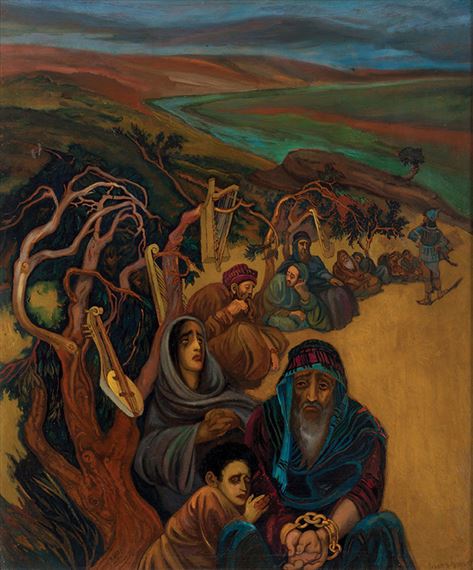
What we found most helpful and illuminating when reading these psalms was to see what the writers were not saying. The writers of the three psalms listed above, who included David and the captured slaves in Babylon, were not describing their commitment to enact revenge on those who brutally persecuted them. They were not saying that they would exact vengeance and repay the preparators for what was done to them. The captives in Babylon, who had escaped the fate of the horrific siege of Jerusalem, the details of which are hard to read or stomach, were not expressing their own vengeance. Their appeal was simply to God for justice. And that is what it is about – Justice. The justice described in the Mosaic law – the principal of equal and just retribution.
Today, when we hear the cry of families of victims of vicious crimes, it is always an appeal for justice, justice for the ones they loved. That’s what they fight for. That’s what they demand from the courts and that is what they never give up on, because it is Justice that is at stake. This is exactly what the writers of the cursing psalms are doing, they are crying out for an equal and just retribution. But for them the appeal is not to a human court, but to the highest court, to the Judge of all the earth. And it is this act of taking it, in all its rawness, to God and leaving it with him, which at once, lances that boil, dissolves the rage, neutralises the anger and eliminates the personal desire for revenge. The outburst of outrage is more than just cathartic. It achieves something.
So, we have found, having taken these challenging passages, which sound pretty terrible to our ears, taken them head on, unflinchingly, we have found that they do not, in fact, contradict the law of love but they complement it and we see how the curses and the blessings, the love and the hatred stand together without contradiction.
It was just another of those celebrity travel programmes, an hour of wasted time, following the journey through tropical forests and vast desserts, encountering strange exotic animals and people, the scripted conversations and pre-arranged meetings, with the army of translators, camera, sound, and tech guys carefully out of shot and the now familiar drone view from above…you know the sort of thing. But it was the Congo that caught my attention “Into the Congo with Ben Fogle” the fearless adventurer of Castaway fame and Prince William look-alike.
It had the predictable, lessons on man-made climate change and the horrors of colonisation. It would be hard to travel through the Congo without making reference to the industrial scale slavery instituted under King Leopold, in one of the darkest stains on European history. The significance of the slave plantations, was not lost, as they produced the rubber essential for the pneumatic tyres which powered the industrial revolution in Europe.
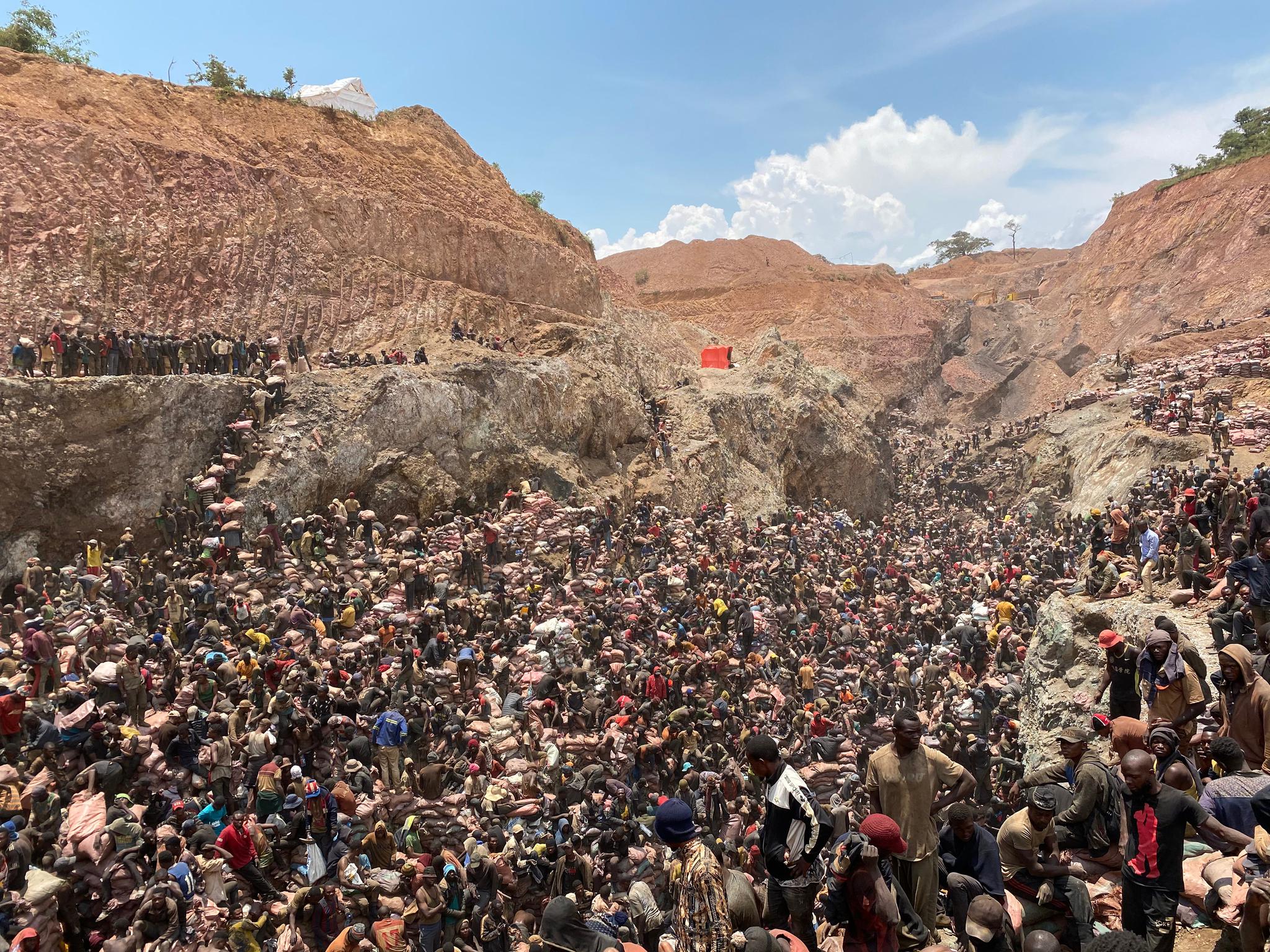
Ben Fogle’s journey was limited to the Congo and not to the Democratic Republic on security grounds and I am sure he would not have been able to bring his entourage through to the south of that vast nation and visit the cobalt and copper mines in Kolwezi close to the Zambian border. For here is the irony so meticulously and harrowingly exposed by Siddharth Kara in “Cobalt Red, how the blood of the Congo powers our lives”. The brutal slavery of thousands of people men women and children in the cauldron of these mines competes with King Leopold in his greed and savagery. The minerals, the cobalt lithium and copper they dig by hand out of these mines goes to supply the other world with the essentials for the green revolution.
“ It would not be a stretch to suggest that much of the EV revolution rests on the weary shoulders of some of the poorest inhabitants of Kolwezi, yet few of them have the benefit of even the most basic amenities of modern life, such as reliable electricity, clean water, and sanitation, medical clinics and schools for children.”
“The global economy presses like a dead weight on the artisanal miners, crushing them into the very earth upon which they scrounge”
Much of his account is hard to read with descriptions of the unspeakable suffering of an enslaved people, which is happening now and which we are in some way connected. And yet…and yet, we hear so little of these things and would rather not hear when we do.
Siddharth Kara is a professor in global slavery and human trafficking and a truly fearless activist, making dangerous journeys into areas controlled by gangs and militia to uncover the truly shocking reality of what is happening in this heart of darkness. His account is a dreadful tale of human lives trapped in a hideous cycle of misery, men, women, mothers with babies, boys and girls clawing at the ground with metal rods, crawling through collapsing mine shafts, washing stones in toxic liquids, transporting heavy sacks with barely enough to survive. Accidents are not waiting to happen, they happen all the time. Boys carrying heavy loads malnourished and exhausted fall down the slopes of the pits and suffer fractured spine and leg injuries. the bodies of children trapped in collapsed mines are never retrieved and their mother’s weep as the walk over their graves every day. “We work in our graves” was what some say. It is truly horrific and stomach churning. And it involves individual human lives. This was Elodie, orphaned by cobalt mining:
“After the loss of her parents Elodie, said she turned to prostitution to survive. Soldiers and artisan miners purchased her regularly. ‘The men in Congo hate women’ she said ‘They beat us and laugh’. Elodie became pregnant. After her son was born she started digging at lake Malo. She said that prostitution and digging for cobalt were the same. ‘muango yangu njoo soko’. My body is my market place. Elodie slept in an abandoned, half-finished brick hut near the southern edge of Kapata with a group of orphaned children. The children were known as Sheques a word derived from ‘Schengen area’ which indicates that they are vagabonds without families. There are thousands of shengues across the Copper Belt and they survive by any means necessary, be it scrounging for cobalt, doing petty jobs, or being purchased for sex. Elodie said she typically earned about CF 1,000 (about 1$) a day at lake Malo which was not enough to meet even the most rudimentary needs. She was forced to let soldiers do ‘unnatural things’ to her in order to survive. Elodie was one of the most brutalised children I met in the DRC. She had been thrown to a pack of wolves by a system of such merciless calculation that it somehow managed to transform her degradation into shiny gadgets and cars sold around the world.”
Its easy too to blame other people when our hands are clean. It is easy to be lost in our own self-righteousness pursuing the noble aim of saving the planet, while turning a blind eye and a deafy to the cries and the suffering of those outs of sight, further down the line, who carry the burden of it. Those who pay the price in their bodies and blood of our grand projects. It makes me more and more convinced that the pursuit of “Net zero” is nothing but a vanity project, paid in blood, but not ours.
You would think that now, four years after the day the world went mad and governments flipped like circus dolphins in near perfect unison, it would be a time to lay things finally to rest. Now that those responsible have had their day in court, been held to account, the truth now revealed and lessons learned, you would think that a line could be drawn, the whole sorry tale could be laid to rest and we can move on. It turns out not to be so.
It is not over, because even after four years there is still no definitive account on where the nasty virus came from and we are unlikely ever to get that. There seems no will or interest in finding out and anyway, does it really matter? Well, yes, it does. If this was deliberately created in a lab as part of a biological weapon programme and leaked by accident or on purpose, it would be good to know.
It’s not over, because there has been so little recognition of the terrible harms that have been needlessly caused to the very fabric of our society.
Lockdowns were a holiday for those in secure jobs, a party for those making the decisions, a gift to those with latent ambitions to boss others around, a respite for those who like to be told what to do, and a middle-class indulgence with gardens and welcome time to spend with their kids . But for the rest, for most, the experience and the long-term effect on our society on our economy on our health, on respect for authority, on value for education, on our humanity, was a disaster and, critically, one needlessly and recklessly imposed upon us.
Masks were a fiasco. The virus was transmitted by aerosols not droplets. The scientists knew this from the start, which was why they told us, on camera, that the pieces of cloth were worthless. That was before they flipped because of political pressure. Not only were they worthless in halting transmission, they were dangerous. The warnings which should have been printed in the package of every mask would include a list of likely side effects; dermatitis, headaches, perpetuating fear, stunting infants’ cognitive and emotional development; excluding the hard-of-hearing, evoking fatigue, reducing lung efficiency, tormenting the autistic, increasing falls in the elderly, re-traumatising the historically traumatised, the inhalation of micro fibres, concentration impairment, reducing the quality of healthcare, discouraging patients from attending hospital, impeding school learning, the aggravation of existing anxiety problems, encouraging harassment of the mask exempt, enabling criminals to escape conviction, and polluting our towns and waterways. I am still waiting for someone to put their hand up.
The vaccine might have saved lives but there is no actually proof that they did. With mass vaccination there could be never be a controlled test, so we will never know. We do know, however, that it was never fully effective and there were genuine doubts about its safety. Enough doubts for alarm bells to ring and the roll-out halted. But it wasn’t. Curiously, unlike what happened with other vaccines, no alarm bells were heard and nothing, it seemed, was to get in the way of the programme. So many untruths were told: that it would stop you getting the disease, that it would stop you transmitting it, even though the manufacturers knew and have admitted that these were false from the start. No answers were given to the very reasonable question “ Why were the pharmaceutical giants given a free pass with no liability?”. Anecdotally it is clear they had little, if any, effect. All the people I know who get covid have had the vaccine multiple times. People I know (a few) who refused the vaccine didn’t get covid. For myself, I took two doses of the Astra Zeneca vaccine before it was quietly withdrawn. I wasn’t aware of any bad side effects, but not long after I was serious ill and spend over two weeks in hospital with an unexplained large abscess in the liver. The consultant couldn’t say why the bacteria lodged itself there, but the likely hood that the vaccine had tampered with my natural immunity made that a credible explanation.
It is not over, because there has been no proper accountability. The behemoth covid enquiry trundles on, studiously ignoring the very questions it should be asking and the key players with some exceptions are still there, many moving sideways in the revolving door of our corrupt institutions. And they are corrupt. When the institutions of government shuffle failed politicians and executives into other salaried positions carrying their pensions with them, then you know serious corruption is involved. So, an Inquiry wont’ cut it. Perhaps a “Truth and Justice” commission might be the thing, but I fear that a line can only be drawn once the matter comes to court.
Emily Oster wrote an astonishing piece in “The Atlantic” in October 2022 calling for “a pandemic amnesty”. The reason she gave for moving on was that governments and those making the decisions were well-intentioned and their pronouncement rested on benign ignorance. You know the sort of thing, “We were doing our best.. we might have done things better but .. it was all for the common good.” Oster’s generous forgiving attitude to those culpable is understandable and even commendable but it doesn’t serve the interests of justice.
It is not over, because we still can’t talk about it. Many a social gathering has been ruined when someone carelessly mentions the dreaded C word, or when you innocently profess that you never believed in it, and everyone goes silent. It is that awful moment among friends or family or just folks you know when they discover they have a traitor in the midst and the surprise is palpable.
It is not over until there is truth and justice and honesty and transparency and it’s not over until we can talk about it.
Now that the leader of the opposition, our prime minister in waiting, has given his support, and a national treasure has told her own personal story, the passing of new legislation to allow for assisted suicide is becoming almost inevitable. It will be yet another assault on our battered humanity. Of course, it will be dressed up in the caring, loving, emotion tugging language we have grown accustomed to, but whatever arguments are offered, however it is spun, it will be nothing less that state sanctioned killing.
It has always been this way. The powers that be, wait their time till bit by bit, drip by drip, nudge by nudge with the useful help of the arts, drama and the media community with personal sad stories, finally bring the reluctant reactionary population round to their way of thinking. Ideas which only last Saturday were seen as quite ridiculous, bizarre, and belonging to the stage in comedy and farce, can be made to work, when a determined elite put their minds to it. There is something almost predictable about it. It was so with abortion on demand, same sex marriage and transgenderism.
With Euthanasia, the current step, is the call for a fresh debate. It is some years now since the UK parliament last debated the motion. That was back in 2015, when it was roundly defeated, but the mood has changed, we are told, and many are coming round to a more liberal and progressive view on this deeply controversial subject. There is a feeling that a fresh cohort of members of parliament, following a general election, would take a more enlightened view. For the moment, the call is simple. We need a fresh debate and who can be against that? Well, I can and I am. It is not something we should debate. The matter has been settled and it has been settled for thousands of years. The state has no authority to sanction killing other than in the very narrow parameters of administering justice or involvement in a just war. It is the classic Judeo-Christian principle upon which so much of our civilisation is based.
Many will accept a debate and argue against any change to the law on the principle that it would be the slippery slope to all sorts of killing which would so easily seep through the net. Safeguards, no matter how robust, have an uncanny albitite to be, in reality, quite weak. It will be easier to dispatch the elderly who feel they have become a burden, easier for young people who have become disillusioned with life to be assisted to end it and easier for people who can’t get affordable housing to find another way out. All valid arguments, and based on solid evidence no doubt, but I am against it, simply because it is wrong.
Life is not something we invented. It is not a human construct. We did not choose when, where, how or to whom we were born. life is a gift. We didn’t make it, or craft it or purchase it. We owe everything to its creator and to try deny this, to usurp the maker’s authority by making ourselves gods, deciding when our life is completed is foolishness in the extreme. It is like the pot arguing with the potter, who made it. A picture that the prophet Isaiah so aptly used.
It is a sad fact, a desperately sad fact that suicides are commonplace in our society and possibly most of us will have had a close encounter with one or more. It takes the breath away from you in the way nothing else does, because it strikes at the very core of our humanity, putting into question the very reason for our existence. It is impossible to conceive of the desperate pain that brings a person to this point and the pain that it delivers to those who loved them. Who can possibly be in a position to judge the rightness of any individual’s actions in these situations? That can only be a matter between them and their creator, but for the state to sanction the taking of life, it would fly in the face of all of this and cut at the very heart of our humanity.
Esther Rantzen’s daughter was right when she said that if her mother was to board a plane for Zurich, she would ground it. It wouldn’t be up for discussion and that’s life.
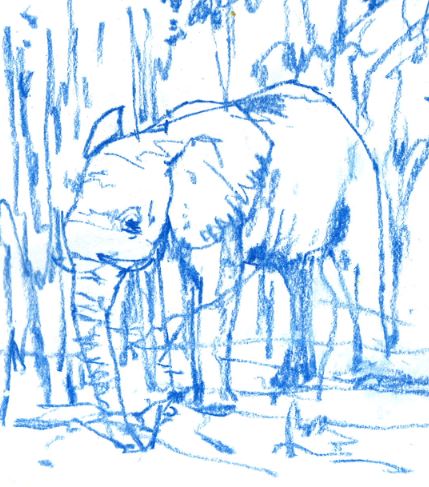
It was a cartoon from a few weeks back. Looking down on the Covid enquiry we saw the learned inquisitor with his right elbow leaning on the podium, interrogating the hapless minister and in a clipped schoolmaster voice pronouncing “We are not going there Mr Gove!” The tables and some desks in the room were being knocked over and pushed aside by what turned out to be the tree trunk legs of be a gigantic elephant towering above them and bearing the banner “The source of the virus”. The great beast was seen by everyone but all connived in a conspiracy of denial, pretending it wasn’t there. Not the most clever or inventive of cartoons, granted, but hitting the nail squarely on the head, all the same. That a major public enquiry, costing millions and taking years to report, would chose to deliberately block any discussion on the likely source of the virus, – only demonstrates what an utter farce the whole pantomime is. Can you imagine the Grenfell enquiry excluding any discussion on where the fire started? No neither could I.
But the truth is there was, and is, a herd of elephants in that room. Here are just some:
The devastation of lock-down
The deification of science
The surrender to totalitarianism
The zero covid delusion
The idiocy of masks
The weaponization of fear
The illusion of omniscience
The sacrifice of children
The vaccine redemption dogma
But there will be nothing to see here. Instead the enquiry, which anyone could write, will find that we should have locked down quicker and faster.
I have failed. I have failed the country. I have failed you. I didn’t have the courage to stand up to the bullies who pressed down on me with their bogus science and one-track minds. I just didn’t have the strength of character to withstand the pile on from my fake advisers, the advisors who I appointed. The onslaught was too great and I was too weak to resist. To my shame I was more concerned with my own reputation, how history would judge me and I was terrorised by the prospect of being forever known as the covid murderer, responsible for deaths of tens of thousands. The emotional pressure was just too much
It was all against my gut, of course. Coercion, lockdowns and the whole sorry debacle was totally against everything I stood for. Other nations come in with the heavy hand but that was not who I believed we were. I said as much and more but I never had the courage or conviction to stick to it. And so the whole dreadful disaster unfolded and continues to unfold: children were socially stunted, teenagers locked in rooms with a solitary diet of screen time, marriages were celebrated behind closed doors, deaths were mourned in pitiless parlours, the dying deprived of human comfort in their final dreadful hours, diagnoses were missed, churches, cinemas, pubs, concert, halls, libraries, cafes, restaurants and anywhere where people meet, closed their doors, businesses were ruined, services cut, people were paid to do nothing, playgrounds were locked, walkers hustled indoors, faces were covered, masked, muffled and drowned in a sea of anti-social distancing, levels, tiers and the rule of six.
And now, as it turned out, as we now know it was all for nothing. None of it worked. All of my team say ‘We should have done it all much quicker’ but I say it should never have been done at all. It was wrong, disastrously wrong, and if there is something we can learn (and that is surely what this enquiry is all about), we should never ever contemplate the same ever again.
How I regret not taking on board the other voices. Those of sane and sound mind of knowledge and experience, leaders in their critical scientific fields. Their wise and simple advice to focus protection on the vulnerable, would have led us to a much safer and better place, without the horrors we now face. How I wish I had listened to those who warned us of the disastrous route we were embarking on. Those who we shut out, shut down, ridiculed and worse. They were right all along and we were wrong.
And how I regret my enthusiasm for the wonder vaccine. How I trumpeted the great British success with Astra Zeneca leading the world in producing it and rolling it out so quickly; only for it to be quietly withdrawn with ominous links to rare blood disorders. I hailed the vaccine overall as a game changer and boasted of its safety and effectiveness when we knew from the start that neither were ever true. My team will say it saved millions of lives but I am not so sure. It can never now be proved, yet still there is growing anxiety over serious side effects leading some to premature deaths.
And, Mi Lady… I could go on…there is so much more I can say but can I finish with just one thing…
I am sorry, and I offer no excuses, no apology. I claim no mitigating circumstances. The decision was all mine, I take full responsibility and … if it helps… I will answer your questions”
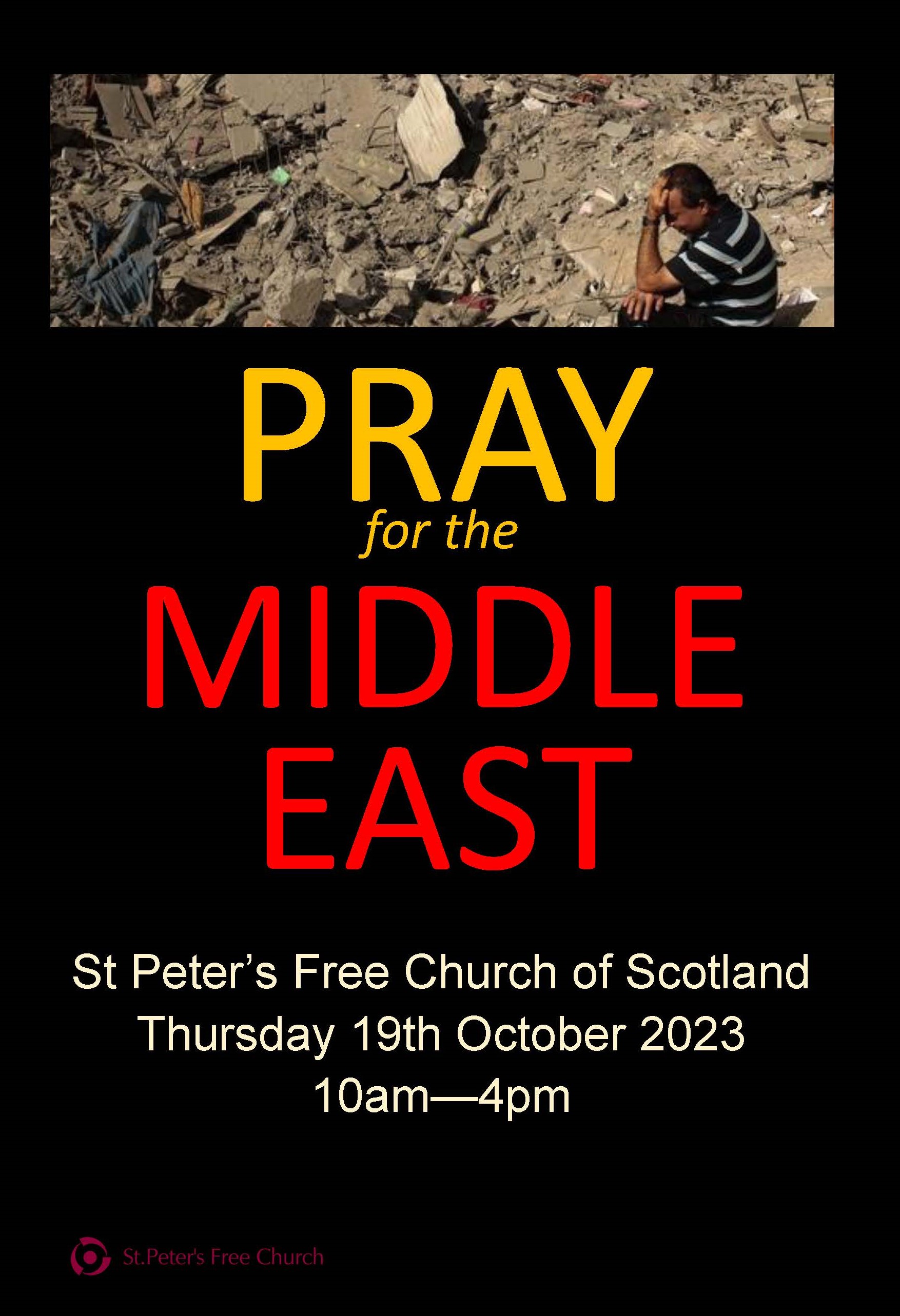
Today, one of the wildest of the year, with Babet flexing her muscles, is a Day for Prayer for the Middle East. The doors of our church building are open from 10am-4pm to allow people to call in and spend some time in prayer, calling on God to have mercy and intervene in the horror that has been visited on humanity in the Middle East. It is hard to know what to pray for and the call from Christians, right there on the ground in Israel and Gaza, is that they too would know what to pray for. Here, the words of the Psalmist are apposite, “ When the foundations are being destroyed, what can the righteous do?”
Trying to unravel the truth from this the most complex of religious geo-political ideological issues is almost impossible. I have been listening to a number of voices: Melanie Phillips, Bari Wies, Owen Jones, Ben Shapiro, Noam Chomsky and others. I have read again parts of Robert Fisk’s “The great war for civilisation”, Simon Schama’s “The story of the Jews” and Jeremy Bowen’s “Six days”. I know I have only scraped the surface and I will never get to the bottom. Fisk describes it aptly “The narrative of events – both through Arab and Israeli eyes and through the often-biased reporting and commentaries of journalists and historians since 1948 – now forms libraries of information and disinformation through which the reader may wander with incredulity and exhaustion”. But it isn’t enough just to give up and go to bed, or as some would say, “Don’t worry Jesus will return soon”. Somehow it demands some form of judgement and a making up of a mind.
In my mind, the conflict between Israel and Hamas is asymmetrical, not just in terms of military power, but in terms of morality. Both sides live and fight by different rules. The warfare is also total. One side will never be satisfied until the other is destroyed and wiped off the face of the earth. In that bleak reality there can be no compromise or peace deal no matter how hard the movers and shakers in the world try and the only possible solution, horrible as it may seem is for one side to have the complete victory. For the sake of Western Civilisation, as we have known it, the victor, in my view, has to be Israel. The alternative is an irrevocable slide into a chasm of barbarism. But that is just me.
So, we spent a good part of the time today, with the newspaper spread out in front of us, reading from Scripture: the Psalms, Isaiah and the gospels and seeking what we should be praying for.
We prayed for those who have been given the authority and the power to influence and intervene: for Netanyahu Biden and Sunak, for Abdel Fattah el-Sisi, King Abdullah, Najib Mikati, King Salman, Basshar al-Assad and Ali Khamenei. We were remembering how God used pagan rulers in the past for his purposes. We prayed for those who could find no comfort after the savage and brutal hacking down of their loved ones and those in captivity, for the families living in terror of each new explosion in the night, for those piteously oppressed, for those deprived of food water and medical treatment. We prayed against evil in all its forms. We prayed for a miracle and for miracles in the darkest of situations and we prayed for the Gospel the only true answer for all humanity, to be heard and believed.
By the afternoon, storm Babet was asserting her power with increasing anger and so we retreated and cut short the day earlier than planned, while leaving it all in the safe hands of God, whose voice controlled the winds and the waves and who “makes wars cease to the ends of the earth. who breaks the bow and shatters the spear; who burns the shields with fire.
This week saw the sad death of a local church congregation. It was our spiritual home, our family and some of our closest friends, for almost two decades. So much of our lives were intertwined with the fellowship of people who worshipped God in that place. Though we have been separated for some time, the bonds we had were still solid and when the inevitable news came through, it filled us with an intense and deep sense of loss and sadness.
Our connection began when I was called, with neither qualifications nor training, in the early 90’s to serve as a parish worker, an urban ministry associate, with a local church in a peripheral housing scheme in Dundee. With a beautifully vague job description, I was set loose to grapple with how the gospel of Jesus Christ related to the pretty much neglected people in the housing schemes on the edge of our cities.
It was an issue that concerned me greatly and dated from my late teens when I heard a sermon which changed my life. It was on Paul’s letter to the Christians at Phillipi where he speaks to their attitude and challenges them to follow Christ Jesus:
“Who, though he was in the form of God,
Did not count equality with God a thing to be grasped,
But emptied himself,
Taking the form of a servant
Being born in the likeness of men.
And being found in human form
He humbled himself
And became obedient unto death,
Even death on a cross.”
I often see things in pictures and it was the picture of a hand that could have held on but let go, that was planted in my brain. So when we got the letter and spread it out on the table in the coffee shop, one drab Glasgow afternoon, we just knew that we had to come to Dundee and to Mains of Fintry Parish Church.
Fintry was one of the earlier post war housing schemes built in Scotland. It was constructed on a bean field to the north of Dundee and in common with housing developments at that time, it had little in the way of public amenities for the ten thousand souls who were housed there. There was a primary school, a pub, a handful of shops and a church. An early aerial photograph depicts a pretty bleak landscape of serried rows of houses, not unlike a concentration camp yet many of the original resident expressed their delight and gratitude coming there, with fresh air, kitchens, bathrooms and modern living.
In the sixties Fintry was also known nationally and had a notorious reputation for poverty, crime and violence. Most of which was centred around the northern edge of the scheme. Two of the streets were renamed specifically to avoid the stigma associated with them, but this strangely had the opposite effect. Even much later, in our time, we had difficulty in obtaining a loan for a car, as our address, within the parish, was problematic to the would-be provider.
It was to this unlikely setting, in the mid 70s, that Peter Humphris was called to be the minster of the congregation whose building stood at the heart of the parish. With his cultured middle England voice and fine manners, Peter might have seemed a strange choice for this setting, but with his wife Kathleen, they stuck to the task and within a short space of time had gathered a good number of new Christians, some who had been brought to faith under the influence of the charismatic evangelist James Gill. Despite being on the periphery of the city, students were drawn to the preaching, prayer and life of the church, many who went on to serve in other parts of the world. Fintry was one of the first churches in Dundee to welcome Chinese students and internationals from many nations and cultural backgrounds principally through the labours of Malcolm and Ruth Farquhar. Fintry was also the place where the idea of summer beach mission was brought to an urban setting with the running of annual holiday clubs. These sometimes involved upwards of 200 children queuing up at the gate each day for a week’s activities of games crafts music song and stories. These were meticulously planned, with teams gathered from many places and days of training, well in advance. There was an explosion of creativity in writing material, art, music and drama with issues such as child protection addressed long before these became mainstream. There were many other creative inventions, inspirations and ideas too for the telling of the Gospel, some of which were adopted by other congregations and this continued though the ministry of Colin Brough and a focus on the church and the community. It was a purple period, a marrow experience
Things were about to change, however. And it happened far away in the hallowed halls of the Church of Scotland General Assembly in 2009. The decision taken then began a process which distanced the Church from the teaching and authority of Scripture. It was a slow process but a predictable one. It was death by dialogue. In one particular assembly it was the blatant manipulation of process with a fair spattering of deceit. I had always thought that within the denomination there were two wings: the conservative evangelical and the liberal. What I learned as I climbed the wide stone stairs leading to the Moderators room, with the Principal Clerk who commented on the faces he recognised on the portraits that hung on these rising walls, there was a third wing. They were the establishment. They could be liberal or conservative, as it suited, they could tolerate either. But what they would not tolerate was to lose power over their church. I remember that moment very clearly and, for me, it signalled the end.
But from Fintry, it seemed far away and all but irrelevant. “We haven’t changed,” people would say. “What happens in Edinburgh has nothing to do with us”.“We will continue as we are and preach the Gospel” . But it was an illusion. There was a mistaken belief that we were a congregational church when the reality was that we were Presbyterian and under the authority of Presbytery. While Presbytery would never prohibit or silence the preaching of the gospel they would and could see to the dismantling of churches, linking, merging and uniting in a downward spiral of decline, which had the same effect.
In May 2013 the line had been crossed and I knew that I could no longer, in all conscience, remain within the denomination that had rejected or, at best, deliberately fudged the clear teaching of Scripture.
Leaving Fintry was one of the hardest decisions we had to make and it was a deep wrench. It would have been easier had we fallen out, become disgruntled or unhappy with the direction of the ministry, but it was none of these. And it was a token of the bond we shared that no-one expressed any criticism of our decision and we were met with nothing but understanding and respect for the stand we were taking. But we took it alone. No-one seemed to share our conviction that this was the beginning of the end for the national church. Even among many friends, who we regarded as fellow travellers, there was a suggestion that we had acted in haste, and the proper thing would be to stay and reform the denomination from within. Sadly, this was never going to happen and while some churches have flourished and grown in this time, following a congregationalist model, overall the story has been a devastating one of accelerating decline with the closure of so many places of worship, dwindling numbers and the haemorrhaging of people and resources.
This week the parish church in Fintry is no longer, the people scattered and the remnant absorbed into an anonymous sounding “North East Parish” of 30 thousand souls. A lamp has been removed. But the Church, the Church of Jesus Christ grows and flourishes, in may places, all over the world, and the gates of hell will not prevail against it.




 Restless Spirit