The Bookend

First of all you have to understand that the church has always been part of my life. Not just a part but one of the most significant parts of it. It is family. Blood is thicker than water but this bond is thicker. So going to church has always been my habit. Not that the church is a place, it is people, but people come together in a place and unless you are a king or celebrity, people don’t generally congregate around you. You have to go to them.  So the term “Going to church” is a valid one and a vital part of life for anyone who is a follower of Jesus. Like family, however, it is not always sweetness and light, its history has not always been something to be proud of, its people sometimes drive you crazy and at times you stretch their patience too. We blow up, fall out, walk out and separate but one thing remains a constant, we are part of God’s family and he won’t change that. It is not a right but a gift and if I was a preacher I could probably explain that much better.

Now the church, which I belong to, has two services on a Sunday: a morning and evening service. This is not for convenience but deliberately as part of tradition going back many years. Nowadays, however, the question keeps coming up: “Why two?”  “Why would you need to want to go twice?” “Surely once is enough”. But it is not a rule thing. It is not a commandment. You would be hard pressed to find something in the Bible that lays down that law. But it comes, I believe, from how we view the day itself.  For followers of Jesus, Sunday is the “Lord’s Day”. It belongs to him. It is not our day. In one sense every day is His day but Sunday is especially for him and that is where the evening service comes into its own. It is a bookend. The morning and evening services are bookends to the Lord’s Day.

This Sunday, after a full on weekend wholly exhausted physically, mentally and emotionally with the stress of logistics, the heat of the kitchen, the intercourse with so many people from so many parts of the world (a weekend away with Friends International), we arrived back in the evening just in time for our evening service. While the voice of common sense said, “relax, unwind, sit down, have a bath, go to bed, chill out”, instead we went to church and joined our church family in worship, praying, reading, sharing and listening to God’s voice. Entering the building late we were met with the sound of singing, of many voices old and young, high and deep, together and in harmony, coming from the heart, rising to the roof and beyond.  It would be very hard to begin to describe the all-embracing sense of wholeness, healing, invigoration, revitalisation and excitement that overwhelmed us as we joined the people in this special time, this bookend to the Lord’s Day.  And …I thought… there is nowhere else I would rather be.

Crawford Mackenzie

The Fishing Net

guitarist

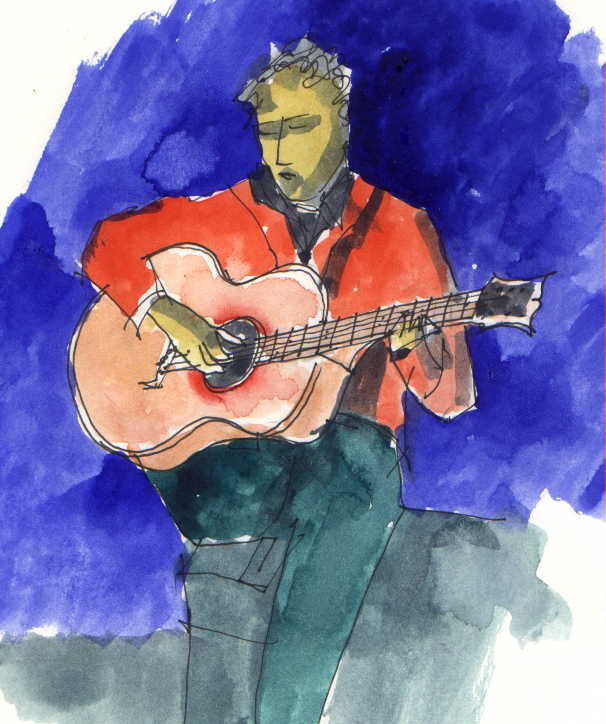
When I arrived in Aberdeen in the autumn of 1967, to begin my studies at the School of Architecture, the first thing I did with my student grant, after paying my dig money, was to buy a guitar. It was nylon string bottom of the range Tatra classic from Bruce Millers in George Street.  At the same time I became involved in a Friday night coffee bar run from the basement of the Salvation Army Citadel at the west end of Castle street. You entered through a small door on a side street, where the North Sea wind hurled its way up into town, and down a flight of stairs to a brightly painted room with a small stage and mic and a counter at the other end serving hot milky coffee, Coke and Fanta. The café was called “The fishing net” a reference to Jesus’s commission to Peter “I will make you a fisher of men”. It was decorated with paintings of fish, seaweed, brightly colourer nets and fishing tackle. During the evening a small folk trio or solo artist would play and sing and someone would speak with a message. It was run by a number of churches in the city with the aim of making connections with young folk on the streets on a Friday evening. , They were invited in, befriended and engaged in conversation.  I had only been going for a few weeks when one of the leaders asked me to play and sing on the following Friday. With foolish naivety, I accepted, completely oblivious to the fact that I had no material and had never sung, far less played guitar, in public before.  Hastily I scratched a couple of songs together, one which had a remarkable and not unconscious resemblance to the Kinks “Sunny afternoon” and the other to the Beatles “a day in a life” The third was a spiritual. I practised hard but as the day grew nearer became more and more aware of my foolishness. I remember the night very clearly, walking across to the stage with guitar over shoulder shaking like a leaf, thinking “I can’t do this” and praying “lord if you really want me to do this, let it be you who does it”. It is a prayer I have found myself praying each time I have been asked to sing, since. The noisy room was suddenly stilled and as I ham fistedly clunked my way through the songs I had this strange experience as if standing outside myself looking on as someone else took over, carrying the message to the hearers.

Once finished and with the waves of relief pouring over me I relaxed at a table and fell into a discussion with a slightly inebriated leather clad rocker. He wasn’t interested in the songs but wanted to argue about the existence of God.  I was helpless and could offer no good explanation or original thought.  We were soon joined by two others, one clutching a battered bible. Suddenly there was clarity and rational in the discussion and I sat back with dropped jaw listening to the discussion amazed at the command of our new friend. (the one doing the talking) He had understanding and ability to communicate the cosmic realities of creation and redemption and the wonder of the gospel in spell bounding clarity. It was only after he left that I learned that he was already well known in student and church groups, the president of the Christian Union in the University and later a significant figure in Reformed Christian circles both in Scotland and the USA, highly regarded for his teaching, writing and editorial work.  So it was a surprise,  that our lives should cross again some 45+years later, when we both joined with our families, in our new church setting. It was an added and unexpected delight to hear him preach. While some preachers become old and tired and tread well-worn predicable paths and others have spoken for a specific time and place, his preaching carried refreshing  timeless authority, vitality and relevance.   Now endowed with the richness of truth distilled slowly through the years it was presented with crystal clarity, much as it was, around the table, in the basement café, all these years ago.

Crawford mackenzie

Why I still go to church

black watch

The questions comes up, of course, because so many of my friends, my family, people I love and care about, folk I admire and respect, don’t.  Some flirted with church in their formative years but got bored of the petty politics, struggled with the institution, were turned off by the back biting and hypocrisy, felt excluded, marginalised, betrayed, and overwhelmed with the sheer absurdity of belief that they left for the sake of their own sanity.  I find I share an awful lot in common with them and have a fair bit of sympathy with their position.  I sometimes wonder why I never joined them.  But I haven’t and I won’t and I can’t. Because….

Because the church is much more. The bonds are stronger than friendship.  The ties are thicker than blood. It is bigger than family.  The local church might seem like a collection of misfits and oddballs, rough diamonds and smoothies, saints and martyrs (“the martyrs being the ones who have to put up with the saints”*), people we get along with and people we don’t.  It is made of people of different age groups, different cultural backgrounds sometimes speaking different languages, people who don’t share the same outlook, standards, interests. All of this must point to the fact that something else is going on here.  That something else is God.  It is God’s church and so he does the choosing. He brings us together. He does the deciding. He does the planning.  He does the perfecting. It is his business and he does it and will do it in his way and in his time.

Because we live in a world that is full of fantasy and illusion, false God’s and paper kings, soaked through with a powerful pervasive philosophy that says that what we see and hear and can touch is the real world. It bombards our thoughts, bends our minds and coerces us into believing this is true. So we need to find ourselves somewhere else where we can be brought into the real world.  Where we can regularly make contact with what is really important. With what is more important than life or death. And that somewhere else is the church. That is why the call to worship “We are here to worship God” is pivotal. It is a call away from the false realities to the true reality and of his purpose of salvation and redemption and glory. In his presence the other world with its great show, its charms, its promise, its money, its power, seems so pathetic, so foolish, so small and so sad.

Because, in church, I am reminded of where my true identity lies.  It is not in being a man, a father, a grandparent, an architect, a dabbler in painting, music and DIY, a Scot, a European a White Anglo Saxon Protestant Christian.   My identity is not in my interests, my family, my roots, my sexual orientation, my ability or disability, or in  my race. My identity is in Christ.  I don’t need to wonder “Who am I?”  But I need that regular reminder of this knowledge which is found in the strange setting of a group of ordinary people meeting together, bowed in worship before the one true God.  I need to know again that I am a sinner, who has been accepted by God because of Jesus, with nothing to bring but empty hands accepting his grace.

That’s why I still go to church.

Crawford Mackenzie

* Quoted by Eugene Peterson in “The Wisdom of Each other”   Zondervan

The Failure of Men (looking for a model)

Since early days I had an interest and love of songs, song writing and the songwriters art. From David’s psalms where the tunes have been lost, to Bob Dylan, who epitomises the pinnacle in contemporary song writing and whose work has so far not yet been eclipsed.  Many people have written good songs but few have produced consistently good material. Many of the singer songwriters I have admired have been women. From the soft and lyrical, country voices caressing words to the biting snarl of pent up rage. Singer songwriters like:  Sinéad O’Connor, Nanci Griffith, Mary Chapin Carpenter, Pat Benetar, Bebe,  Souad Massi, Coco Mbassi, Suzanne Vega, Charlott Dipande and others .  Many of these write and perform songs which often display their deep dissatisfaction with the men in their lives and with men in general. Sometimes it is wistful disappointment in “He never will need me” to the savage “Malo malo malo eres ”. I was always curios why I, as a man, should be drawn to this material.  Why would I choose to hear my gender mocked and savagely ridiculed?  Why would I be drawn in the way that some men are drawn to the strand of pornography which show men being humiliated by women in feminine dominant sadomasochism scenarios .  It took me some time to realise that I shared in this frustration in this disappointment with men and this inevitably meant with myself. I too was frustrated with the way we were and how far we fell short of what we should or could be.  But to have a sense of disappointment you must have a standard or a model you can aspire to. You must have a vision of something better.  What was it?

I had many male models to admire friends and colleagues and leaders in society and in the world. I had three older brothers who I looked up to and through whom I learned: the desire for exploration and finding out, the beauty of hard work and order and doing things well, the constant pushing beyond the obvious of what we were told to the other side of the argument, the cynics art of lifting the lid on pretentions and self-authority and, I had my father.  On the long walk homes from Cleadale in the dark after visiting a home with tea and scones he would tell stories, or round the Raeburn in a morning, when there was time, he would read from the bible and excite us with tales of David or Paul.  It was in the way he told the stories that I knew that he admired these men in their courage and commitment, despite all their obvious flaws.  In the same way as he was excited and drawn to the lives of these men, I was most affected not as much by what my father said, as by what he did. His commitment was all the way. Once set on the path He was never half hearted. Even when he insisted on praying publicly and giving thanks to God for a meal in a crowded fish and chip shop, to the embarrassment of his children,you could not but admire someone who was not afraid of ridicule or shame in the eyes of others.  He was not as the Scottish Paraphrase puts it “ashamed to own my lord or to defend his cause”.  I often sung that in church uncomfortably thinking that I would be a little ashamed at times. He didn’t ever seem to be. Later I discovered the character Job, specifically; when he describes the kind of role he had in his community. Reading this through a 21st century lens, with our twisted sense of humility, it might seem a little arrogant, but pride would have been furthest from him when he longed for the days past that had been taken from him so cruelly:

“When I went to the gate of the city
    and took my seat in the public square,
 the young men saw me and stepped aside
    and the old men rose to their feet;
 the chief men refrained from speaking
    and covered their mouths with their hands;
 the voices of the nobles were hushed,
    and their tongues stuck to the roof of their mouths.
 Whoever heard me spoke well of me,
    and those who saw me commended me,
 because I rescued the poor who cried for help,
    and the fatherless who had none to assist them.
The one who was dying blessed me;
    I made the widow’s heart sing.
 I put on righteousness as my clothing;
    justice was my robe and my turban.
 I was eyes to the blind
    and feet to the lame.
 I was a father to the needy;
    I took up the case of the stranger.
 I broke the fangs of the wicked
    and snatched the victims from their teeth.

Here I thought was an example, a model to follow. The respect he had was not because of his position or his wealth or his skills of gifts but because he rescued the poor cared for the orphans and promised the dying man that he would look after his widow. He took up the case of those who couldn’t and if this required boldness and firmness and necessary force against the wicked who caused the suffering he would not hesitate.  He was neither a macho misogynist nor a soft in the middle new man. His was a life to emulate. Here was model to follow.

Crawford Mackenzie

A Difficult Task

I have been asked and pressed a number of times on facebook and other discussions, to justify why I hold to the orthodox position on homosexual practices and, in particular, what was the basis for this belief. It is not a subject I ever wanted to speak about and I have been very reluctant to make any comment.  I also feel that the onus to explain and justify the moves towards the normalising of same-sex relationships should fall to those who are proposing it.  In a way there is no need to justify what has been the orthodox position for centuries. It is up to others to justify why the change is either, necessary, good or the right thing to do. This explanation should not have been necessary. Still, as the push towards this momentous change in society, which will have far reaching implications, has been overwhelmingly in one direction and the voices against, with some notable exceptions, all but silenced, I feel a need to state the case as best I can. It is difficult to distil the thinking into a few words, when others have devoted whole volumes and years of study to it, but I have tried and here is what I would say.

Homophobia

At the first I have to make the clear distinction between the person and the act. I have nothing to say about the person. I have no authority or qualification to do so.  My position is wholly based on the act – sexual relationships between people of the same sex.  This distinction is very important and has often been conveniently blurred. It is perfectly sensible and reasonable to believe that a person’s actions are wrong and disapprove of them and yet not discriminate against them.  It happens all the time. The prevailing thought, however, is that if you are unwilling to embrace same sex relationships and believe them to be fundamentally wrong, you are harbouring homophobic thoughts and attitudes. This then is the breeding ground for prejudice discrimination, hostility and eventually violence. There is also the suggestion that such an attitude can precipitate the suicide of a perceived victim. Homophobia, in this definition, is just one step up from Nazism.

Self-evidence

For me, the major explanation and authority comes from the Bible, and I know that many who do not accept the authority of the bible will be dismissive of it because of that. But my position is, however, not only based on what has been revealed in the bible, but also from what is clearly seen in nature. What I have called “self-evident” truth, although again some have objected to the use of that term. It is to do with the unarguable anatomical distinction between men and women clearly pointing to a design, and I would say to a designer. If there is a design then, in a world where we have free will, there is the possibility of a distortion, a spoiling of the designer’s intention. It seems perfectly plain. It is unnatural.  It is something a child sees as obvious and doesn’t need to be taught. Even without the bible, I would take the same position that I do.

The Bible

I do believe the bible to be the word of God not just parts of it. It is our one true guide to life but more importantly it reveals God and Jesus, the son of God, to us. I also believe it is a whole and needs to be read as a whole and so I would not try and pick out a verse here and there (what could be called “proof texts”)  to make a point.

The Design

The first thing is that nowhere in all of the books of the bible is there the remotest hint that homosexual sex is anything but wrong and is often condemned in the strongest of terms. No one argues with this. But the place I would start is Genesis and the creation narrative. Nothing could be clearer that God created humans as male and female deliberately. It was the climax of creation and it was only then that he rested and gave his creatures the command to carry on the work of creation from the garden into the entire world. That is enough for me. From there the design is simply clarified and reminded in the positive and the negative. It is possible, as others have done with far greater clarity than I could ever employ, to trace this design throughout the bible, book by book, emphasising its central importance as a picture of the relationship between Christ (the son of God) and the church (his bride). Paul describes this as a mystery. It is a wonder and, at the same time, something extraordinarily beautiful and lovely. Because of that, any distortion any soiling of the picture is a blasphemy against God.

Jesus

It is probably easier to start from what the advocates for the normalisation of same sex relationships claim the bible says. One of the big ones is that Jesus said nothing about it and so by default he was for it. He would have blessed a same sex union if there was one at the time in the same way that he blessed the couple at Cana by his presence. That is how the argument goes. It is of course a baseless argument. It is arguing from the negative. Jesus said nothing to contradict or supplant or nullify the moral law which condemned such practise in the strongest of terms.  In the Sermon on the Mount he did not water down the moral law but he reinforced it. He said that sin starts in the heart. When it came to marriage he pointed back to the creation narrative which explained that the design was for a man and women to become one.

Leviticus

The moral law was defined in the Ten Commandments which included the seventh (or sixth) and amplified in Leviticus. So many people follow the well-trodden line set out by atheists, bishops and celebrity evangelicals who sneer and savagely mock those who hold to the orthodox view, by saying “You are hypocrites. You disregard some rules (on not eating pork, not wearing clothes made of different materials for example) while choosing to keep others (on homosexuality)”. This is the classic Jed Bartlett put down and is, of course, a great laugh. But those who say this have either not taken the trouble to read Leviticus or have deliberately misread it.  It is not difficult to see there is a clear distinction between the cleanliness laws, the rules that apply to the business of approaching God , the laws that Jesus fulfilled by what he did, and the moral law which remains. The actual verse which specifically prohibits homosexual practise is not amongst verses on clothing or what not to eat, as people would have us believe, but is in a chapter devoted to the prohibition of many kinds of sexual sin and is in fact sandwiched between the law against sacrificing children and the law against sex with animals.  By this logic, which the critics employ, there is no reason why we should prohibit sex with animals or the sacrificing of our children if, in the spirit some future enlightened age, it was thought the right thing to do.

Sodom

In the account, God was about to punish the city because of its many sins but we are not told explicitly what they were. The fact that homosexual rape was involved, may simply suggest how bad thing had become but we are not told.  The suggestion that it was because of their inhospitality to strangers is simply unfounded, as Lot, one of the chief citizens of that town, did in fact, offer and press on the strangers, hospitality, so that obligation was fulfilled.  Also the sin of inhospitality is the not the one Jude has in mind when he wrote his letter.  It is specifically sexual immorality and perversion.

David and Jonathan

The suggestion that David and Jonathan had a homosexual relationship and that Ruth and Naomi were lesbians, as I have heard some say, is farcical.

Paul

It is hard to get round what Paul says about homosexual practices both in Romans, Corinthians and Timothy without somehow denigrating Paul. Some have suggested that he was speaking solely about pederasty and not about long term homosexual relationships, which he would have been ignorant of.  The first position (deciding that you can’t trust Paul) pretty much writes off the most of the New Testament and I think that you either accept the authority of the bible or you don’t. The second stretches language and credibility and also makes the astonishing assumption of what Paul did and didn’t know.  Any reasonable person can see what he is talking about. In Romans he is beginning his thesis on the gospel of Jesus Christ, the core of the Christian faith, by focusing on the reality of God’ anger against sin. But it is not against homosexual sin, sexual sin or other specific sins, for the matter (of which he lists many) but the act of rebellion against God in which we are all implicated.  Homosexual sins and the others he lists are a result of God leaving us to it and the consequences of that rebellion. This is the necessary backcloth to the scene, before he introduces the good news in the wonder and beauty of what Christ has done for us.  It needs someone better than me to explain that fully, but what you cannot deny is that Paul describes homosexual sex as unnatural and a perversion of God’s design

Conclusion

It would be heartless, in the extreme, not to recognise that so much of this is very difficult and can be hard to accept.  Many have been badly hurt and speak of great pain and anguish in the way the church, society and governments have treated them over the years. Being ostracised, discriminated against and left out in the cold. An unloving, censorious attitude has often prevailed but that cannot be traced back to the bible or laid at the feet of Paul or Jesus. The bible makes quite clear that homosexual sin is just one of many, no better no worse. We are all sinners. We are all in the same boat, so there is never any ground for discrimination or thinking of ourselves as better or above another person. Paul himself shows the way when he warns his readers that they will be judged by God, if they continue in their sinful ways, he includes those who practice all kind of sins and says no one will get to heaven, but then goes on to say to his hearers, that they were all like that too but have been washed and made clean. Finally he says that he too is a sinner of the worst kind but he has been forgiven and being made a new person in Jesus. That’s the Good news. The rest is bad.

Crawford Mackenzie