
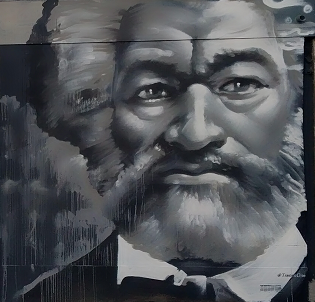
The denomination to which our local church belongs recently found it necessary to carry out an audit and examine what links the church may have had with the Trans-Atlantic Slave Trade. As a relatively newcomer in the denomination, I was unaware of the controversy, that dated back to the early days of the church, which was founded in 1843. What at first was puzzling was that Slavery had already been outlawed in the antis-slavery act ten years earlier (though this only covered part of the British Empire) and it seemed strange that the church could be complicit in slavery when it was still unborn. The reason for the controversy, however, was explained, by a visit which a delegation from the new church made to the American South in 1846. This group which included Thomas Chalmers were seeking the support of churches in America and you can understand why a secessionist movement would get a great deal of sympathy in the South. The delegation returned with a not insignificant gift of £3,000, but many within and out-with the church considered this money to be “tainted” as it likely came from slaveholders and a campaign to “Send the Money Back” was initiated. Fredrick Douglas, the abolitionist, was a strong and vocal advocate for the campaign, and lent his support while in Scotland, which included an attempt, with others, to carve the slogan on the cliffs of Salisbury Crags. His portrait now graces a wall in Gilmore Place, close to where he once lived. But the “blood money” was never returned. How the church resolved this at the time, I am not sure, but I suspect that a degree of pragmatism was involved. Even if an error was acknowledged, returning the money would not have helped the cause of those still enslaved in any practical way.
But why, more than 150 years after the event, the issue has now had to be revisited? It seems strange in the extreme. Afterall, the history of these events has been well known to the church and this assessment could have been done at any time. Why now? And why is that while the history of this hideous trade has been taught in school and accepted for what it is a heinous sin in our nation’s history, one on which there was national admission of guilt, repentance, the passing of anti-slavery laws and the costly efforts to have the trade banished world-wide, why now is there to be a another reckoning?
Is it simply to do with the way these things come in waves in the public consciousness? I remember in the 60’s the campaign for nuclear disarmament was a very hot issue, but strangely over the following decades, despite increased proliferation, the issue slipped into the background and only resurged again in the more recent decades. I remember one of my colleagues in our Architectural practice back in the early 70’s arriving at the office one day sporting a CND badge. We thought that rather quant at the time.
Could it be the very subtle infiltration of a way of thinking that owes more to Marx and Lenin than our Judeo-Christian heritage? A way of thinking that views the act of de-humanising another human, made in the image of God, not so much as a sin but simply part of the worldwide class struggle? The never-ending battle between the oppressed and the oppressor, the powerless and the powerful, the victim and the victimiser. Guilt is not so much personal but historical and in Marxism there is no forgiveness. Czeslaw Milosz, in his classic work “The Captive Mind” which must stand alongside works by Orwell, Solzhenitsyn and Havel in exposing the depravity of totalitarian culture, explains this succinctly in a chapter entitled “Man- the enemy”. Here the real enemy of the Marxist-Leninist project turns out to be humanity itself.
“The contradiction between Christianity and Stalinist philosophy cannot be overcome. Christianity is based on a concept of individual merit and guilt; The New Faith on historical merit and guilt. The Christian who rejects individual guilt denies the work of Jesus and the god he calls upon transforms himself into History”
The enemy then is the reactionary.
“The sin of the reactionary is argued very cleverly: every perception is orientated, i.e. at the very moment of perceiving, we introduce our ideas into the material of our observations; only he sees reality truly who evaluates it in terms of the interests of the class that is the lever of the future, i.e. the proletariat. The writings of Lenin and Stalin teach us what the interests of the proletariat are. Whoever sees reality other than the proletariat, sees it falsely; in other words, his picture of reality is deformed by the pressure of the interest of classes that are backward and so destined to disappear. Whoever sees the world falsely necessarily acts badly; whoever acts badly is a bad man; therefore, the reactionary is a bad man, and one should not feel sorry for him.”
So you can feel indifferent to the sufferings of those whose only crime is the blocking of “historical progress” and Milosz concludes :
“This line of reasoning has at least one flaw – it ignores reality”
But I suspect there is also another reason. It is much easier and less troublesome to focus on vague historical communal guilt and show virtue over our passion for the sins, than it is to confront the brutal reality that slavery exists today. Added to that is the disturbing thought that we could in some way be complicit in and benefit from it.
My contention is that instead of wasting our efforts, handwringing and agonising over the crimes of the pasts, we should be grappling with the brutal reality of slavery today. Instead of exhuming skeletons, historic crimes, which have been acknowledged and confessed, which have been forgiven and forgotten by God, we should apply ourselves to the very real live suffering of others. I am thinking of trafficking of children, the sweat-shop factories and the mining of toxic minerals. Minerals, which are necessary for the production of our mobile phones, electric cars, and all sorts of devices, including the one that this is written on.
Crawford Mackenzie
 Restless Spirit