LOVE AND HATE

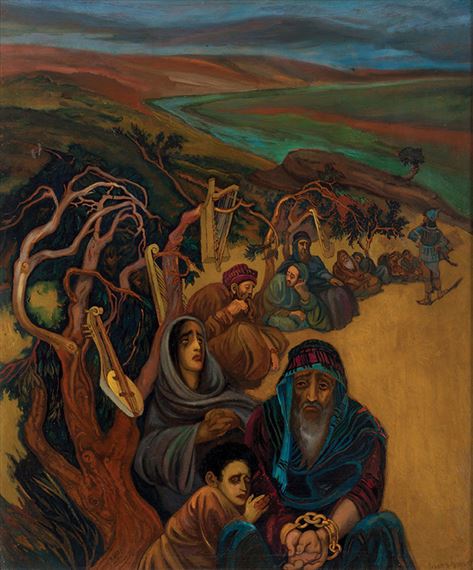
By the rivers of Babylon Saul Raskin

In our local church family, we, in common with many other churches, have several small pastoral groups that meet each week in individual homes, where we read and study the Bible together and pray for each other, for the church and for the world.  It is a very special time, with a wide range of ages experiences, backgrounds and stages in life, but with a common love for the lord Jesus and a bonding that transcends all human barriers.

We have just begun a short series of studies in the Book of Psalms in the Old Testament, not individual psalms but particular themes that run through this collection which deals with almost every human emotion: joy, loneliness, honesty, remorse, sadness, fear, anger.  In this we have been helped by James Montgomery Boyce, David Taylor, John Day, Gordon Wenham, Erich Zenger ,Derek Kidner and C S Lewis.

Inevitably, we will have to consider the Psalms that include cursing, of which there are many. Something like one-in-five have calls for vengeance or cursing in some form or other, with Psalms 58, 109 and 137 being amongst the most terrible. Throughout the centuries these have been a problem to Christians and it is not difficult to see why. They are also often quoted by those who argue against the divine inspiration and authority of scripture as reasons why we cannot believe in the bible. “How can we take the bible seriously” they will say, “as it is full of so many contradictions”. A good friend of mine, only the other day, said just that and gave this as the reason why he had stopped reading it. The authority of the bible was subject to a higher authority, in his case, that of his own rational mind. So, It is really only a problem for the Christian who believes in the authority, authenticity and inerrancy of scripture. For those who don’t, it should be of little interest or concern.

But here I have a disturbing thought. Could it be that the reason why Christians find these words, expressing outright hatred and white-hot rage, problematic, is that the problem is with us? Could it be that there is something about this God we are missing and just not getting? Could it be that we have not really grasped the absolute horror of evil, the heinousness of sin and where it inexorably leads? Maybe we haven’t stood by the remains of the furnace in Auschwitz and heard the guide tell us to be careful because we are standing among the dust of hundreds of murdered lives. Maybe we have never seen the heaps of bodies burning in Chin state in Myanmar. Maybe we have never been with the pastor visiting a village in the DRC, just a few months ago, and coming across the bodies of men women and children lying where they were shot with a single infant still alive in the arms of its dead mother. Maybe we have never recognised the corruption, deceit, selfishness and greed that knocks at the door of our own hearts. Maybe we still think the battleline between good and evil lies not in us, but somewhere out there. 

Christians, however, have coped with this “problem” in different ways.

One was simply to ignore the offending passages.  But that is hard to do, if you believe that “All Scripture is God-breathed and is useful for teaching, rebuking, correcting and training in righteousness”. So that doesn’t work.

Another is to see these expressions as wrong and should be condemned. Scripture includes many things that are wrong. David’s sin with Bathsheba being one. But that doesn’t really work either. because while David’s sin was condemned and he himself confessed it, the Bible, at no point, condemns the writers of these psalms for what they said or for the desire for vengeance which they expressed.

A third, which many have settled on, is the idea that these expressions belong to the Old Testament while in the New, Jesus and Paul have shown us a better way- how we should love our enemies, how we should bless and not curse. The Psalm writers under this explanation had a limited understanding of things and really didn’t know any better. But this falls too because love for your enemies was not a new idea or a new command. It is embedded in the Old Testament law and Jesus quoted the proverb which explicitly say we should feed our enemy when he is hungry and give him something to drink when he is thirsty. On the other side, Paul pronounced a curse on Elymas the magician and Jesus himself pronounced a curse on Israel.  So, we have love for the enemy in the Old and curses in the New.

What we found most helpful and illuminating when reading these psalms was to see what the writers were not saying. The writers of the three psalms listed above, who included David and the captured slaves in Babylon, were not describing their commitment to enact revenge on those who brutally persecuted them. They were not saying that they would exact vengeance and repay the preparators for what was done to them. The captives in Babylon, who had escaped the fate of the horrific siege of Jerusalem, the details of which are hard to read or stomach, were not expressing their own vengeance. Their appeal was simply to God for justice. And that is what it is about – Justice. The justice described in the Mosaic law – the principal of equal and just retribution.

Today, when we hear the cry of families of victims of vicious crimes, it is always an appeal for justice, justice for the ones they loved. That’s what they fight for. That’s what they demand from the courts and that is what they never give up on, because it is Justice that is at stake. This is exactly what the writers of the cursing psalms are doing, they are crying out for an equal and just retribution.  But for them the appeal is not to a human court, but to the highest court, to the Judge of all the earth.  And it is this act of taking it, in all its rawness, to God and leaving it with him, which at once, lances that boil, dissolves the rage, neutralises the anger and eliminates the personal desire for revenge. The outburst of outrage is more than just cathartic. It achieves something.

So, we have found, having taken these challenging passages, which sound pretty terrible to our ears, taken them head on, unflinchingly, we have found that they do not, in fact, contradict the law of love but they complement it and we see how the curses and the blessings, the love and the hatred stand together without contradiction.
In Silence

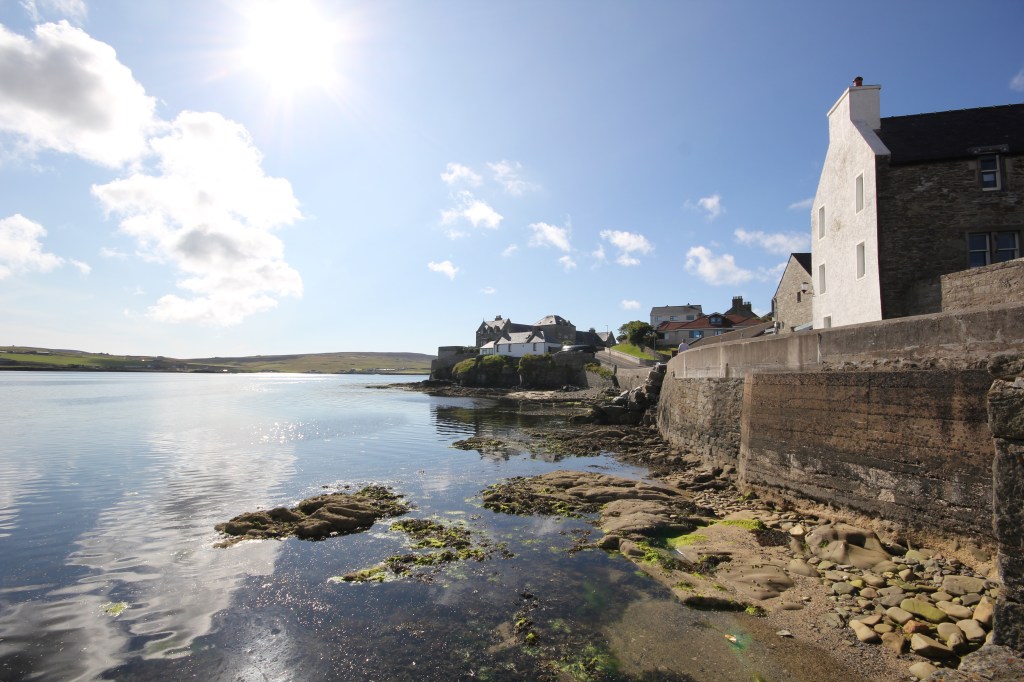
It’s barely a five minutes walk from our cosy apartment in the Lanes by the harbour, where the waves of the North sea lap against the stone walls of the houses and boatsheds, the cobbled jetties, piers and little bays of rock and sand out to the knab that outrageous rock promontory that stands sentinel at the edge of the harbour. It is early morning and the soft wind is blowing in off the sea with that daily freshness that instantly reaches the heart and the head and things seem so much clearer.

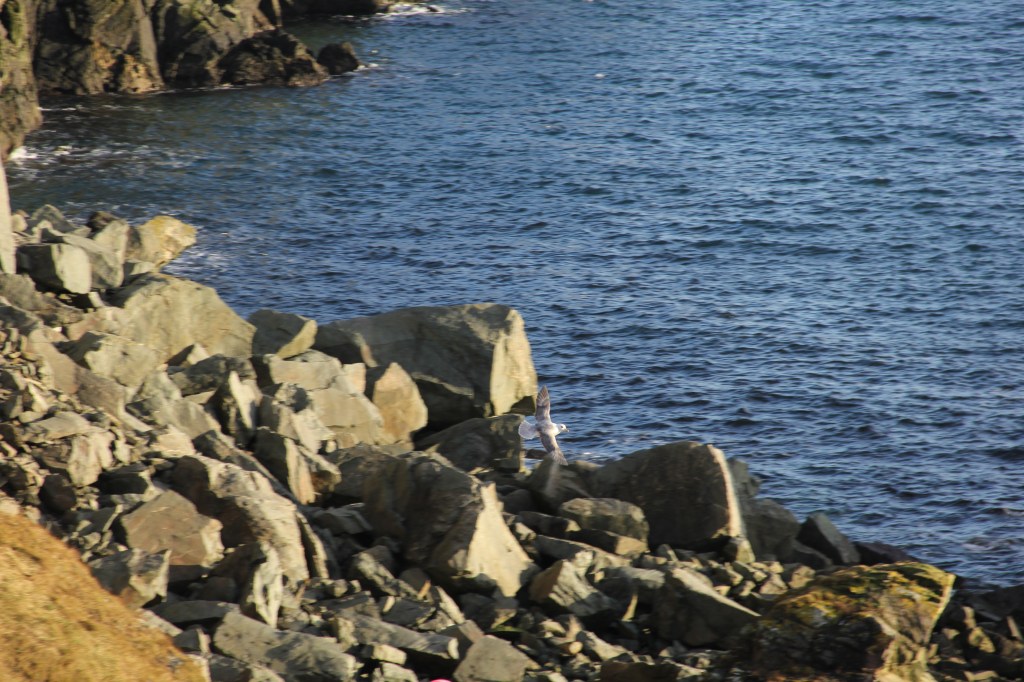
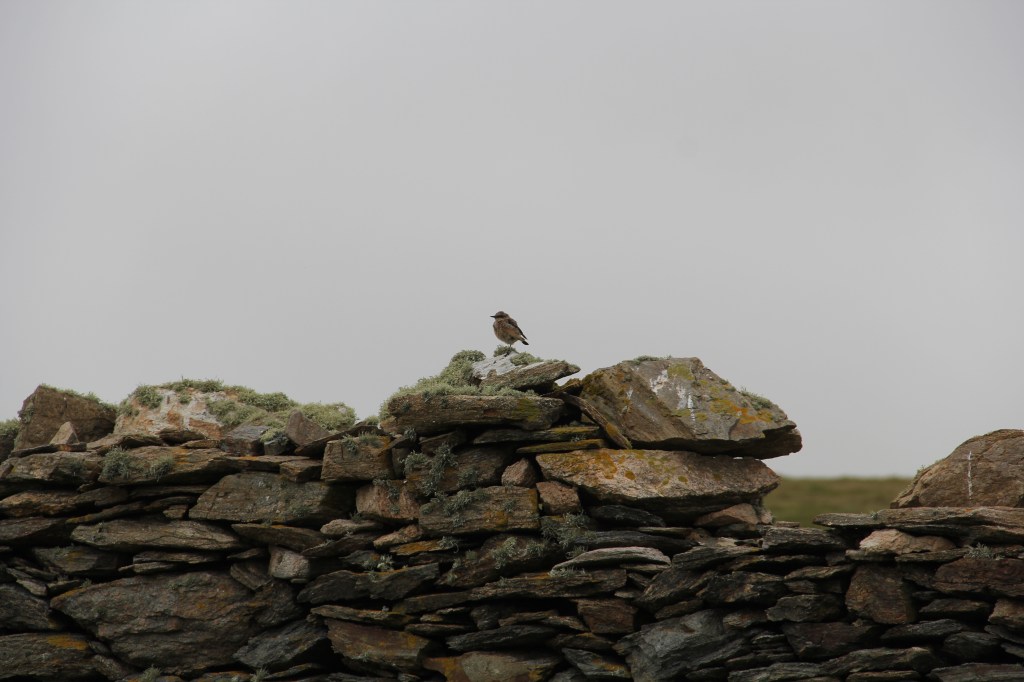
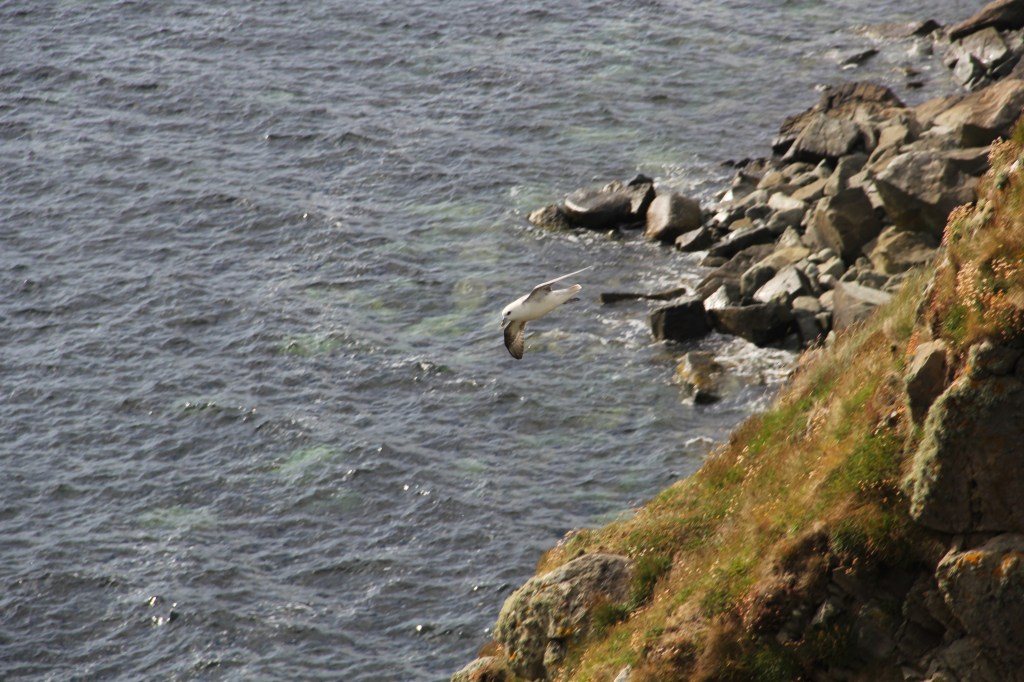
The sun has risen over Bressey and glints across the water as the tirricks dance over the waves before pouncing to pick up an errant piltek and return with it for breakfast. The track takes a line just above the shore past the graveyard on the eastern slope and rises to its highest point where I stop and gaze across the wall, down over the cliff and far out to the southern horizon. The cliff face is terrifying. I tried once to go down across the rock to find a good place to fish, but soon lost my confidence, was frozen with fright and realising I could never trust myself to a caste and made a careful retreat to safer ground. Today I stand behind a solid masonry wall and watch the Fulmars performing their aerobatic displays. Like spitfires, effortlessly tilting and turning, they zoom in fast past the nest on the cliff to rise again into the wind. On the sharp dark rocks below, a line of shags with wings at ease stand erect. In conversation? Possibly. At a suitable distance apart, but on the same rock, a small group of black guillemots study the waves, as one fluttering with its white flashes speeds over to join them. Across the water, the gannets seem to fall over themselves as they find a shoal of mackerel. Like giant planes they glide over the waves then turn and dive headlong into the water disappearing in a white streak of foam. The soft wind caresses the long grass and wild flowers on the edge of the slope, sea campion, kattikloo, lammas flooer and sweet william all dancing to the same tune while the sea pinks shimmer on the edge of the slope. The smell of the sea breeze mixed with the grasses is intoxicating. It could be the finest of wines, it takes your breath away and transports you to another place and time. There is almost too much to take in. Nothing remains the same, in sun or rain in gales and stillness, the sea is constantly moving and every creature seem thrilled to the unspeakable joy of living.

This is the point where I abandon the camera and sketch book. Here, as in all of the nature, there is something that cannot be captured. It cannot be preserved in a bottle or a can or defined on a painting or live-on in a poem. True, we try and the artist and poets have so often opened our eyes and helped us see what we would otherwise be blind to.  The romantics, despite their bad reviews, have given us a way of looking at the world and we are richer for that. I am thinking of Keats and his “Ode to Autumn” that I learned at school and has stayed with me ever since.  The way the sounds and the rhythm and the colours come together gives you the taste of the apples, the smell the flowers, the bleat of the lambs and feel the weight of the bounty. It helped me see that season in a new light.

This morning, I read David’s Psalm 65 and it is pouring through my mind, as I stand here in wonder.  It is set in a very different time and land, possibly parched and dry, and so it is full of the blessings of water. You can almost hear it gurgle, drip and flood as it fills the furrows. You see the valleys filled with grain, the slopes with sheep and the rich produce that weighs down the cart wheels. What makes David’s song different from Keats, is that beyond all the wonder of the world he sees the hand of the creator, constantly and intimately involved in refreshing, renewing, recreating, restoring in this great living work of art. But it is not an abstract vague or distant entity, a mother nature, but a personal God who can be known, who speaks and who listens.  The first four verses alone tell us so much of this God. He hears our prayers, he takes away our sin, he chooses and calls and draws us near to his place where there is complete satisfaction, fulfilment and joy.  It is an astonishing song, but it is also intriguing as the literal translation of the first verse reads. “Praise waits, in silence, for you, O Lord”  I was curious about the idea of praise waiting in silence and wondered if it said something about how we approach God. Perhaps, before responding in heartfelt gratitude, in exuberant unrestrained praise, our first attitude should be one of total reverence, waiting for him in silence.

That’s how I feel this morning, when overcome with the wonder all around me but today eclipsed by the unspeakable joy of having just seen the miracle of a new life and held her in my arms, this fragile, and to my eyes, perfect creature, her tiny lips creased into a smile, and her eyes closed in carefree abandon.

“Praise waits, for you, in silence Lord”.

Crawford Mackenzie

Let us go

Walking through the park in the beautiful yet eerie stillness of the morning, the words to Psalm 122 come to mind. I know them off by heart and recite them to myself. I also know them in the 1620  metrical form. We sang it as children to the 18c tune St Paul  with the almost clumsy double note at the end of the line in the second verse, to cope with the extra syllable. I remember singing it on one summer Sunday morning  on the Isle of Muck. We had travelled earlier in a launch from our home in the nearby island of Eigg and scrambled over the slippy rocks to be treated to tea and fresh scones before making our way up to the school building. Through the tall windows behind the make shift pulpit, some sheep had left off their grazing to stare at the strange creatures standing inside singing. Somehow the relevance of the psalm, with the tribes gathering in Jerusalem and the houses packed together, so far away in space and time was quite lost on me. But today they have a special resonance.

The Psalm moves beautifully and quickly from the first person to the second to the third and then to the destination the home of the King. “I was glad when they said to me let us go to the house of the Lord”. It is full of movement in a single direction, a going up, a coming together, a closeness, a sense of belonging, and a sense of security, prosperity and of peace. You know that the Psalm writer is not describing something ephemeral, virtual or abstract. He is not talking about an idea, but an actual physical event and the joy that the invitation gives him.

Deprived of that special blessing, meeting each week together in church, I feel the loss so keenly today. This absence makes the heart go much more than a little bit fonder and the virtual replacements only make the longing for the reality that bit more intense.  We have a weekly digital service and a sermon from one of the finest young preachers I know and afterwards we have digital coffee in cyberspace with our online home group. It is astonishing what technology has achieved and the blessings that can come from it, but it just doesn’t compare.   

And I wonder why the church has, without, it seems any protest or question, followed the government instructions, cancelled services and closed buildings and so easily surrendered this most precious thing.   It is not, of course, surprising that a secular government would view these gatherings as an unnecessary luxury in a crisis, while bicycle shops, pet shops, DIY  centres, and off-licences on the other hand, are seen as essential to life. It is surprising, that the churches themselves think so too.

Still, in the vacuum, with social distancing, in the new normal, I will pray for the peace and security of Jerusalem. “For the sake of the house of the Lord our God I will seek your good”