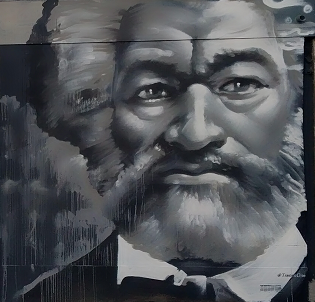
The denomination to which our local church belongs recently found it necessary to carry out an audit and examine what links the church may have had with the Trans-Atlantic Slave Trade. As a relatively newcomer in the denomination, I was unaware of the controversy, that dated back to the early days of the church, which was founded in 1843. What at first was puzzling was that Slavery had already been outlawed in the antis-slavery act ten years earlier (though this only covered part of the British Empire) and it seemed strange that the church could be complicit in slavery when it was still unborn. The reason for the controversy, however, was explained, by a visit which a delegation from the new church made to the American South in 1846. This group which included Thomas Chalmers were seeking the support of churches in America and you can understand why a secessionist movement would get a great deal of sympathy in the South. The delegation returned with a not insignificant gift of £3,000, but many within and out-with the church considered this money to be “tainted” as it likely came from slaveholders and a campaign to “Send the Money Back” was initiated. Fredrick Douglas, the abolitionist, was a strong and vocal advocate for the campaign, and lent his support while in Scotland, which included an attempt, with others, to carve the slogan on the cliffs of Salisbury Crags. His portrait now graces a wall in Gilmore Place, close to where he once lived. But the “blood money” was never returned. How the church resolved this at the time, I am not sure, but I suspect that a degree of pragmatism was involved. Even if an error was acknowledged, returning the money would not have helped the cause of those still enslaved in any practical way.
But why, more than 150 years after the event, the issue has now had to be revisited? It seems strange in the extreme. Afterall, the history of these events has been well known to the church and this assessment could have been done at any time. Why now? And why is that while the history of this hideous trade has been taught in school and accepted for what it is a heinous sin in our nation’s history, one on which there was national admission of guilt, repentance, the passing of anti-slavery laws and the costly efforts to have the trade banished world-wide, why now is there to be a another reckoning?
Is it simply to do with the way these things come in waves in the public consciousness? I remember in the 60’s the campaign for nuclear disarmament was a very hot issue, but strangely over the following decades, despite increased proliferation, the issue slipped into the background and only resurged again in the more recent decades. I remember one of my colleagues in our Architectural practice back in the early 70’s arriving at the office one day sporting a CND badge. We thought that rather quant at the time.
Could it be the very subtle infiltration of a way of thinking that owes more to Marx and Lenin than our Judeo-Christian heritage? A way of thinking that views the act of de-humanising another human, made in the image of God, not so much as a sin but simply part of the worldwide class struggle? The never-ending battle between the oppressed and the oppressor, the powerless and the powerful, the victim and the victimiser. Guilt is not so much personal but historical and in Marxism there is no forgiveness. Czeslaw Milosz, in his classic work “The Captive Mind” which must stand alongside works by Orwell, Solzhenitsyn and Havel in exposing the depravity of totalitarian culture, explains this succinctly in a chapter entitled “Man- the enemy”. Here the real enemy of the Marxist-Leninist project turns out to be humanity itself.
“The contradiction between Christianity and Stalinist philosophy cannot be overcome. Christianity is based on a concept of individual merit and guilt; The New Faith on historical merit and guilt. The Christian who rejects individual guilt denies the work of Jesus and the god he calls upon transforms himself into History”
The enemy then is the reactionary.
“The sin of the reactionary is argued very cleverly: every perception is orientated, i.e. at the very moment of perceiving, we introduce our ideas into the material of our observations; only he sees reality truly who evaluates it in terms of the interests of the class that is the lever of the future, i.e. the proletariat. The writings of Lenin and Stalin teach us what the interests of the proletariat are. Whoever sees reality other than the proletariat, sees it falsely; in other words, his picture of reality is deformed by the pressure of the interest of classes that are backward and so destined to disappear. Whoever sees the world falsely necessarily acts badly; whoever acts badly is a bad man; therefore, the reactionary is a bad man, and one should not feel sorry for him.”
So you can feel indifferent to the sufferings of those whose only crime is the blocking of “historical progress” and Milosz concludes :
“This line of reasoning has at least one flaw – it ignores reality”
But I suspect there is also another reason. It is much easier and less troublesome to focus on vague historical communal guilt and show virtue over our passion for the sins, than it is to confront the brutal reality that slavery exists today. Added to that is the disturbing thought that we could in some way be complicit in and benefit from it.
My contention is that instead of wasting our efforts, handwringing and agonising over the crimes of the pasts, we should be grappling with the brutal reality of slavery today. Instead of exhuming skeletons, historic crimes, which have been acknowledged and confessed, which have been forgiven and forgotten by God, we should apply ourselves to the very real live suffering of others. I am thinking of trafficking of children, the sweat-shop factories and the mining of toxic minerals. Minerals, which are necessary for the production of our mobile phones, electric cars, and all sorts of devices, including the one that this is written on.
Linda Grant who wrote an introduction to a new edition of Vassily Grossman’s “Life and fate” translated by Raymond Chandler, said that it took her three weeks to read the book and three more to get over it. It took a lot longer for me to read and I am still recovering.
There is something enduringly magisterial about this epic novel, regarded by some as the finest Russian novel of the twentieth century. In its 800 or so pages it covers what must be the bleakest period in this great nation’s history under the brutality of the soviet and fascist systems. But it is not a book with a message in the classic sense of the word. The great tyrannical ideologies are almost footnotes in this beautifully woven human story of individual lives caught up in the bizarrest and ugliest of situations and yet somehow demonstrating the integrity of the human spirit, something that the terrible might of evil forces are unable to fully crush. So it is a story of hope. It is also a story of great tenderness.
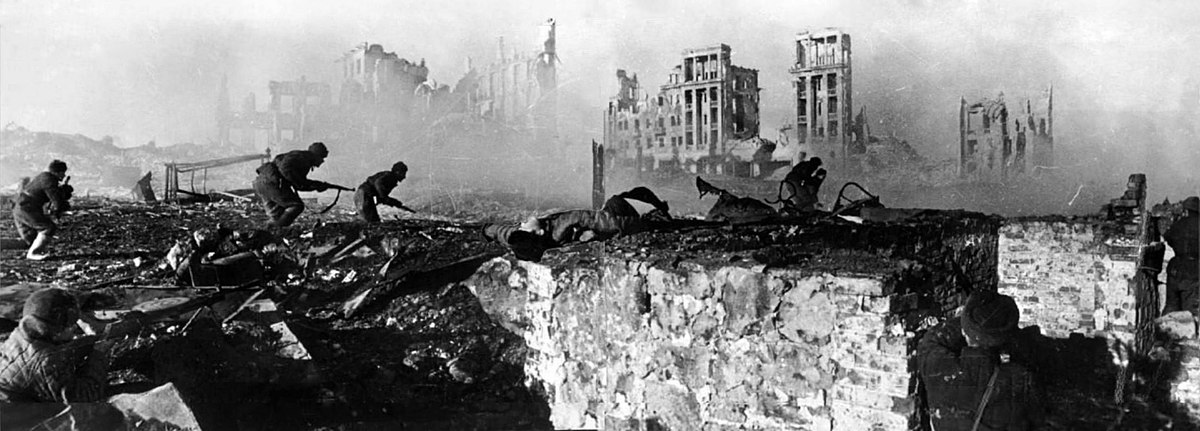
It moves through Stalingrad on the banks of the Volga, the street by street fighting and the encircled division in building 6/1, to the middle-class home of the scientist and his laboratory comrades. We are in the interrogation rooms, the death camps and the gas chambers. We follow the Führer, though the woods and Stalin is on the line. We travel with the tank corps and the retreating sagging armies. There are the Russian, the Germans, Armenians, Ukrainians and the Jews, the Bolsheviks and fascists, All the time the ghost of 1937 is eerily present casting its dark shadow over the conversations and memories and everywhere there is the relentless struggle between the big ideas and the reality of what is happening on the ground.
It is a quite beautiful and inspiring tale.
Much of the novel rotates around Victor Pavlovich, a middle-class theoretical physicist in a power struggle with his colleagues and stressed in his fraught relationships with his wife and daughter, complicated by a secret liaison. Much of his torture, however, was over the conflict between his loyalty to his work, to the purity of science and where it conflicts with the Leninist view of the nature of matter. His careless comments taken out of context, get him into trouble and are used by his enemies to ensure his downfall. In the process of administering his disciplinary case, he has to complete a massive questionnaire which seeks to garner any hint of anti-revolutionary thought or taint. Any connection or sympathy for the exiles or of the purged of 1937 will mean certain exile. When he notes the most casual of links with someone who was arrested, he is seized with a feeling of irreparable guilt and impurity. He prepares to make his confession and He recalls a meeting at which a party member, confessing his faults had said “Comrades, I am not one of us”. It was when he sensed he had lost everything that he gets the call from Stalin. “I wish you success in your work” is the one affirmation that changes everything. The actual work is not defined and only referred to obliquely “A new shadow, still faint and mute, barely perceptible, now hung over the ravaged earth, over the heads of the children and old men. No-one knew of it yet, no-one was aware of the birth of a power that belonged to the future” (page 751)
There is Grekov the crude but likeable commander of the division in the encircled house 6/1. While there was death and destruction all around he and his men take pity on an injured cat and care for it as it were a child. The radio operator is the only female in this terrible place and she senses that sooner or later one of the men will make a pass at her. She somehow senses it will be the commander, by the way he looks at her, but she so much wants it to be the young poet Seryozha. Her hopes are dashed, however, when Seryozha is sent out on a raid. The raid, for some reason is cut short and he returns early. They spend the night snuggled up together in their lice ridden great coats and boots and she is still sleeping on his shoulder when the unit reforms in the morning. The commander announces that Seryohza is to be sent back to HQ. This will surely end the promising relationship but in a twist of surprising kindness Grekov tells the radio operator that she should go back too. She is not needed there anymore. Later when the Commissar comes to relieve Grekov of his position, his unorthodox and anti-soviet tendences have become too much for the authorities, he ask after the radio operator.
“Are there any women in the building?”
“Tell me, comrade Commissar, is this an interrogation?
“Have any men under your command been taken prisoner?
“No
“Well where is that radio operator of yours?
Grekov, bit his lip and his eyebrows came together in a frown.
“The girl turned out to be a German spy.
She tried to recruit me
First I raped her then I had her shot”
He drew himself up to his full height and asked sarcastically
“Is that the kind of answer you want from me?
It’s beginning to seem as though I’ll end up in a penal battalion”
Then there is Sagaydak ruminating on his special role as a newspaper editor. “He considered that the aim of his newspaper was to educate the reader- not indiscriminately to disseminate chaotic information about all kind so probably fortuitous events. In his role as editor Sagaydak might consider it appropriate to pass over some event: a very bad harvest, an ideological inconsistent poem, a formalist painting, an outbreak of foot and mouth disease, an earthquake, or the destruction of a battleship. He might prefer to close his eyes to a terrible fire in a mine or a tidal wave that had swept thousands of people off the face of the earth. In his view these events had no meaning and he saw no reason why he should bring to the notice of readers, journalist and writers. Sometimes he would have to give his own explanation of an event: this was often boldly original and entirely contradictory to ordinary ways of thought. He himself felt that his power, his skill and experience as an editor were revealed by his ability to bring to the consciousness of his readers only those ideas that were necessary and of true educational value.”
Novikov the tank comander looks at his men and his heart is warmed:“One soldier was singing; another, his eyes half closed, was full of dire foreboding; a third was thinking about home; a forth was chewing some bread and a sausage and thinking about the sausage; a fifth, his mouth wide open, was trying to identify a bird on a tree; a sixth was worrying about whether he’d offended his mate by swearing at him the previous night; a seventh, still furious was dreaming about giving his enemy – the commander of the tank in front- a good punch on the jaw; an eight was composing a farewell poem to the autumn forest; a ninth was thinking about a girl’s breasts; a tenth was thinking about his dog sensing that she was about to be abandoned among the bunkers; an eleventh was thinking how good it would be to live in a hut in the forest drinking spring water, eating berries and going about bare foot; a twelfth was wondering whether to feign illness and have a rest in hospital; a thirteenth was remembering a fairy- tale he had heard as a child; a fourteenth was remembering the last time he had talked to his girl- he felt glad that they had now separated for ever: a fifteenth was thinking about the future- after the war he would like to run a canteen.
‘Yes’ thought Novikov, ‘They’re fine lads’ “
When Getmanov leaves for the front and has to say goodbye to his family: “He held his hand to his chest, afraid that his booming heart-beats would disturb the children. He felt a piercing ache of tenderness, anxiety and pity for them. He desperately wanted to embrace his son and daughters and kiss their sleeping faces. He was overwhelmed by a helpless, tenderness, an unreasoned love; he felt lost, weak and confused.
He wasn’t in the least worried or frightened at the thought of the new job he was about to begin. He had taken on many new jobs, and he had never any difficulty in finding the right line to follow. He knew it would be the same in the tank corps. But how could he reconcile his unshakable, iron severity with this limitless tenderness and love?
In the corridor he said goodbye, kissed his wife for the last time and put on his fur coat and cap. Then he stood and waited while the driver carried out his suitcases.“Well then” he said – and suddenly stepped up to his wife, removed his cap and embraced her once more. And this second farewell – with the cold damp air off the streets slipping in through the half-open door and blending with the warmth of the house, with the rough, tanned hide of his coat touching the sweet-scented silk of her dressing gown- this final farewell made them feel that their life, which had seemed one, had suddenly split apart. They felt desolate.”
When we think we can’t bear any more we are taken with Sofya Levinton and a young boy David, she has linked hands with, into the darkest hole of the century, yet, even here, humanity shines through. She is as a medic and could have escaped the gas chamber but chose to go with her people and with motherly instincts, though herself a virgin, took the boy’s hand and kept him beside her until he collapsed by her side.
“ Sofya felt the boy’s body subside in her arms. Once again she had fallen behind him. In mine shafts where the air becomes poisoned, it is always the little creatures, the bird’s and mice, that die first. This boy, with his slight, bird-like body, had left before her. “I’ve become a mother” she thought. That was her last thought. Her heart, however, still had life in it: it contracted, ached and felt pity for all of you, both living and dead; Sofya felt a wave of nausea. She pressed David ,now a doll, to herself; she became dead, a doll.”
But we are also on the other side with Anton Khmelkov as he expresses his disgust at his co-worker Trofima Zhucheko in his attitude to the gruesome work of closing the hermetically sealed doors. Trofima looked happy and even excited by his work marshalling the columns of prisoners from the railway.
“ What Khmelkov didn’t understand was that it wasn’t Zhuchenko’s greater guilt that made it so disturbing. What was disturbing was that Zhuchenko’s behaviour could be explained by some terrible, innate depravity – whereas he himself was still a human being. And he was dimly aware that if you wish to remain a human being under fascism, there is an easier option than survival – death.”
Towards the end of the story the German company Commander Lenard, following his ragged army in retreat, comes, in the evening, upon a group of his men hacking meat from a frozen dead horse while others in a ruined building were gathered round a fire and a blackened cauldron while a cook prodded the meat with his bayonet
“The light of the evening can reveal the essence of a moment. It can bring out its emotional and historical significance. Transforming a mere impression into a powerful image. The evening sun can endow patches of soot and mud with thousands of voices; with aching hearts we sense past joys, the irrevocability of loss, the bitterness of mistakes and the eternal appeal of hope.
It was like a scene from the Stone Age. The grenadiers, the glory of the nation, the builders of the new Germany, were no longer travelling the road to victory. Lenard looked at these men bandaged up in rags. With poetic intuition he understood that this twilight was the end of a dream.
Life must indeed conceal some strangely obtuse internal force. How was it that the dazzling energy of Hitler and the terrible power of a people moved by the most progressive of philosophies had led to the quiet banks of a frozen Volga, to these ruins, to this dirty snow, to these windows filled with the blood of the dying sun, to the quiet humility of these creatures watching over a steaming cauldron of horsemeat?”
The futility and inevitable demise of all the worlds kingdoms is finally revealed. The utter stupidly and folly of believing that by our skill our dexterity, our ideas, our wisdom our solidarity and our determination we can build a heaven on earth, is inevitably laid bare in time. It is the truth that history always teaches us and one we fail to learn. All that is left, as Grossman sees it, is the individual, their tenacious hold on hope and their modest peculiarities expressed sometimes in inexplicable acts of human kindness.
In my desert island I would want to be reminded of the beauty of the individual and our shared humanity.

 Restless Spirit