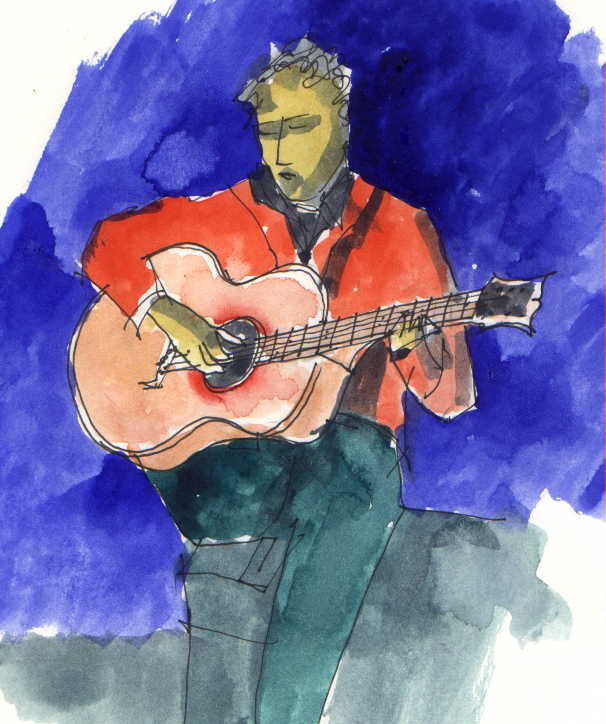
When I arrived in Aberdeen in the autumn of 1967, to begin my studies at the School of Architecture, the first thing I did with my student grant, after paying my dig money, was to buy a guitar. It was nylon string bottom of the range Tatra classic from Bruce Millers in George Street. At the same time I became involved in a Friday night coffee bar run from the basement of the Salvation Army Citadel at the west end of Castle street. You entered through a small door on a side street, where the North Sea wind hurled its way up into town, and down a flight of stairs to a brightly painted room with a small stage and mic and a counter at the other end serving hot milky coffee, Coke and Fanta. The café was called “The fishing net” a reference to Jesus’s commission to Peter “I will make you a fisher of men”. It was decorated with paintings of fish, seaweed, brightly colourer nets and fishing tackle. During the evening a small folk trio or solo artist would play and sing and someone would speak with a message. It was run by a number of churches in the city with the aim of making connections with young folk on the streets on a Friday evening. , They were invited in, befriended and engaged in conversation. I had only been going for a few weeks when one of the leaders asked me to play and sing on the following Friday. With foolish naivety, I accepted, completely oblivious to the fact that I had no material and had never sung, far less played guitar, in public before. Hastily I scratched a couple of songs together, one which had a remarkable and not unconscious resemblance to the Kinks “Sunny afternoon” and the other to the Beatles “a day in a life” The third was a spiritual. I practised hard but as the day grew nearer became more and more aware of my foolishness. I remember the night very clearly, walking across to the stage with guitar over shoulder shaking like a leaf, thinking “I can’t do this” and praying “lord if you really want me to do this, let it be you who does it”. It is a prayer I have found myself praying each time I have been asked to sing, since. The noisy room was suddenly stilled and as I ham fistedly clunked my way through the songs I had this strange experience as if standing outside myself looking on as someone else took over, carrying the message to the hearers.
Once finished and with the waves of relief pouring over me I relaxed at a table and fell into a discussion with a slightly inebriated leather clad rocker. He wasn’t interested in the songs but wanted to argue about the existence of God. I was helpless and could offer no good explanation or original thought. We were soon joined by two others, one clutching a battered bible. Suddenly there was clarity and rational in the discussion and I sat back with dropped jaw listening to the discussion amazed at the command of our new friend. (the one doing the talking) He had understanding and ability to communicate the cosmic realities of creation and redemption and the wonder of the gospel in spell bounding clarity. It was only after he left that I learned that he was already well known in student and church groups, the president of the Christian Union in the University and later a significant figure in Reformed Christian circles both in Scotland and the USA, highly regarded for his teaching, writing and editorial work. So it was a surprise, that our lives should cross again some 45+years later, when we both joined with our families, in our new church setting. It was an added and unexpected delight to hear him preach. While some preachers become old and tired and tread well-worn predicable paths and others have spoken for a specific time and place, his preaching carried refreshing timeless authority, vitality and relevance. Now endowed with the richness of truth distilled slowly through the years it was presented with crystal clarity, much as it was, around the table, in the basement café, all these years ago.
The questions comes up, of course, because so many of my friends, my family, people I love and care about, folk I admire and respect, don’t. Some flirted with church in their formative years but got bored of the petty politics, struggled with the institution, were turned off by the back biting and hypocrisy, felt excluded, marginalised, betrayed, and overwhelmed with the sheer absurdity of belief that they left for the sake of their own sanity. I find I share an awful lot in common with them and have a fair bit of sympathy with their position. I sometimes wonder why I never joined them. But I haven’t and I won’t and I can’t. Because….
Because the church is much more. The bonds are stronger than friendship. The ties are thicker than blood. It is bigger than family. The local church might seem like a collection of misfits and oddballs, rough diamonds and smoothies, saints and martyrs (“the martyrs being the ones who have to put up with the saints”*), people we get along with and people we don’t. It is made of people of different age groups, different cultural backgrounds sometimes speaking different languages, people who don’t share the same outlook, standards, interests. All of this must point to the fact that something else is going on here. That something else is God. It is God’s church and so he does the choosing. He brings us together. He does the deciding. He does the planning. He does the perfecting. It is his business and he does it and will do it in his way and in his time.
Because we live in a world that is full of fantasy and illusion, false God’s and paper kings, soaked through with a powerful pervasive philosophy that says that what we see and hear and can touch is the real world. It bombards our thoughts, bends our minds and coerces us into believing this is true. So we need to find ourselves somewhere else where we can be brought into the real world. Where we can regularly make contact with what is really important. With what is more important than life or death. And that somewhere else is the church. That is why the call to worship “We are here to worship God” is pivotal. It is a call away from the false realities to the true reality and of his purpose of salvation and redemption and glory. In his presence the other world with its great show, its charms, its promise, its money, its power, seems so pathetic, so foolish, so small and so sad.
Because, in church, I am reminded of where my true identity lies. It is not in being a man, a father, a grandparent, an architect, a dabbler in painting, music and DIY, a Scot, a European a White Anglo Saxon Protestant Christian. My identity is not in my interests, my family, my roots, my sexual orientation, my ability or disability, or in my race. My identity is in Christ. I don’t need to wonder “Who am I?” But I need that regular reminder of this knowledge which is found in the strange setting of a group of ordinary people meeting together, bowed in worship before the one true God. I need to know again that I am a sinner, who has been accepted by God because of Jesus, with nothing to bring but empty hands accepting his grace.
That’s why I still go to church.
Crawford Mackenzie
* Quoted by Eugene Peterson in “The Wisdom of Each other” Zondervan
I have been asked and pressed a number of times on facebook and other discussions, to justify why I hold to the orthodox position on homosexual practices and, in particular, what was the basis for this belief. It is not a subject I ever wanted to speak about and I have been very reluctant to make any comment. I also feel that the onus to explain and justify the moves towards the normalising of same-sex relationships should fall to those who are proposing it. In a way there is no need to justify what has been the orthodox position for centuries. It is up to others to justify why the change is either, necessary, good or the right thing to do. This explanation should not have been necessary. Still, as the push towards this momentous change in society, which will have far reaching implications, has been overwhelmingly in one direction and the voices against, with some notable exceptions, all but silenced, I feel a need to state the case as best I can. It is difficult to distil the thinking into a few words, when others have devoted whole volumes and years of study to it, but I have tried and here is what I would say.
Homophobia
At the first I have to make the clear distinction between the person and the act. I have nothing to say about the person. I have no authority or qualification to do so. My position is wholly based on the act – sexual relationships between people of the same sex. This distinction is very important and has often been conveniently blurred. It is perfectly sensible and reasonable to believe that a person’s actions are wrong and disapprove of them and yet not discriminate against them. It happens all the time. The prevailing thought, however, is that if you are unwilling to embrace same sex relationships and believe them to be fundamentally wrong, you are harbouring homophobic thoughts and attitudes. This then is the breeding ground for prejudice discrimination, hostility and eventually violence. There is also the suggestion that such an attitude can precipitate the suicide of a perceived victim. Homophobia, in this definition, is just one step up from Nazism.
Self-evidence
For me, the major explanation and authority comes from the Bible, and I know that many who do not accept the authority of the bible will be dismissive of it because of that. But my position is, however, not only based on what has been revealed in the bible, but also from what is clearly seen in nature. What I have called “self-evident” truth, although again some have objected to the use of that term. It is to do with the unarguable anatomical distinction between men and women clearly pointing to a design, and I would say to a designer. If there is a design then, in a world where we have free will, there is the possibility of a distortion, a spoiling of the designer’s intention. It seems perfectly plain. It is unnatural. It is something a child sees as obvious and doesn’t need to be taught. Even without the bible, I would take the same position that I do.
The Bible
I do believe the bible to be the word of God not just parts of it. It is our one true guide to life but more importantly it reveals God and Jesus, the son of God, to us. I also believe it is a whole and needs to be read as a whole and so I would not try and pick out a verse here and there (what could be called “proof texts”) to make a point.
The Design
The first thing is that nowhere in all of the books of the bible is there the remotest hint that homosexual sex is anything but wrong and is often condemned in the strongest of terms. No one argues with this. But the place I would start is Genesis and the creation narrative. Nothing could be clearer that God created humans as male and female deliberately. It was the climax of creation and it was only then that he rested and gave his creatures the command to carry on the work of creation from the garden into the entire world. That is enough for me. From there the design is simply clarified and reminded in the positive and the negative. It is possible, as others have done with far greater clarity than I could ever employ, to trace this design throughout the bible, book by book, emphasising its central importance as a picture of the relationship between Christ (the son of God) and the church (his bride). Paul describes this as a mystery. It is a wonder and, at the same time, something extraordinarily beautiful and lovely. Because of that, any distortion any soiling of the picture is a blasphemy against God.
Jesus
It is probably easier to start from what the advocates for the normalisation of same sex relationships claim the bible says. One of the big ones is that Jesus said nothing about it and so by default he was for it. He would have blessed a same sex union if there was one at the time in the same way that he blessed the couple at Cana by his presence. That is how the argument goes. It is of course a baseless argument. It is arguing from the negative. Jesus said nothing to contradict or supplant or nullify the moral law which condemned such practise in the strongest of terms. In the Sermon on the Mount he did not water down the moral law but he reinforced it. He said that sin starts in the heart. When it came to marriage he pointed back to the creation narrative which explained that the design was for a man and women to become one.
Leviticus
The moral law was defined in the Ten Commandments which included the seventh (or sixth) and amplified in Leviticus. So many people follow the well-trodden line set out by atheists, bishops and celebrity evangelicals who sneer and savagely mock those who hold to the orthodox view, by saying “You are hypocrites. You disregard some rules (on not eating pork, not wearing clothes made of different materials for example) while choosing to keep others (on homosexuality)”. This is the classic Jed Bartlett put down and is, of course, a great laugh. But those who say this have either not taken the trouble to read Leviticus or have deliberately misread it. It is not difficult to see there is a clear distinction between the cleanliness laws, the rules that apply to the business of approaching God , the laws that Jesus fulfilled by what he did, and the moral law which remains. The actual verse which specifically prohibits homosexual practise is not amongst verses on clothing or what not to eat, as people would have us believe, but is in a chapter devoted to the prohibition of many kinds of sexual sin and is in fact sandwiched between the law against sacrificing children and the law against sex with animals. By this logic, which the critics employ, there is no reason why we should prohibit sex with animals or the sacrificing of our children if, in the spirit some future enlightened age, it was thought the right thing to do.
Sodom
In the account, God was about to punish the city because of its many sins but we are not told explicitly what they were. The fact that homosexual rape was involved, may simply suggest how bad thing had become but we are not told. The suggestion that it was because of their inhospitality to strangers is simply unfounded, as Lot, one of the chief citizens of that town, did in fact, offer and press on the strangers, hospitality, so that obligation was fulfilled. Also the sin of inhospitality is the not the one Jude has in mind when he wrote his letter. It is specifically sexual immorality and perversion.
David and Jonathan
The suggestion that David and Jonathan had a homosexual relationship and that Ruth and Naomi were lesbians, as I have heard some say, is farcical.
Paul
It is hard to get round what Paul says about homosexual practices both in Romans, Corinthians and Timothy without somehow denigrating Paul. Some have suggested that he was speaking solely about pederasty and not about long term homosexual relationships, which he would have been ignorant of. The first position (deciding that you can’t trust Paul) pretty much writes off the most of the New Testament and I think that you either accept the authority of the bible or you don’t. The second stretches language and credibility and also makes the astonishing assumption of what Paul did and didn’t know. Any reasonable person can see what he is talking about. In Romans he is beginning his thesis on the gospel of Jesus Christ, the core of the Christian faith, by focusing on the reality of God’ anger against sin. But it is not against homosexual sin, sexual sin or other specific sins, for the matter (of which he lists many) but the act of rebellion against God in which we are all implicated. Homosexual sins and the others he lists are a result of God leaving us to it and the consequences of that rebellion. This is the necessary backcloth to the scene, before he introduces the good news in the wonder and beauty of what Christ has done for us. It needs someone better than me to explain that fully, but what you cannot deny is that Paul describes homosexual sex as unnatural and a perversion of God’s design
Conclusion
It would be heartless, in the extreme, not to recognise that so much of this is very difficult and can be hard to accept. Many have been badly hurt and speak of great pain and anguish in the way the church, society and governments have treated them over the years. Being ostracised, discriminated against and left out in the cold. An unloving, censorious attitude has often prevailed but that cannot be traced back to the bible or laid at the feet of Paul or Jesus. The bible makes quite clear that homosexual sin is just one of many, no better no worse. We are all sinners. We are all in the same boat, so there is never any ground for discrimination or thinking of ourselves as better or above another person. Paul himself shows the way when he warns his readers that they will be judged by God, if they continue in their sinful ways, he includes those who practice all kind of sins and says no one will get to heaven, but then goes on to say to his hearers, that they were all like that too but have been washed and made clean. Finally he says that he too is a sinner of the worst kind but he has been forgiven and being made a new person in Jesus. That’s the Good news. The rest is bad.
In a recent article in Scottish Review1, Gary Hasson powerfully opens a lid on what is possibly the biggest problem threatening our society, yet is hardly ever spoken about. It is the festering wound and the major source of division in contemporary Scotland. It is the elephant in the room, the war we mustn’t talk about, the brother we never had. It is starkly illustrated by the sharp difference between life in the peripheral housing schemes and the leafy west ends of our cities. Yet it is possible to live out your life without ever noticing it. Maybe you have to be in a prison waiting room, be searched and have your arm stamped or live in a burned out close which has become a shooting gallery, or see a gang fight explode at close quarters, or be routinely insulted and humiliated by some wearied official behind a grill, or just had to learn to accept tenth rate service from medics, educationists, and councillors just because they can get away with it. It sounds like something that every politician should be agitating for but I do not believe it is within the gift of politicians to fix even there was the will. I don’t believe it is to do with money or a solution could be bought. I don’t think the psychology and sociology and educational theorists have the whole answer either. Neither Darwin, nor Marx nor Freud, “Three most crashing bores of the Western world”2come anywhere near. The problem lies much deeper. On one side is the arrogance, greed, pride and indifference or simply obliviousness of those who have the power the wealth and the wit to be sorted, on the other an almost total lack of self-esteem, self-worth and self-respect of those on the other side of the tracks. Apart from the odd outburst, the odd riot, the odd march, there is a resigned acceptance that this is just the way it is. It all became very clear to me early on in my work with the Mains of Fintry Urban Ministry Trust and it is not new. Nick Davies wrote about it in 1997 “Dark Heart, the shocking truth about hidden Britain”3. The book was, and is, a desperately depressing insight into the underbelly of urban life in the late 20c, but he was simply an investigative journalist and had no real answer. The crippling lack of self-worth and the sense of being trapped with no way out is deeply ingrained in the psyche. It is reinforced with every attempt by those with the resources, time, skill and money to help. “You are only helping because you can and we can’t” Even the acknowledgement of gifts, the positive strokes, the affirming comments are taken as yet another nail in the coffin “You are only saying that to make us think we are good when we know and you know we are rubbish” It is seen as yet another patronising put-down. Our Kosovar friend made an interesting comment on this. When volunteers and NCO’s came to her country to help rebuild the nation, after the war, they were treated with disdain and suspicion. “They must have done something really bad to be sent to a dump like this” was what they said. It was only later that she saw the thing differently.
So what is the answer?
I have only one: one solution, one way, one truth, one life- Jesus. If God was prepared to become one of us and go through unbelievable pain and suffering and die for me then I must be worth it and that changes everything.
But it is also not just a theory. I have seen it happen. I have seen people find God and become Christians and find their lives being transformed. They were no longer cowed and subservient but, without turning their back on the traditions, families and cultures, they stood tall with dignity. I have seen it in both individuals and in communities in the east end of Glasgow, in the north end of Dundee, in the pueblos Jovenes in Lima and in the Quechan communities in the Sierra of Peru. It was something that even an atheist like Matthew Parris recognised, after visiting Africa in 2008 “Now a confirmed atheist, I’ve become convinced of the enormous contribution that Christian evangelism makes in Africa: sharply distinct from the work of secular NGOs, government projects and international aid efforts. These alone will not do. Education and training alone will not do. In Africa Christianity changes people’s hearts. It brings a spiritual transformation. The rebirth is real. The change is good…..The Christians were always different. Far from having cowed or confined its converts, their faith appeared to have liberated and relaxed them. There was liveliness, a curiosity, an engagement with the world, a directness in their dealings with others – that seemed to be missing in traditional African life”. 4
So, for me, the hope for our nation does not lie with politicians, civil servants and the ruling classes, nor with the educationalists, sociologists and social scientists, nor with the economists, entrepreneurs and traders in money, nor with the artists, poets, musicians and architects, nor with the entertainers, celebrities and comedians but, strangely as it may seem, with the humble preacher, who faithfully and carefully studies the bible and brings out its truth and majesty in words that people can understand. In this simple act the whole of life, for the individual and the community, can be transformed and the great divide breached.
2 William Golding: “Marx, Darwin and Freud are the three most crashing bores of the Western World. Simplistic popularization of their ideas has thrust our world into a mental straitjacket from which we can only escape by the most anarchic violence.”
3 Nick Davies: Dark Heart, the shocking truth about hidden Britain, 1997, Vantage
The overnight bus from Lima was an experience I would try and avoid, if I could. We drove along the coastal plain on a muggy hot night, stopping to pick up passengers and sellers of choclo, oranges and bottled drinks, on the way, before beginning the long climb up into the sierra. It was a continual zigzag. On the upper floor we were constantly thrown from side to side which put an end to any idea of sleep. All windows were tightly closed and condensation from the heaving bodies dripped down the glass. A cockroach was trying to get into a bag of vegetables. Some passengers had already been sick and the worryingly thin sick bags were sliding around the floor. I was hoping that one didn’t burst just at my feet and I was praying that the driver would not fall asleep at the wheel. It was a long nine hours before the glimmering light of dawn eventually brought relief and the appearance of small farms and dwellings in the hills, now dotted with eucalyptus; cactus and pampas grass lightened the spirit. Then suddenly, we were there, over the hill and looking down on Ayacucho, spread out in the valley below us just coming to life and waking up to a new day.
I had a number of places on my wish list to visit during my trip but this was the one at the top. There were a number of reasons why this was so. It was here in 1824 that the battle of Ayacucho was fought and the victory that not only secured Peru’s independence from Spanish rule but signalled the end of the colonist’s power in South America. Simon Bolivar credited with the victory, changed the name of the city from Huammango to Ayacucho “the corner of the dead” or “field of blood” as a tribute to the many who died on the battlefield. It was in this city in the late 1960’s that the Sendero Luminoso was born under the inspiration of their charismatic leader, Abimael Guzmán. The “Shining Path”, was a Maoist guerrilla insurgent organisation representing pure communism, whose aim was to destroy the existing bourgeois state and replace it with a dictatorship of the proletariat which would in turn precipitate a world revolution. The brutal war between the rebels and the government force, that continued throughout the 80’s and early 90’s , resulted in thousands of deaths. Many innocents were caught in the crossfire. After the murder of one of their lieutenants, the Shining Path took revenge and massacred a whole village including old people, children and pregnant women. Guzman was unrepentant. “We responded with devastating action, neither we nor they have forgotten it, because they got an answer they didn’t possibly imagine, to be sure. lucanamarca, More than 80 were annihilated, that is the truth…. The main point to make is that we are a hard nut to crack and we are ready for anything , anything” The Christian church was a specific target for the terrorists. They refused to take the side of the revolutionaries and suffered terribly as a result. Many congregations were slaughtered and pastors killed. One of those was Rómulo Sauñe Quicaña. He came from a rural community and it is possible that he was descendant from the Inca royal household. He heard about Jesus as a teenager and gave his life to serving his Lord as a pastor among the Quechua people introducing new hymns in the Quechua language, using traditional instruments. As a gifted linguist, he assisted with the translating of the bible into Quechua. The effects of this work were truly revolutionary. The Quechan Christians now had a confidence and assurance in their faith that the Maoists with their dehumanising philosophy could not match. When you know that you are loved by God, being sold the idea that you are an economic unit as part of the proletariat mass holds no attraction. Because Rómulo Sauñe and others refused to bow the knee to the ideology of the Shining Path or to their methods, he was hated. Coming home from visiting a local church in 1992 his bus was stopped at a road block and he and four companions were murdered. Two weeks later Guzmán was captured in an apartment above a dance studio in a fashionable suburb in Lima and the war was effectively over.
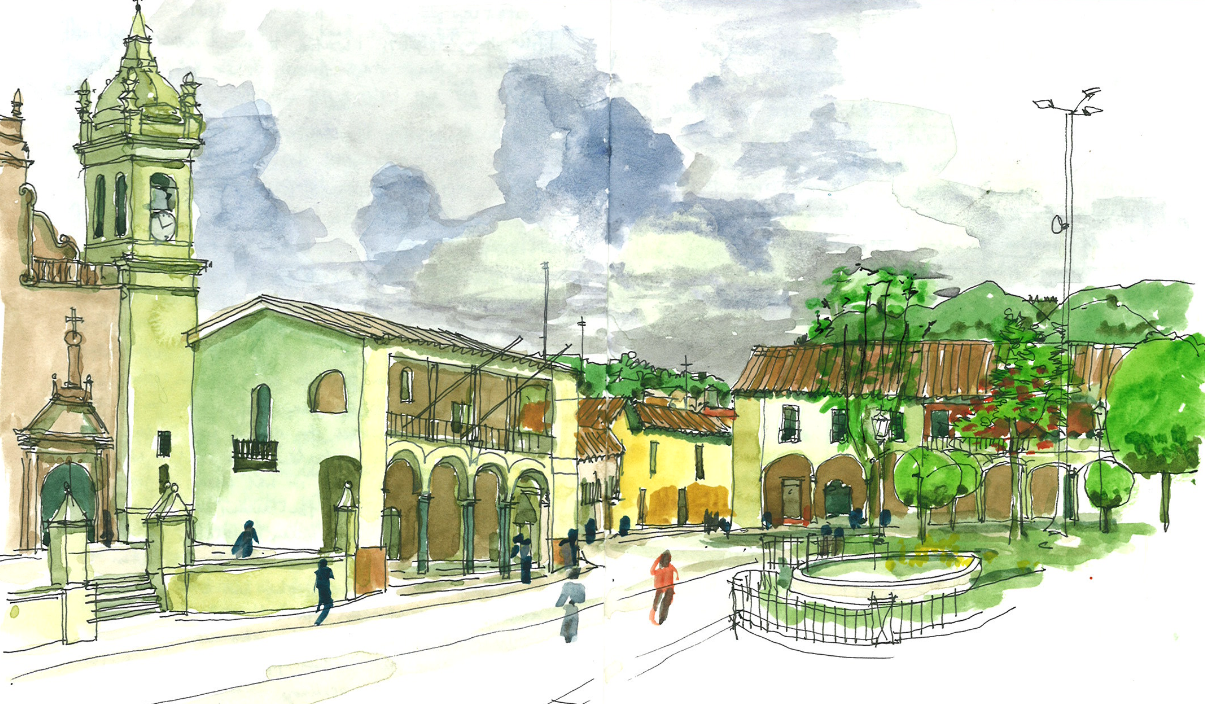
In 1987, at the height of the conflict, the Ayacucho Quechuan bible was first published but because of the upheaval and migration over the years, this had to be fully revised and republished. It was dedicated in May 2013 . Those who were there at the dedication describe it as a very moving scene, when massed choirs approached the city square from four corners and thousands joined the celebration, among them, many who had lost family members in the war and who had come through great suffering. I wanted to see the site of the ancient battle. I wanted to walk down those streets. I wanted to be in that square.
Arriving at the bus station that morning my thoughts, however, were not so much with the history and the events that unfolded in this place but with how dreadful I felt. This was brought on partly by the overnight journey and partly on account of the altitude. I was told that when you arrive at altitude the first thing you should do is nothing: no lifting, no walking and no work, just rest, for half an hour or so to allow your lungs to become accustomed to the thinness of the air. I wanted just to sit, but my companion was insistent that we find a hotel first of all. So we took a taxi to the city and called on a few dubious establishments. Each was regarded, by my companion, as too expensive so we searched for other equally disreputable places. Finally she settled on one. It was very tawdry, lacking linen, towels, soap, toilet paper in fact just about everything you would expect in a hotel, apart, that is, for a bed and a remote control for the TV. I was past caring. It was somewhere to rest. I threw myself on the bed and passed out for an hour or so while my companion went looking for a friend she knew. When she returned she had found somewhere better so we paid off the man behind the grill and left. The other hotel was luxury by comparison. But there was something more. The place had an atmosphere. It was hard to describe. Perhaps it was the little things that make up the whole, perhaps it was the way the staff went about their business, perhaps it was just fancy, but it felt a good place to be. My weariness had quickly evaporated and had been replaced with a surprising sense of well being and excitement at new discoveries. I was introduced to the owner, a man in his early seventies cheerful, warm and friendly and later, to his daughter. She ran a small clinic from some small rooms within the hotel and was the first and only person that I met on my trip who spoke English. She was Quechuan and was fluent in four languages. She studied in Brazil and the UK but her life’s work was as a medic among the desperately poor villages that surrounded Ayacucho. For seven years she had worked to provide proper sanitation in this region and was able to witness the astonishing improvements to health, particularly amongst children. Previously there was a very high level of infant and child mortality due to contaminated water supply. We had just met, but I felt I had known her all my life and I had this strange conviction that I had come here for a purpose. She spoke about a clinic she ran in a town outside the city and asked if I would like to see it. It was in Quinua, the site of the battle and a place we had actually planned to visit. Immediately we went looking for a combi bus to take us there.
The village is about an hour and half by combi and much higher up in the mountains (3,300m). Above the village is a large impressive plateau. You can stand here and look out across the valley, down to the city with the Andes circling around and that wonderful gasping sense of space and scale and beauty and the crystal clearness of the air like the purest water you drink or the finest wine. It had all the beauty we associate with the Scottish highlands but on a far far grander scale. At the edge of the plateau is a rather ugly obelisk, a memorial to the battle that was fought on that field. Inside there is a small museum telling the story of how the loyalists in red were defeated by the rebels in blue with the help of the local rural population wielding pitchforks and axes. A young boy acted as our guide and explained the significance of the various artefacts. After some hours the sky began to darken and we knew that rain was about to fall. This was the rainy season after all. We made our way back down to the village and reached the market just before the clouds burst open and heavy rain descended, loading the thin tarpaulin roofing sheets and scattering waterfalls in arbitrary directions. Lunch of cuy (guinea pig) rice and beans was followed by a look at the work of the artisans and their famous pottery.
The clinic is in the centre of the village: a single storey building, up from the road, typically concrete and bricks, and incomplete with reinforcing rods stretching to the sky. Our friend was in the middle of a consultation, so we took a seat in the waiting room. It was the same room and we could hear the discussion that was going on, although busy with our own activities, my companion checking on facebook and me scribbling notes. Quite suddenly, the conversation stopped and there was silence. I looked up. There were three medics, the patient and a relative around the table. All heads were bowed and there was prayer for the situation with the words, I heard many times, “nothing is impossible to God” When I remarked on this to my companion afterwards she was surprised. “Would medics in the UK not pray for their patients?”
Most of the building construction I had seen, apart, that is, from the major public building and the malls, was shambolic, unfinished and in a permanent state of disrepair. The clinic was no different but here the situation was much worse. The actual construction was poor. It wasn’t working. Two columns, hastily inserted in one of the rooms to save the concrete roof from collapsing, bore testimony to this. The junctions between the various parts of the building allowed water to drip down the walls of every room with dark damp stains turning green. Amongst the faded health posters and basic facilities it was a most depressing scene. On the concrete roof in among the debris of water tanks and make shift solar panels, we talked about the work. The need for the clinic was obvious. It was the only one. The government did not have the resources to provide anything here and so it was left to voluntary agencies to run and support this work. It often boiled down to knocking on doors to find someone who would help. The people themselves were desperately poor. Added to this was the spectre of domestic violence and the migration of young people to the cities often leaving the old people to die in desperate conditions with poor shelter. This was the summer and it felt quite cold. I shuddered to think what a winter would be like in these open concrete dwellings with tin roofs and no insulation. While our friend was describing the terrible conditions of these people and their basic needs, she broke down. I felt so helpless. I was a passing visitor a fleeting stranger. What could I do? I wanted to get out my height rod and measure up. I wanted to draw up sketch proposals for accommodation and improvements to the building. I wanted to get the materials, gather some workers, pick up my tools and get started right away. All I could do was to show some sympathy, buy some gifts from the craft shop and leave.
On the final leg of my journey home, all the experiences and memories were cluttering up my mind. They were too many: too many people, too many situations, too many memories to make any coherent and consistent sense of what it all could mean. As the miles and time and climate and language passed and moved into more familiar territory, the idea of helping with the clinic seemed nothing more than the craziest of ideas, an interesting interlude, a story to tell. The realistic possibility of it becoming a serious project, one that I could be part of, seemed more and more fanciful. After all it was in a remote part of a country in the southern hemisphere, on the other side of the world, it was three languages removed, it was among a different people and in a completely different culture. I had learned too much about the disasters that happen when people with misguided zeal blunder into situations to help and leave, having made it so much worse. Yet something niggled and it still does.
I came to see the place of so many memories but left with a memory of a cry of desperate need. One that would not go away.
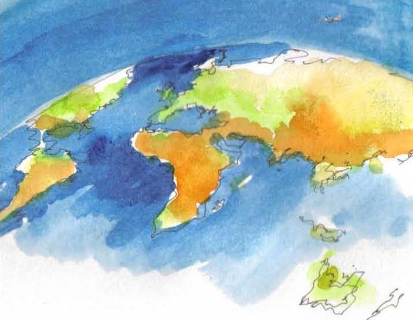
Tomorrow morning I will be joining the long queue, shuffling through the cattle pens, waiting for inspection before committing myself to the belly of a giant silver bird on a long haul flight across the sea. When I have travelled before, it has been to the east to Europe, Israel, Nepal and China, or south to Zambia. This time I am flying across the mighty Atlantic to the western edge of the “New world”, to Peru. It was an idea half conceived more than 40 years ago and inspired by a friend who on completion of his studies began his life’s work of translating the bible into indigenous languages of the Andes, principally into Quechua the ancient language of the Incas. It, of course, begs the question “Why would you devote your life to translating a book into a relatively obscure language?” But to ask the question, itself, misses the point, or rather two:
The first is that the bible is not a book but contains all that we need to know about God, ourselves and the cosmos, the starting point for all other explorations. It is the “Word of God”. It communicates what God has to say about who he is and who we are. It is not, in one sense, easy to understand, but like a giant picture with extremely fuzzy edges, (read some of what is said in Genesis and in Revelations for example) when you focus on the centre: moving from all the people to one people, to one person, to one life of 30 years, and specifically, to three days at the centre of history, then its cosmic relevance is revealed.
The second is that, while it is bedded in the culture and language of the period, in which it was written, it transcends these. While it is rooted in real time in history, it speaks to all time. While it begins in the specific geography of the Mediterranean lands, its impact reaches across the globe. While it was inscribed in Hebrew and Greek, it is read and understood in thousands of languages. It is not difficult to see the significance for a Quechua speaker in the high Andes, being able to read the bible for the first time in his own language rather than in the language of the foreigner or possible oppressor, in the same way that native Gaelic speakers were able to do the same in the early ninety century in Scotland. The pragmatist would say “why bother? If you want to read the bible, learn English or Spanish or Latin or Greek”, but that of courses misses the point. God speaks in words and pictures we can understand. God is speaking and he speaks to me, right into my situation, now, in my mother tongue.
But I have other reasons for travelling. My early fascination with the Incas made me scour the library for every book I could find on the subject and I poured over John Hemming’s “The Conquest of the Incas” I even had a strong feeling to travel and work in Peru and made pathetic attempts to learn Spanish, through a linguaphone course, which had to be donated to the library after a few months. Years later a young Peruvian man from the barrios in Lima came to stay in our home. He had volunteered a year of his life to help in the local church and community and it was not long before everyone, young, old and in between, took him to their hearts and thought the world of him. He brought and gave so much it would be hard to put into words what we learned from him. When he left he was sorely missed and he still is. As we parted at the airport on a grey Edinburgh day, I expressed the hope that sometime soon I would be able to come over and visit. Now several years later that hope is being fulfilled.
As I make my final preparations: thinking about the ancient Incas, their incredible story and anticipating seeing the amazing sites at Arequipa, Titicaca Cuzco, Ayacucho and Machu Picchu, thinking about the long awaited reunion with my friend, meeting his family and church and seeing something of his life in Lima and thinking of the stories we will share, I can’t help feeling that the story which will eclipse them all will be the one about bringing Gods word to all peoples.
We arrived in Aberdeen in mid-November in the late fifties. To children brought up on a tiny Scottish island with a tinier population, it was an experience to shake the senses. Save for a twice weekly ferry bringing already stale bread and margarine, an out of date “daily” newspaper bound into a weeks’ edition, a hit and miss wireless set and limited telephone lines, we were isolated from the rest of the world. Now we were in a city with thousands of people. There were cars and busses, street lights, TV’s with moving pictures, restaurants and shops of all kinds stacked with toys and sweets that made our eyes jump from their sockets. There was the constant noise of the trains in the nearby marshalling yard and the hum of traffic and people walking and cycling, moving to and from work. Amongst it all was an enduring memory: the Christmas Eve watch night service.
It was magical experience. Being allowed up so late was exciting in itself. Our normal journey to church would be the mile and half on foot, but on this occasion we were carried in a taxi and dropped off at the church with both doors swung open pouring golden light into the dark street and casting shadows from the great piles of snow at the side of the pavement. We slipped into the high polished pews squeezed close between the men in heavy winter coats and women in furs and hats and gazed in wonder at the twinkling lights in the enormous Christmas tree. As the service began, We were led in rousing carols by the minister directing, dancing and urging us on to greater strains from the bold and joyful “O come all ye faithful” through the ballads of the shepherds and the wise men to the sweet and lyrical Scottish and Irish carols. From time to time a figure would appear from behind the tree to read from the timeless story and a soprano would sing in unaccompanied solo “In the bleak midwinter” with the startling our “God …heaven cannot hold thee” and then as it came close to the hour, the lights were switched off, one by one, and we were left in the soft light of the Christmas tree. Without words to look at we sang from memory: “Still the night”. It was when we came to repeating the final line of the second verse “Christ the Redeemer is here” it came to me in a way that is hard to describe or explain, but I knew it was true. He was. Christ the Redeemer was here. To a young mind overwhelmed with the magic and beauty of it all and, as yet, ignorant of the twists and turns that life would so quickly throw our way, it was a moment when I truly believed. 50 plus years later, I still do. It was true then and it is true now.
We didn’t notice the less than subtle hand that reached out from behind the tree to press the Grundic tape recorder and allow the Christmas morning to be announced with the chimes from Big Ben. But it didn’t matter. We were singing our hearts out and, with our loudest voices, rising in crescendo on “Hark the herald …Glory to the new born King”
I was asked to review a book recently. It was not for publication or distribution but a friend, who I care about, had simply asked me to read and comment on a book she had read which had made a big impact on her. She didn’t say if the impact was negative or positive, so I was given a clean slate and approached it with an open mind.
I have to confess that I don’t read a lot and am amazed by friends who can devour several books in a day, who carry a pile with them on holidays and have their kindles loaded up with, what seems like, whole libraries. The little I read tends to be more in the non-fiction than in the fiction section and I often re-read books a number of times. I am also a slow reader. My English teacher, at school, tried to teach me to skim read but I never learned and now I don’t want to. I prefer to savour the language and the thought and to remember the phrasing and give time for the ideas to sink in. So this was a special and a tough task.
The book was not new. It was first published in 1995 and is reputed to be an international best seller, but it was one of the worst books I have ever read. The writer claims to have had a revelation or series of revelations over some years, directly from God, in which god speaks in everyday language with words of wisdom, stories and humour, contemporary references and many quoted words and verses, mainly from the Bible. But unlike other recognisable forms of literature, with parables, myths and allegory etc, this writer clearly wants the reader to believe that it was in fact God who was speaking directly to him. This is made clear in the introduction. “It happened to me” he says “I mean that literally” and “it was for everyone and had to be published”. He describes it as “gods latest word on things”. Now I have known and heard of many people who claim to have heard God speaking directly to them and I have no reason to doubt that these have been true and real experiences but, in each case, God was speaking to the individual and usually over something specific like a decision or a direction or a calling. In this book, the writer maintains that God is not only speaking directly to him but charges him with telling the message, spreading the word to others and specifically to do this by writing the books, of which there are three. “You will make of this dialogue a book, and you will render my words accessible to many people. It is part of your work” If he is to be believed and if he is accurately reporting what God was saying, then the Bible is deeply flawed from beginning to end and Jesus was either deluded, mad or simply a fraud.
It would not be difficult to catalogue the ridiculous, bizarre and contradictory claims that are made throughout the book, but here are just some of them:
1) There is no right or wrong only love and fear
2) God is not the creator he is merely the observer
3) There was no such thing as the ten commandments
4) There is no sin
5) There was no need for sacrifice
6) There is no heaven
7) There is no hell
8) There is no devil
9) Self is all there is
10) We are gods or in the process of becoming gods
11) Jesus is a master on a level with Krishna and Buddha.
12) All the gospel writers lived and wrote their accounts long after Jesus had died
13) We only suffer because we chose to. At any moment we could stop suffering. We could be healed, we could be perfectly at peace and happy if we chose to be.
I can well understand why people would be drawn to this book especially if they have been hurt, disillusioned or damaged in some way with organised religion. It would make them feel better about themselves but so would morphine or heroin or alcohol, for a time. The book is poison.
On the cover, were a number of review quotes. From the Mail on Sunday; “An extraordinary book“ I couldn’t put it down”.
It was extraordinary; I couldn’t get it into the bin fast enough.
We gathered together in the corner of the lounge, a bare handful of people in a dark and depressed November evening, mildly weary and tired, busy with lots of other things on our minds and with the unspoken question “what on earth are we doing here?”. It was a congregational mid-week meeting for prayer, a centuries old tradition, the reputed “power house” of the church and we had come with a dogged commitment to something we believed in even although at times our enthusiasm and our sanity was seriously in question. Our pastor led us and read from Paul’s second letter to the Christians in Thessalonica. Specifically, the final catalogue of practical advice in the last chapter “Always be joyful and never stop praying. Whatever happens, keep thanking God because of Jesus Christ. This is what God wants you to do.” (CEV). It was something so beautiful and simple and intensely practical. It was one of these moments when a shaft of light suddenly breaks through into the gloom and disturbs the moribund weariness.
I got a response from my MSP this morning. It was slow in coming but detailed, reasoned and courteous all the same. I know him and he is a good guy. But it told me what I already knew. He had made his mind up and would not be changing. He would be voting for the bill when it comes to parliament. It was a matter of justice, of equal rights, of inclusiveness and while those with “deeply held beliefs” would be respected and would be protected in law, there was no going back.
For a long time now we could see it was a done deal, as the leaders of all parties were in line on this issue and the voices against restricted to a small minority, it was inevitable that the legislation would pass into law without a hitch.
Looking back, you cannot but be impressed by the way those agitating for same sex marriage went about their campaign. Any group wanting to change the way society works could learn much from it. It was planned and executed with great skill and meticulous care. First the population had to be softened up and this was done with the introduction of civil partnerships. Once this act was safely embedded in, then the main campaign could begin in earnest. An early tactic was to change the words from “same sex” to “equal”. It was so simple, clever and effective. No one could be against equality. Next, the pre-emptive strikes on anyone who would dare to oppose the change- witness the ferocious attack on John Mason for having the temerity to suggest that no individual should be forced to approve of same sex marriage. But the real weapon was the threat of the “H” word (homophobia). This weapon, more than any other, strikes fear into the heart and, the mere possibility of its use, silences the opposition and turns nerves of steel into quivering jelly. With the public softened up, the lone voices ridiculed and the sensitive cowed and intimidated, there remained the rump of the opposition in the shape of the church and the mosques. Here the campaign was handed a series of gifts. An alliance of disparate religious groups (Unitarians, Quakers, Pagans, and Liberal Jews) lead by a celebrity cleric the former bishop of Edinburgh declared their support. The Church of Scotland dithered, wobbled and fudged their way through consultations, commissions and debates and the Roman Catholic Church in Scotland, while stoutly defending the case against all odds, was effectively torpedoed with the disgrace and demise of its leader and most vocal advocate. Pockets of resistance remained in the Muslim community and the evangelical church but astonishingly, in the later, cracks were beginning to show. Many evangelicals spoke of not coming to a settled view on the issue. Well known media evangelicals like Tony and Peggy Campolo could parade their doubts and uncertainties in a series of presentations disguised as a “dialogue” . The lack of any clarity was all that the campaign needed to push home its advantage and secure the victory. It was a campaign of breath-taking boldness, and speed and one of which NormanSchwarzkopf would have been proud. The instigators will be mighty pleased that it was carried off with such aplomb and in such little time. It is now left to the people of Scotland, to our children and their children, to come to terms with the reality of what this will in fact mean. For it is abundantly clear that none of the protagonists have the slightest idea of where this might lead or what they have so casually unleashed.

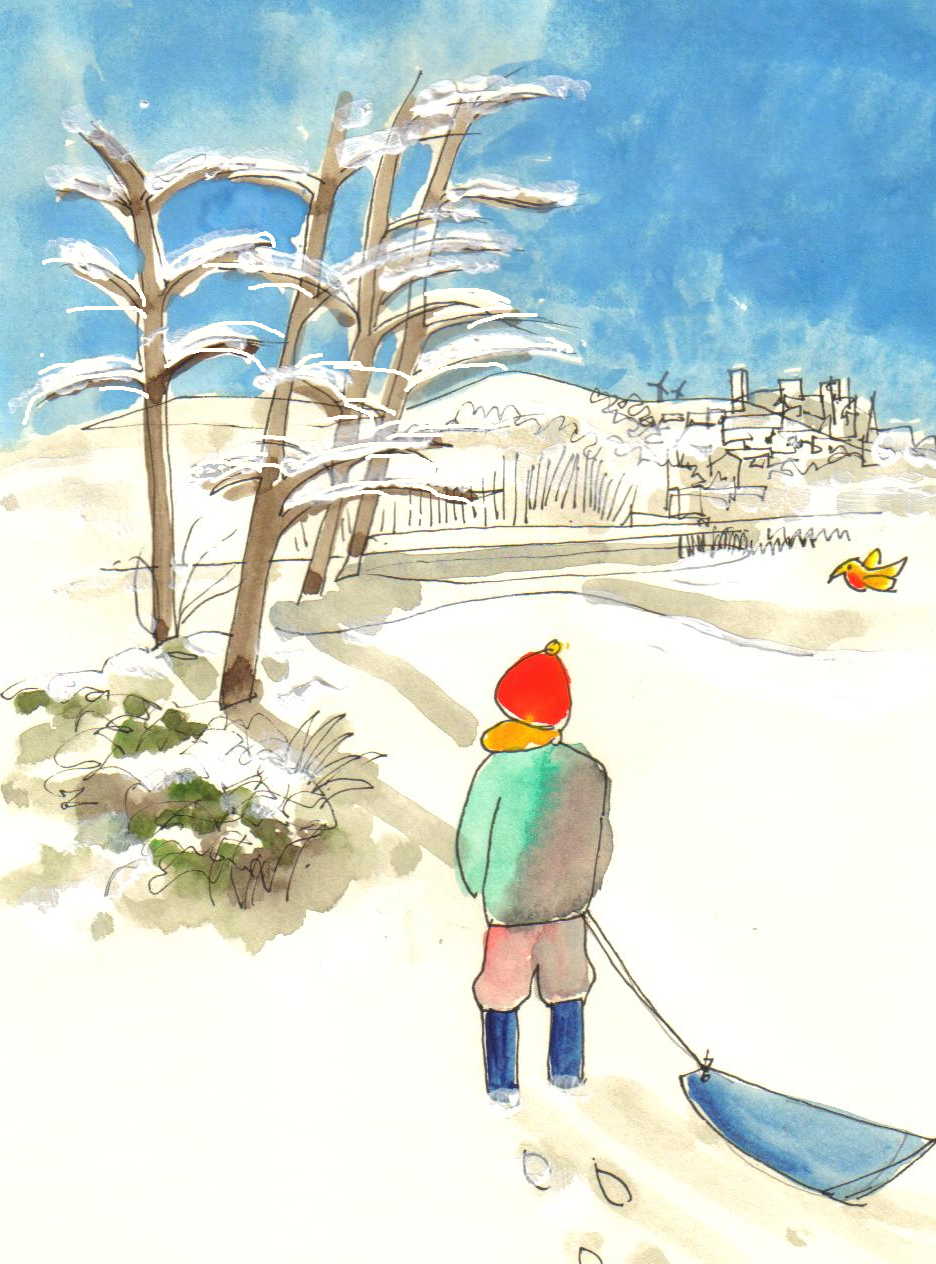
 Restless Spirit