PRECIOUS AND BEAUTIFUL THINGS

THE PAINFUL REALITY

It was not how I had it planned. It was not the way it was meant to be. I was to be first. When the evil mass took hold of my liver three years before and left me surrounded with doctors and nurses in full-on emergency gear, trying  to keep me alive, I was convinced that this was it. But it was not to be. With their skill, the prayers of the people and the good and gracious hand of our God, I survived. But later, later that same year, the cancer made its presence known in her body. From then it continued its sinister and relentless pincer movement throughout her delicate frame, spreading its tentacles to the most important organs, till there was nothing left that could be done.  The painful reality had to be faced, it was just a matter of time. Despite the treatment, the chemo, the radio, and immunotherapy, this thing inside her was slowly killing her and it would not let go.

HEARING BUT NOT LISTENING
I had three years to prepare for this event, but I wasn’t prepared. Even when the consultant told us it was weeks rather than months, I wanted to scream out in disbelief. Yet she knew and she tried so hard to tell me, to prepare me, to help me see, but I wasn’t listening and I didn’t see. It seemed like the cancer had been kept at bay. Life was as normal, nothing had changed and we could go on like this for years, maybe even decades. Yet she knew, she was right all along and I was wrong.

Nobody had told me about it how it would be or how I would feel. No one had explained to me what bereft actually meant. But, the thing is, they had, in words, in books, in poetry, in songs. It was all there it was just that I hadn’t listened. I couldn’t hear. I even wrote these songs myself. Ten years ago I wrote a song about bereavement through the seasons, but I never knew what it meant until now. I remember reading Bob Dylan’s comments on songs on one of his early album, which were preoccupied with death. He said he was too young to write songs like that, so they must have come from somewhere else.

THE EVENINGS
In the evenings, when we are alone and nothing else was happening, we would read the bible, with a devotional book someone had given her and we would pray together. It was a practice that was fitful at best throughout our married life but became a regular habit in the later years. It made me so happy. Each time I heard her pray, I cried. It was in the evening too, that we talked. We talked about the things we did that day and played the game “ Guess who I saw in town today?”  A song by John Sebastian of the Lovin’ Spoonful came to mind. It was written back in the sixties and called “Darlin be home soon”. The recording seemed a bit cheesy, even at the time, but the song got to me then and strangely it came back to me now, with the opening lines “Come, and talk of all the things we did today/Hear, and laugh about our funny little ways..”   It occurred to me too that this was what happened in the garden. It was in the evening of the day that God came and walked and talked with Adam and Eve. It is in the evenings that I feel most bereft.

HOW SHORT HOW SHORT

It all happened so quickly in the end. Sunday, we were sitting out having lunch in the garden. Monday brought an emergency GP appointment and a swift referral to the oncology ward. She was visibly relieved to lie down on that bed and be surrounded with the care she needed.  By the Wednesday evening, I was so exhausted and distracted, she pleaded with me to go home and rest. On the Thursday morning, I was taking notes with her instructions of things to do that day, while she was messaging people with arrangements for a meeting in the following week. It was a busy day, people were coming and going and I had now grasped that time was short. I resolved to be awake when I returned in the evening and to make sure that I packed my bible and the book. When we were alone in the stillness , when the buzz of the ward had quietened down, we could read and pray together, just as we had done before. But it was not to be. By lunchtime she was gone.

THE EMPTY HOUSE
When I opened the door of the empty house for the first time, I was hit with the banal absurdity of it all. What was this place now for? What was the point of it? It was our home, now it wasn’t. It was my “stop all the clocks” moment. There was no need for this anymore. The newly decorated room, the restored windows, the Morris paper, the walnut floor, the Louie Poulsen lighting, the hand-crafted kitchen the carefully selected colours and fabrics, they were all about a place, our home, where friends and family from far and near would be welcomed, to share a meal, a rest for the night or longer. We wanted to be like the Shunamite woman who had a room with a bed, a chair, a table and a lamp for the prophet Elisha when he passed that way. Now it’s purpose has dissolved and I don’t know what to do.

THE OBSERVATION

Too soon, much too soon I read again C S Lewis’ “A Grief Observed”. It was brutal: grief was being like a “rat caught in a trap”, the bereaved were such a problem, maybe “they should be isolated in special colonies like lepers”, God must be a “giant vivisectionist” and worse. But he works his way through all of that in the most astonishing way. He climbs through the self-indulgent grief the self-pity, the flawed images and the house of cards to finally seeing “ I need Christ not something that resembles him” I hope I can get there.

THE PRECIOUS AND BEAUTIFUL THINGS
I love the proverb in the Book of Proverbs 24:3+4 partly because of its architectural reference. It goes: “By wisdom a house is built/By understanding it is established/By knowledge the rooms are filled with precious and beautiful things”. Together we built the house, she filled it with precious and beautiful things and the precious and beautiful things were people. My task is to cherish these precious and beautiful things.

FIRST THEY CAME FOR THE LANGUAGE

If you want to make something distasteful into something more palatable, changing the name helps a lot. It might not be etymologically correct, but if you get it accepted in everyday discourse your battle is pretty much won. You can change people’s view of something by changing the name. That has long been the case. We used to build large tower blocks and call them “courts” which they never were, but it sounded better to live in a court than a tower.  Killing civilians in wartime didn’t seem so bad if we called it “collateral damage”. Same sex marriage could get over the line if we called it “Equal marriage”. If you are pro-abortion a “foetus” sounds better than an expected baby. You know how it works. Flipping it the other way, also works.

Nothing epitomises that more than the media and governments inversion of language when it comes to the current war in the Middle East. Here you have a whole slew of descriptive words that have not only drifted from their original meaning but been upended and become part of almost everyone’s conversation. Our language has been so massaged that we end up adopting terms that bear no actual relation to reality. The power of the media with its subtle infiltering of a mindset pulls us into the absurd situation, where we find ourselves believing something which is manifestly untrue and the simplest of investigation would show it to be so.

Images play a big role here.  The manipulation is clearly effective.  People will protest  “We have all seen the pictures daily on our screens” without a second questioning if what we see on these screens might not actually be true.  We have this strange ambivalence to the visual image, be it still or moving. We have no trouble seeing videos of Putin and Trump romping around on sledges in the snow and hugging polar bears in Alaska, knowing that they are fabricated. At the same time, we are convinced that a picture of an emaciated child in the rubble of a building, tells a true story. A story of deliberate mass starvation, even when the picture in question, featured on the front page of the New York Times is completely false, as the paper later acknowledged.  It was too late, of course. The picture was false but the narrative was believed.  

You know the words: ethnic cleansing, starvation, indiscriminate, massacre, apartheid, and genocide. These are universally used across the board and accepted as fact without question. When I hear the media use these words in the context of Israel’s war against Hamas, I realise they are speaking a different language from the one I know. In their classic usage they bear no resemblance to reality and are an inversion of it. It makes it hard and pretty much impossible to discuss or engage with the issue in any rational way.  When the common language is lost, we are left with shouting, name calling, flag waving, flag burning and the babel of hatred, with Jackboots waiting in the wings.

First, they came for the language, but it was only words, so I said nothing.

IT’S NOT DARK YET BUT I’TS GETTING THERE

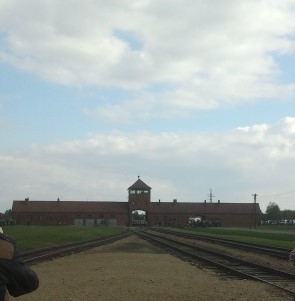
I fully identified and completely understood King Charles, some weeks ago, when he was confronted with the pitiful pile of children’s shoes, on Holocaust Day, and said it was something he would never forget. I had visited the holocaust gallery at the British War Museum and the Yad Vashem remembrance centre in Jerusalem, but it was being in Auschwitz, Oświęcim in 2012 that did it for me. I saw the railway carriage, the mountain of shoes and false teeth, the bullet ridden wall, I stood in the chamber with the ovens when the young Polish guide asked us to be silent out of respect for those who were incinerated there and I stood at the end of the rail line, when she told us to be careful where we stood, because the ground was covered with the powdered bones and dust of the million souls murdered in this place. It was April, but there was no sign of Spring. The trees were dark and bare and there was no bird song to lighten the awful silence. The bottom dropped out of my stomach and I realised then, in a way I had never understood before, that there was no end to evil. Given a free reign, evil in the human heart descends further and further into an abyss of total darkness. It was like looking over a pit and knowing there was no bottom. Any faith I had in humanity could never be recovered. I too would never forget.

All these memorials are helpful but we really don’t need reminders. We saw it, just this week, on full display to all the world, the abomination of naked evil. The choreographed parade, the giant displays, the stage, the mock signing of documents, the celebrating crowd, the cameras and in the centre the bodies of the murdered family, the mother, the nine year old son and the four year old child lying on the platform locked in black coffins. All was black and grey even the sun couldn’t bear to look at the scene and hid it’s face. The sky was embarrassed. This too I will never forget.

The holocaust, however, was then. This is now. That was our “never again”. This is the now reality of evil. There can be no rational, political or sociological explanation for the utter depravity on view. And its roots are in the oldest of hatreds morphed, as Jonathan Sachs lucidly explained, from hatred against the religion through hatred against the race to hatred against the nation and it comes from the very pit of hell.

The main-line news has to sanitise their reports, of course. It has to fit the narrative and so every effort must be made to soften the impact and whiten what is, in reality, irredeemably black. They don’t show you the crowds of men, women and children, some in their father’s arms, shouting cheering and singing over the bodies of the murdered children and later dancing on the stage as if it was their graves. This is a new level of wickedness. The Nazis’ tried to hide their crimes, here they are openly celebrated. And this is what is truly sickening.  When, what looks like, ordinary folk with families of their own, taking part, joyfully it seems, in such a macabre spectacle, any sense of humanity goes down the drain. And I wonder if those who protest on our streets every Saturday actually know who they are supporting.

Terrible as it may sound, I have no faith in humanity. If I had, I lost it and nothing could restore it now. But I do have faith in the one who created humanity, who became humanity, who lived perfect humanity and by his sacrifice made it possible for us unhuman: murderers, liars, cheats, mockers idolators, adulterers, abusers, thieves, slanderers, swindlers, or just decent folks to be made truly human, in him.

HISTORICAL GUILT

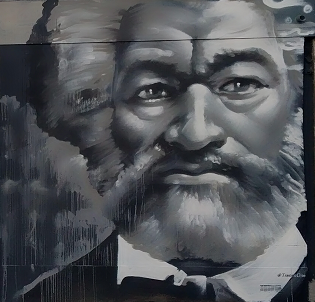
The denomination to which our local church belongs recently found it necessary to carry out an audit and examine what links the church may have had with the Trans-Atlantic Slave Trade.  As a relatively newcomer in the denomination, I was unaware of the controversy, that dated back to the early days of the church, which was founded in 1843. What at first was puzzling was that Slavery had already been outlawed in the antis-slavery act ten years earlier (though this only covered part of the British Empire) and it seemed strange that the church could be complicit in slavery when it was still unborn.  The reason for the controversy, however, was explained, by a visit which a delegation from the new church made to the American South in 1846. This group which included Thomas Chalmers were seeking the support of churches in America and you can understand why a secessionist movement would get a great deal of sympathy in the South. The delegation returned with a not insignificant gift of £3,000, but many within and out-with the church considered this money to be “tainted” as it likely came from slaveholders and a campaign to “Send the Money Back” was initiated. Fredrick Douglas, the abolitionist, was a strong and vocal advocate for the campaign, and lent his support while in Scotland, which included an attempt, with others, to carve the slogan on the cliffs of Salisbury Crags. His portrait now graces a wall in Gilmore Place, close to where he once lived. But the “blood money” was never returned. How the church resolved this at the time, I am not sure, but I suspect that a degree of pragmatism was involved. Even if an error was acknowledged, returning the money would not have helped the cause of those still enslaved in any practical way.

But why, more than 150 years after the event, the issue has now had to be revisited?  It seems strange in the extreme. Afterall, the history of these events has been well known to the church and this assessment could have been done at any time. Why now?  And why is that while the history of this hideous trade has been taught in school and accepted for what it is a heinous sin in our nation’s history, one on which there was national admission of guilt, repentance, the passing of anti-slavery laws and the costly efforts to have the trade banished world-wide, why now is there to be a another reckoning? 

Is it simply to do with the way these things come in waves in the public consciousness?  I remember in the 60’s the campaign for nuclear disarmament was a very hot issue, but strangely over the following decades, despite increased proliferation, the issue slipped into the background and only resurged again in the more recent decades. I remember one of my colleagues in our Architectural practice back in the early 70’s arriving at the office one day sporting a CND badge. We thought that rather quant at the time.

Could it be the very subtle infiltration of a way of thinking that owes more to Marx and Lenin than our Judeo-Christian heritage? A way of thinking that views the act of de-humanising another human, made in the image of God, not so much as a sin but simply part of the worldwide class struggle? The never-ending battle between the oppressed and the oppressor, the powerless and the powerful, the victim and the victimiser.  Guilt is not so much personal but historical and in Marxism there is no forgiveness. Czeslaw Milosz, in his classic work “The Captive Mind” which must stand alongside works by Orwell, Solzhenitsyn and Havel in exposing the depravity of totalitarian culture, explains this succinctly in a chapter entitled “Man- the enemy”. Here the real enemy of the Marxist-Leninist project turns out to be humanity itself.   

“The contradiction between Christianity and Stalinist philosophy cannot be overcome. Christianity is based on a concept of individual merit and guilt; The New Faith on historical merit and guilt. The Christian who rejects individual guilt denies the work of Jesus and the god he calls upon transforms himself into History”

The enemy then is the reactionary.

“The sin of the reactionary is argued very cleverly: every perception is orientated, i.e. at the very moment of perceiving, we introduce our ideas into the material of our observations; only he sees reality truly who evaluates it in terms of the interests of the class that is the lever of the future, i.e. the proletariat. The writings of Lenin and Stalin teach us what the interests of the proletariat are. Whoever sees reality other than the proletariat, sees it falsely; in other words, his picture of reality is deformed by the pressure of the interest of classes that are backward and so destined to disappear. Whoever sees the world falsely necessarily acts badly; whoever acts badly is a bad man; therefore, the reactionary is a bad man, and one should not feel sorry for him.”

So you can feel indifferent to the sufferings of those whose only crime is the blocking of “historical progress” and Milosz concludes :

“This line of reasoning has at least one flaw – it ignores reality”      

But I suspect there is also another reason. It is much easier and less troublesome to focus on vague historical communal guilt and show virtue over our passion for the sins, than it is to confront the brutal reality that slavery exists today. Added to that is the disturbing thought that we could in some way be complicit in and benefit from it.

My contention is that instead of wasting our efforts, handwringing and agonising over the crimes of the pasts, we should be grappling with the brutal reality of slavery today. Instead of exhuming skeletons, historic crimes, which have been acknowledged and confessed, which have been forgiven and forgotten by God, we should apply ourselves to the very real live suffering of others. I am thinking of trafficking of children, the sweat-shop factories and the mining of toxic minerals. Minerals, which are necessary for the production of our mobile phones, electric cars, and all sorts of devices, including the one that this is written on.

Crawford Mackenzie

LOVE AND HATE

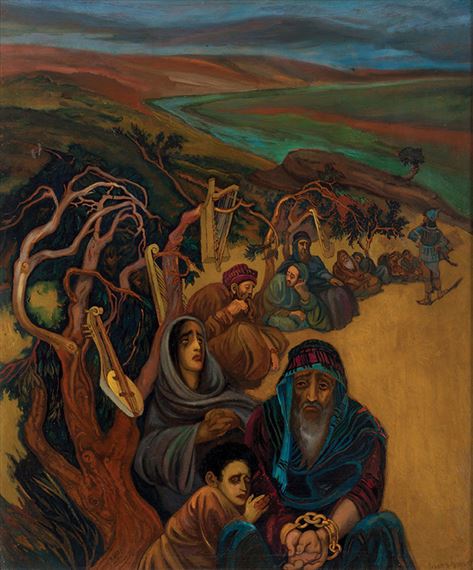
By the rivers of Babylon Saul Raskin

In our local church family, we, in common with many other churches, have several small pastoral groups that meet each week in individual homes, where we read and study the Bible together and pray for each other, for the church and for the world.  It is a very special time, with a wide range of ages experiences, backgrounds and stages in life, but with a common love for the lord Jesus and a bonding that transcends all human barriers.

We have just begun a short series of studies in the Book of Psalms in the Old Testament, not individual psalms but particular themes that run through this collection which deals with almost every human emotion: joy, loneliness, honesty, remorse, sadness, fear, anger.  In this we have been helped by James Montgomery Boyce, David Taylor, John Day, Gordon Wenham, Erich Zenger ,Derek Kidner and C S Lewis.

Inevitably, we will have to consider the Psalms that include cursing, of which there are many. Something like one-in-five have calls for vengeance or cursing in some form or other, with Psalms 58, 109 and 137 being amongst the most terrible. Throughout the centuries these have been a problem to Christians and it is not difficult to see why. They are also often quoted by those who argue against the divine inspiration and authority of scripture as reasons why we cannot believe in the bible. “How can we take the bible seriously” they will say, “as it is full of so many contradictions”. A good friend of mine, only the other day, said just that and gave this as the reason why he had stopped reading it. The authority of the bible was subject to a higher authority, in his case, that of his own rational mind. So, It is really only a problem for the Christian who believes in the authority, authenticity and inerrancy of scripture. For those who don’t, it should be of little interest or concern.

But here I have a disturbing thought. Could it be that the reason why Christians find these words, expressing outright hatred and white-hot rage, problematic, is that the problem is with us? Could it be that there is something about this God we are missing and just not getting? Could it be that we have not really grasped the absolute horror of evil, the heinousness of sin and where it inexorably leads? Maybe we haven’t stood by the remains of the furnace in Auschwitz and heard the guide tell us to be careful because we are standing among the dust of hundreds of murdered lives. Maybe we have never seen the heaps of bodies burning in Chin state in Myanmar. Maybe we have never been with the pastor visiting a village in the DRC, just a few months ago, and coming across the bodies of men women and children lying where they were shot with a single infant still alive in the arms of its dead mother. Maybe we have never recognised the corruption, deceit, selfishness and greed that knocks at the door of our own hearts. Maybe we still think the battleline between good and evil lies not in us, but somewhere out there. 

Christians, however, have coped with this “problem” in different ways.

One was simply to ignore the offending passages.  But that is hard to do, if you believe that “All Scripture is God-breathed and is useful for teaching, rebuking, correcting and training in righteousness”. So that doesn’t work.

Another is to see these expressions as wrong and should be condemned. Scripture includes many things that are wrong. David’s sin with Bathsheba being one. But that doesn’t really work either. because while David’s sin was condemned and he himself confessed it, the Bible, at no point, condemns the writers of these psalms for what they said or for the desire for vengeance which they expressed.

A third, which many have settled on, is the idea that these expressions belong to the Old Testament while in the New, Jesus and Paul have shown us a better way- how we should love our enemies, how we should bless and not curse. The Psalm writers under this explanation had a limited understanding of things and really didn’t know any better. But this falls too because love for your enemies was not a new idea or a new command. It is embedded in the Old Testament law and Jesus quoted the proverb which explicitly say we should feed our enemy when he is hungry and give him something to drink when he is thirsty. On the other side, Paul pronounced a curse on Elymas the magician and Jesus himself pronounced a curse on Israel.  So, we have love for the enemy in the Old and curses in the New.

What we found most helpful and illuminating when reading these psalms was to see what the writers were not saying. The writers of the three psalms listed above, who included David and the captured slaves in Babylon, were not describing their commitment to enact revenge on those who brutally persecuted them. They were not saying that they would exact vengeance and repay the preparators for what was done to them. The captives in Babylon, who had escaped the fate of the horrific siege of Jerusalem, the details of which are hard to read or stomach, were not expressing their own vengeance. Their appeal was simply to God for justice. And that is what it is about – Justice. The justice described in the Mosaic law – the principal of equal and just retribution.

Today, when we hear the cry of families of victims of vicious crimes, it is always an appeal for justice, justice for the ones they loved. That’s what they fight for. That’s what they demand from the courts and that is what they never give up on, because it is Justice that is at stake. This is exactly what the writers of the cursing psalms are doing, they are crying out for an equal and just retribution.  But for them the appeal is not to a human court, but to the highest court, to the Judge of all the earth.  And it is this act of taking it, in all its rawness, to God and leaving it with him, which at once, lances that boil, dissolves the rage, neutralises the anger and eliminates the personal desire for revenge. The outburst of outrage is more than just cathartic. It achieves something.

So, we have found, having taken these challenging passages, which sound pretty terrible to our ears, taken them head on, unflinchingly, we have found that they do not, in fact, contradict the law of love but they complement it and we see how the curses and the blessings, the love and the hatred stand together without contradiction.

CASTING CROWNS

What was astonishing about the funeral services was that in form and content they were thoroughly Christian, in a way that was strange and surprising.  Afterall, we live in a multi-cultural, multi-ethnic and multi-coloured society with many religions and a rich variety of allegiances. Why should prominence, on a national occasion such as this, be given to one? Why should the Christian religion have pre-eminence?  Was this archaic pomp and pageantry not something that we thought we had left behind and progressed beyond, an aberration, an anachronism? Where were the creative minds who could design something more appropriate and apposite to the spirit of our age?

We can only surmise that this was deliberate. In all the services, as far as I was aware, there was no nod or reference to other faiths or no-faiths or supra-faiths, the kind of thing we have grown to expect.   I suspect that this was not down to the clergy who sometimes seem to be mildly apologetic about what they were saying or reading. You can never be sure when someone is reading from a script and hardly glancing above the lectern if they actually believe what they are saying.  This is another conundrum, given this single and unique opportunity to declare the radical gospel of Jesus Christ, to possibly the biggest audience ever, something Billy Graham could never dream of, the, established church declared its allegiance, not to Christ, but to the establishment. As someone has said “The established church never misses an opportunity to miss an opportunity”.

From what we understand, the tone and content and even detail of the service may well have been a specific request by the late Queen. It was maybe exactly what she wanted. Being relatively shy and modest about her faith in life she wanted to say, in death, what she truly believed. 

What made it thoroughly Christian was not the homilies and tributes but the words, the scripture, the hymns and the psalms transported on the melodies and harmonies of some of our greatest composers from the lyrical singing of the Gaelic psalm to James Macmillan’s magnificent “Who shall separate us”. There was nothing faintly apologetic or reticent about them. In the hymns we had “All my hope on God is founded” exposing the vanity of human pride and the futility of earthly glory “Sword and crown betray his trust”. In the setting there was a lot of swords, as we were to see, and crowns too. There was the challenge to all people “that on earth do dwell” to “sing to the Lord with cheerful voice” and to everyone “Christ calls one and all to follow”. There was the prayer for the kindling of the desire to “work and speak and think for thee”  and there was the assurance that nothing can separate us from the love of God death nor life…and that “Goodness and mercy all my life, shall surely follow me/and in Gods house forevermore my dwelling place shall be”

There was a strange irony in all of this with the serried ranks of scarlet soldiers white hatted sailors, feathers and plumes, the world leaders in sombre black and the baubles looking very much trinkets but carrying the weighty symbolism of power and authority in the stupendous setting of the fan vaulted abbey. I wonder if the irony was lost on the congregation of the “Great and the Good” if the significance of the orb with its declaration that Christ is King of kings and Lord of Lords was understood or if they listened to themselves sing “Tower and temple fall to dust”

Now I don’t know, but I suspect there was nothing contradictory or conflicting in the Queens own mind as she accepted the passing of her own life, and in the final verse of the final hymn “Till in heaven we take our place/till we lay our crowns before you/lost in wonder, love and praise.” For her it all made sense she was simply a servant, and a subject of her lord. there was no contradiction in that. And there was nothing conflicting in showing the deepest respect love, kindness and genuine care for all of her subjects, whatever god they may worship, welcoming them wholeheartedly, while, at the same time, declaring without embarrassment or compromise what she believed was the true faith, the faith she had vowed to defend.

“But I am Free”

A HIDDEN LIFE

It is a week or so now since I watched Terence Malick’s “A hidden Life” but it still haunts me. It must be among the finest films I have ever seen. It moved me deeply. Like all great works of art it strikes in lots of different levels and like all great works of art it cuts to the core of things. It digs deep into the struggle of the human heart with what must be one of life’s greatest dilemmas.

James Macmillan has said that listening to music involves sacrifice, but watching a film like this involves sacrifice too. It is not the ticket price or giving up an evening but the demand to sit for three hours in silence and simply absorb the work in its entirety. Many may find the length and the apparent slowness of the action, the long scenes and the minimal dialogue wearisome. Half way through, that thought also crossed my mind, but by the end I realised it needed all the time. It needed the long shots to communicate the anguish of the story It needed the space to let the thoughts sink in and the economy of words meant that when words were spoken, they were deeply significant and profound.  

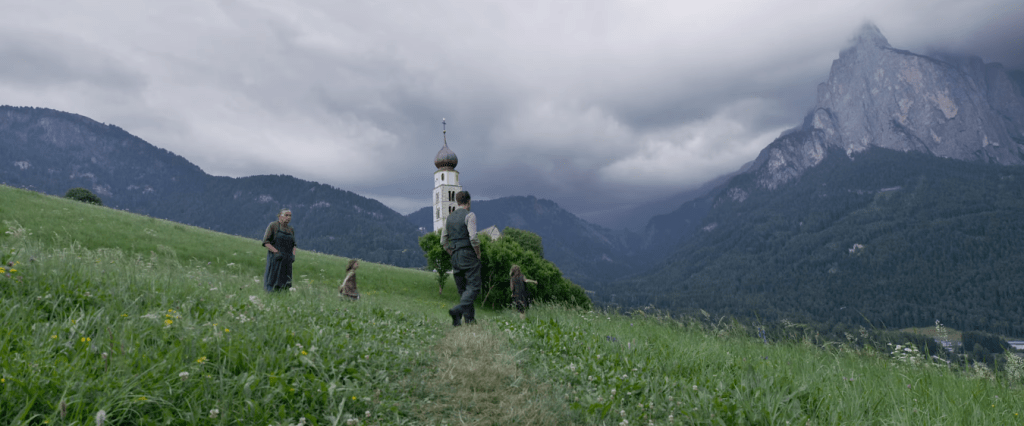
The cinematography alone was breath-taking. The stunning landscape of the Tyrolian Alps with their crazy spiked peaks snow-capped and bathed in beautiful sunshine or clouded with forbidding skies and thunder. The sloping land with the constant, digging, planting and harvesting barley, turnip, tending goats among the simple dwellings and outhouses, grinding wheat with children playing in the cornfields. It was an idyllic scene. The human love and joy in the family that spread out to the community was portrayed with a delightful tenderness. Even the shadow of what was to come was treated with such sensitivity that in so many ways it seemed perfectly reasonable. The soldiers the the town major, the local priest and even the villagers who turned against them with their ugly glances, spitting and the children throwing stones, were not evil, but people with their own demons to fight, their own families and lives to protect.   

The music throughout, sensitively and beautifully arranged under the hand of James Newton Howard with pieces from Handel, Gorecki and  Pert woven seamlessly into the whole provided the backdrop

The towns and prison courtyards with all the of skilfully underplayed. Malick understand more than most how the greatest impact is achieved with the merest hint. There was no gratuitous violence or sex which under another director’s hand would be exploited. You don’t need to be shown everything. The brutality was clear and the passion real.

The principal actors: August Diehl as Franz Jägerstätter and Valerie Pachner his wife Franziska (Frani),

along with the supporting cast, none of whom were known to me, worked with astonishing skill and sensitivity drawing you directly into their anxious internal struggle in what can only be described as an exquisite performance. They are totally convincing and believable. Erma Putz, Jägerstätter’s biographer who based her account on his letters from prison has said that it was an accurate representation of the principal characters from what she learned from the letters and directly from Franziska.

Many, I am sure, will use the film to support some current political stance and point up the dangers of populism and xenophobia. Others may take it as a statement on conscientious objection. There may be something in that, but I saw it as something much deeper and altogether more significant. For me it was about that undervalued virtue of Integrity, the cost and the ultimate sacrifice to be true to the lord of your life.  Jägerstätter’s issue was not over military service or war but in swearing allegiance to another God. That was where he could not go.

Despite all the persuasive arguments arraigned against him: From the mayor of his town, “You are worse than our enemies. You are a traitor”, the local priest, “Have you thought about the consequences of your action?.. Do you know what this will do to your family?. Don’t you know that you will almost certainly be shot?…your sacrifice will achieve nothing.”. Just say the words, God knows what is in your heart”, the Bishop “St Paul told us to be subject to the governing authorities whoever they are…your loyalty is to the fatherland” The atheist inmate “Your God doesn’t care. He didn’t even listen to his own son”

His own family, his mother , his sister in law and even his wife at one point offers him, a little shyly, a possible way out. From the plausible, the reasonable to the aggressive and dismissive each charge must have shot arrows into his heart. After almost each accusation he remains silent, as if accepting that it may be true, but that make no difference. Before his court appearance his solicitor is frustration and bewilderment offers him the easiest way out. “Just sign here and you will be free”  Frantz responds which for me are the most revealing words in the whole film  “But I am free”.

Crawford Mackenzie