His hand

his hand title

His hand could have held on

to all the wonders of heaven

the glory and good things we can hardly imagine…

But it didn’t

His hand let go of all of that and gave it up

to come down and to be one of us

His hand was a baby’s hand with tiny fingers

and tiny fingernails needing trimming

His hand held his mother’s hand till he could walk

His hand followed his father’s hand in working with wood

with saw and plane and nail and chisel

His hand turned wood and turned water into wine

His hand commanded the sea to be still

His hand touched diseased skin and it was healed

His hand touched tongues so they could speak

ears so they could hear

eyes so they could see

His hand took a dead girl’s hand,

lifted her up and brought her back to life

His hand was placed on the heads of children

while adults fumed in the background

and he blessed them saying  “let them come to me”

His hand broke bread and said “this is my body… for you”

His hand was taken, bound and pinned with nails to a timber scaffold

while his life ebbed away from him

Yet… on the morning

His hand pointed to the fishermen on the lake “try the other side”

His hand cooked fish for breakfast

His hand had the marks of nails that Thomas felt

His hand

And now… his hand is offered to you and me

“Take my hand” he says “Be forgiven, come and follow me”


A Difficult Task

I have been asked and pressed a number of times on facebook and other discussions, to justify why I hold to the orthodox position on homosexual practices and, in particular, what was the basis for this belief. It is not a subject I ever wanted to speak about and I have been very reluctant to make any comment.  I also feel that the onus to explain and justify the moves towards the normalising of same-sex relationships should fall to those who are proposing it.  In a way there is no need to justify what has been the orthodox position for centuries. It is up to others to justify why the change is either, necessary, good or the right thing to do. This explanation should not have been necessary. Still, as the push towards this momentous change in society, which will have far reaching implications, has been overwhelmingly in one direction and the voices against, with some notable exceptions, all but silenced, I feel a need to state the case as best I can. It is difficult to distil the thinking into a few words, when others have devoted whole volumes and years of study to it, but I have tried and here is what I would say.

Homophobia

At the first I have to make the clear distinction between the person and the act. I have nothing to say about the person. I have no authority or qualification to do so.  My position is wholly based on the act – sexual relationships between people of the same sex.  This distinction is very important and has often been conveniently blurred. It is perfectly sensible and reasonable to believe that a person’s actions are wrong and disapprove of them and yet not discriminate against them.  It happens all the time. The prevailing thought, however, is that if you are unwilling to embrace same sex relationships and believe them to be fundamentally wrong, you are harbouring homophobic thoughts and attitudes. This then is the breeding ground for prejudice discrimination, hostility and eventually violence. There is also the suggestion that such an attitude can precipitate the suicide of a perceived victim. Homophobia, in this definition, is just one step up from Nazism.

Self-evidence

For me, the major explanation and authority comes from the Bible, and I know that many who do not accept the authority of the bible will be dismissive of it because of that. But my position is, however, not only based on what has been revealed in the bible, but also from what is clearly seen in nature. What I have called “self-evident” truth, although again some have objected to the use of that term. It is to do with the unarguable anatomical distinction between men and women clearly pointing to a design, and I would say to a designer. If there is a design then, in a world where we have free will, there is the possibility of a distortion, a spoiling of the designer’s intention. It seems perfectly plain. It is unnatural.  It is something a child sees as obvious and doesn’t need to be taught. Even without the bible, I would take the same position that I do.

The Bible

I do believe the bible to be the word of God not just parts of it. It is our one true guide to life but more importantly it reveals God and Jesus, the son of God, to us. I also believe it is a whole and needs to be read as a whole and so I would not try and pick out a verse here and there (what could be called “proof texts”)  to make a point.

The Design

The first thing is that nowhere in all of the books of the bible is there the remotest hint that homosexual sex is anything but wrong and is often condemned in the strongest of terms. No one argues with this. But the place I would start is Genesis and the creation narrative. Nothing could be clearer that God created humans as male and female deliberately. It was the climax of creation and it was only then that he rested and gave his creatures the command to carry on the work of creation from the garden into the entire world. That is enough for me. From there the design is simply clarified and reminded in the positive and the negative. It is possible, as others have done with far greater clarity than I could ever employ, to trace this design throughout the bible, book by book, emphasising its central importance as a picture of the relationship between Christ (the son of God) and the church (his bride). Paul describes this as a mystery. It is a wonder and, at the same time, something extraordinarily beautiful and lovely. Because of that, any distortion any soiling of the picture is a blasphemy against God.

Jesus

It is probably easier to start from what the advocates for the normalisation of same sex relationships claim the bible says. One of the big ones is that Jesus said nothing about it and so by default he was for it. He would have blessed a same sex union if there was one at the time in the same way that he blessed the couple at Cana by his presence. That is how the argument goes. It is of course a baseless argument. It is arguing from the negative. Jesus said nothing to contradict or supplant or nullify the moral law which condemned such practise in the strongest of terms.  In the Sermon on the Mount he did not water down the moral law but he reinforced it. He said that sin starts in the heart. When it came to marriage he pointed back to the creation narrative which explained that the design was for a man and women to become one.

Leviticus

The moral law was defined in the Ten Commandments which included the seventh (or sixth) and amplified in Leviticus. So many people follow the well-trodden line set out by atheists, bishops and celebrity evangelicals who sneer and savagely mock those who hold to the orthodox view, by saying “You are hypocrites. You disregard some rules (on not eating pork, not wearing clothes made of different materials for example) while choosing to keep others (on homosexuality)”. This is the classic Jed Bartlett put down and is, of course, a great laugh. But those who say this have either not taken the trouble to read Leviticus or have deliberately misread it.  It is not difficult to see there is a clear distinction between the cleanliness laws, the rules that apply to the business of approaching God , the laws that Jesus fulfilled by what he did, and the moral law which remains. The actual verse which specifically prohibits homosexual practise is not amongst verses on clothing or what not to eat, as people would have us believe, but is in a chapter devoted to the prohibition of many kinds of sexual sin and is in fact sandwiched between the law against sacrificing children and the law against sex with animals.  By this logic, which the critics employ, there is no reason why we should prohibit sex with animals or the sacrificing of our children if, in the spirit some future enlightened age, it was thought the right thing to do.

Sodom

In the account, God was about to punish the city because of its many sins but we are not told explicitly what they were. The fact that homosexual rape was involved, may simply suggest how bad thing had become but we are not told.  The suggestion that it was because of their inhospitality to strangers is simply unfounded, as Lot, one of the chief citizens of that town, did in fact, offer and press on the strangers, hospitality, so that obligation was fulfilled.  Also the sin of inhospitality is the not the one Jude has in mind when he wrote his letter.  It is specifically sexual immorality and perversion.

David and Jonathan

The suggestion that David and Jonathan had a homosexual relationship and that Ruth and Naomi were lesbians, as I have heard some say, is farcical.

Paul

It is hard to get round what Paul says about homosexual practices both in Romans, Corinthians and Timothy without somehow denigrating Paul. Some have suggested that he was speaking solely about pederasty and not about long term homosexual relationships, which he would have been ignorant of.  The first position (deciding that you can’t trust Paul) pretty much writes off the most of the New Testament and I think that you either accept the authority of the bible or you don’t. The second stretches language and credibility and also makes the astonishing assumption of what Paul did and didn’t know.  Any reasonable person can see what he is talking about. In Romans he is beginning his thesis on the gospel of Jesus Christ, the core of the Christian faith, by focusing on the reality of God’ anger against sin. But it is not against homosexual sin, sexual sin or other specific sins, for the matter (of which he lists many) but the act of rebellion against God in which we are all implicated.  Homosexual sins and the others he lists are a result of God leaving us to it and the consequences of that rebellion. This is the necessary backcloth to the scene, before he introduces the good news in the wonder and beauty of what Christ has done for us.  It needs someone better than me to explain that fully, but what you cannot deny is that Paul describes homosexual sex as unnatural and a perversion of God’s design

Conclusion

It would be heartless, in the extreme, not to recognise that so much of this is very difficult and can be hard to accept.  Many have been badly hurt and speak of great pain and anguish in the way the church, society and governments have treated them over the years. Being ostracised, discriminated against and left out in the cold. An unloving, censorious attitude has often prevailed but that cannot be traced back to the bible or laid at the feet of Paul or Jesus. The bible makes quite clear that homosexual sin is just one of many, no better no worse. We are all sinners. We are all in the same boat, so there is never any ground for discrimination or thinking of ourselves as better or above another person. Paul himself shows the way when he warns his readers that they will be judged by God, if they continue in their sinful ways, he includes those who practice all kind of sins and says no one will get to heaven, but then goes on to say to his hearers, that they were all like that too but have been washed and made clean. Finally he says that he too is a sinner of the worst kind but he has been forgiven and being made a new person in Jesus. That’s the Good news. The rest is bad.

Crawford Mackenzie

The Great Divide

In a recent article in Scottish Review1, Gary Hasson powerfully opens a lid on what is possibly the biggest problem threatening our society, yet is hardly ever spoken about. It is the festering wound and the major source of division in contemporary Scotland. It is the elephant in the room, the war we mustn’t talk about, the brother we never had.  It is starkly illustrated by the sharp difference between life in the peripheral housing schemes and the leafy west ends of our cities. Yet it is possible to live out your life without ever noticing it. Maybe you have to be in a prison waiting room, be searched and have your arm stamped or live in a burned out close which has become a shooting gallery, or see a gang fight explode at close quarters, or be routinely insulted and humiliated by some wearied official behind a grill, or just had to learn to accept tenth rate service from medics, educationists, and councillors just because they can get away with it.   It sounds like something that every politician should be agitating for but I do not believe it is within the gift of politicians to fix even there was the will. I don’t believe it is to do with money or a solution could be bought. I don’t think the psychology and sociology and educational theorists have the whole answer either. Neither Darwin, nor Marx nor Freud,  “Three most crashing bores of the Western world” 2come anywhere near. The problem lies much deeper. On one side is the arrogance, greed, pride and indifference or simply obliviousness of those who have the power the wealth and the wit to be sorted, on the other an almost total lack of self-esteem, self-worth and self-respect of those on the other side of the tracks. Apart from the odd outburst, the odd riot, the odd march, there is a resigned acceptance that this is just the way it is. It all became very clear to me early on in my work with the Mains of Fintry Urban Ministry Trust and it is not new. Nick Davies wrote about it in 1997 “Dark Heart, the shocking truth about hidden Britain”3. The book was, and is, a desperately depressing insight into the underbelly of urban life in the late 20c, but he was simply an investigative journalist and had no real answer.  The crippling lack of self-worth and the sense of being trapped with no way out is deeply ingrained in the psyche. It is reinforced with every attempt by those with the resources, time, skill and money to help. “You are only helping because you can and we can’t”  Even the acknowledgement of gifts, the positive strokes, the affirming comments are taken as yet another nail in the coffin “You are only saying that to make us think we are good when we know and you know we are rubbish”  It is seen as yet another patronising put-down.  Our Kosovar friend made an interesting comment on this. When volunteers and NCO’s came to her country to help rebuild the nation, after the war, they were treated with disdain and suspicion.  “They must have done something really bad to be sent to a dump like this” was what they said.  It was only later that she saw the thing differently.

So what is the answer?

I have only one: one solution, one way, one truth, one life- Jesus. If God was prepared to become one of us and go through unbelievable pain and suffering and die for me then I must be worth it and that changes everything.

But it is also not just a theory. I have seen it happen. I have seen people find God and become Christians and find their lives being transformed. They were no longer cowed and subservient but, without turning their back on the traditions, families and cultures, they stood tall with dignity. I have seen it in both individuals and in communities in the east end of Glasgow, in the north end of Dundee, in the pueblos Jovenes in Lima and in the Quechan communities in the Sierra of Peru. It was something that even an atheist like Matthew Parris recognised, after visiting Africa in 2008 “Now a confirmed atheist, I’ve become convinced of the enormous contribution that Christian evangelism makes in Africa: sharply distinct from the work of secular NGOs, government projects and international aid efforts. These alone will not do. Education and training alone will not do. In Africa Christianity changes people’s hearts. It brings a spiritual transformation. The rebirth is real. The change is good…..The Christians were always different. Far from having cowed or confined its converts, their faith appeared to have liberated and relaxed them. There was liveliness, a curiosity, an engagement with the world, a directness in their dealings with others – that seemed to be missing in traditional African life”. 4

So, for me, the hope for our nation does not lie with politicians, civil servants and the ruling classes, nor with the educationalists, sociologists and social scientists, nor with the economists, entrepreneurs and  traders in money, nor  with the artists, poets, musicians and architects, nor with the entertainers, celebrities and comedians but, strangely as it may seem, with the humble preacher, who faithfully and carefully studies the bible and brings out its truth and majesty in words that people can understand.  In this simple act the whole of life, for the individual and the community, can be transformed and the great divide breached.

Crawford Mackenzie

1              http://www.scottishreview.net/GerryHassan145.shtml

2              William Golding: Marx, Darwin and Freud are the three most crashing bores of the Western World. Simplistic popularization of their ideas has thrust our world into a mental straitjacket from which we can only escape by the most anarchic violence.”

3              Nick Davies: Dark Heart, the shocking truth about hidden Britain, 1997, Vantage

4   http://www.timesonline.co.uk/tol/comment/columnists/matthew_parris/article5400568.ece

Why I am not celebrating

When I started this weblog, this subject was one I didn’t want to be writing about. It was one controversy I was happy to avoid. If I had to, I would try and skirt round it as best I could and leave it to the reader to work out where I stood, but things have changed. I feel continually pressed, corned and nagged into coming out and making clear what I believe is the truth of it.

I never liked and still don’t like talking about sex. It is something so precious and intimate and delicate, too much talk crushes the flower and smudges the image. At school you knew that the boys who were always talking about it were not doing it. But with the relentless battering from the media, from self-appointed pundits, celebrity clerics and experts, in almost every minute of every day, from almost every angle, having the thing shoved into your face with virtually no escape, and possibility of respite, there comes a time when you have to say “Enough is enough”.  I can’t be silent any longer.  I have been bullied and intimidated for too long. I am wearied to distraction at the constant bleatings of those who claim to speak for others, for those who are hurting because they are not able to find sexual fulfilment in the way that they want. Yes I know and don’t doubt that people are hurting, that always will be, but when you think of the world of suffering people out there, the people who have to face the rest of their lives with crushing disability, with unbearable loss, with unbelievable deprivation, or simply the desperate human longing for a partner or soul mate or for a child, a longing that will never be fulfilled, it barely registers on the scale.

So where am I?

I believe in God, who created this world and who keeps it going. I believe he has communicated with us and speaks to us. I believe he has been doing that from the beginning of time in different ways but especially by coming and being one of us. I believe he speaks to us: to me, now, today. I believe that all we need to know of him can be found in the Bible, if we listen to his voice speaking through it and allow his Spirit to make it clear. I believe that it contains the only truly good news, the only truly accurate assessment of our condition and situation and the only real and genuine hope.

In it the pattern: the design, the beauty of the relationship between man and women is clearly shown. It is a picture of his love for us. It is something so holy that any variant, anything less, any spoiling of that picture, he abhors. That is why idolatry, adultery,  fornication, homosexual, bestial and incestual practices are condemned. It is the spoiling of the picture, like the misuse of his name, or the abuse of his children. That is the offence.

That is where I am, this is where I stand and that is why I will not be celebrating.

Crawford Mackenzie

An Enduring Memory

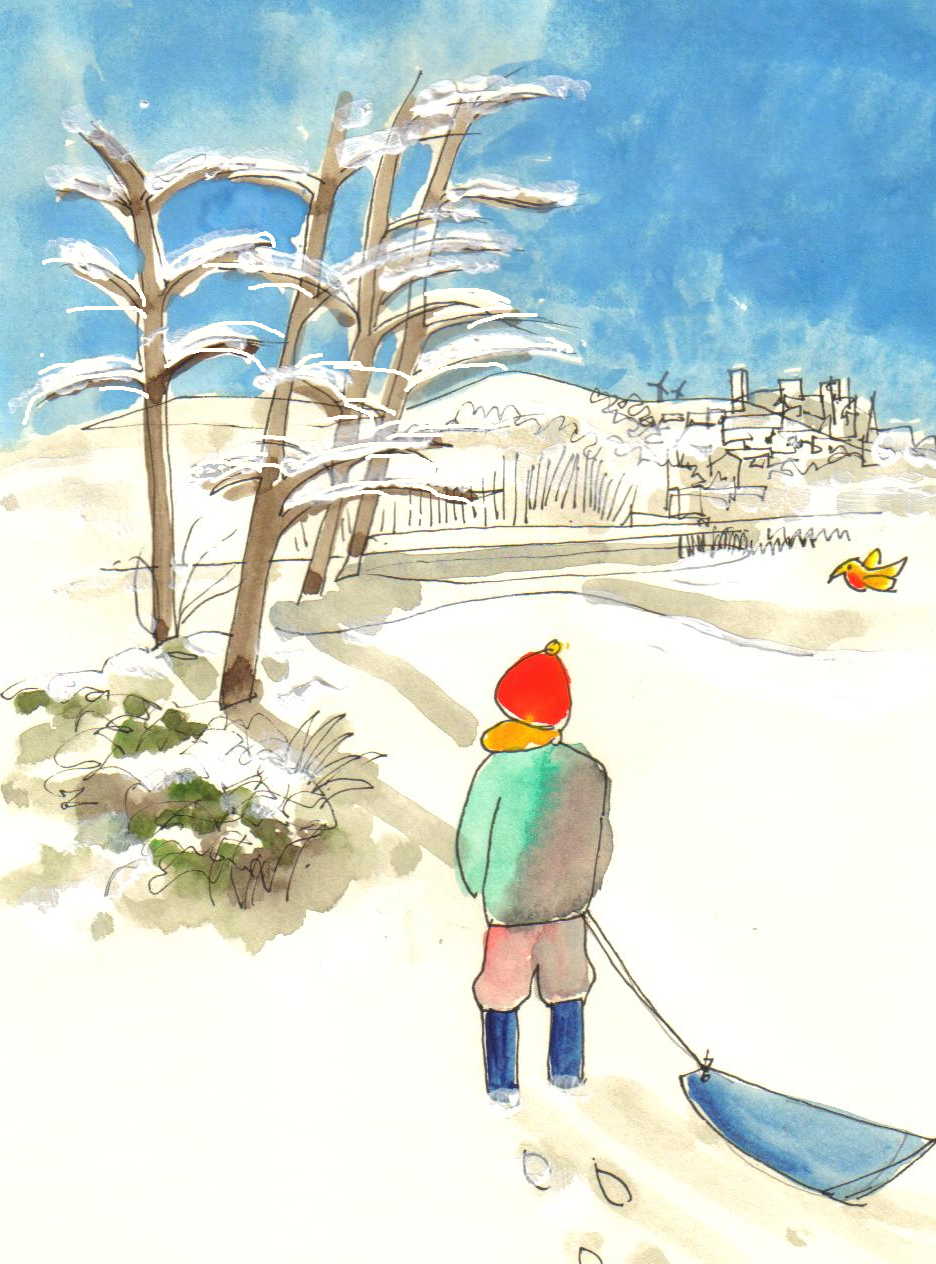
snow on the trees (2)

We arrived in Aberdeen in mid-November in the late fifties.  To children brought up on a tiny Scottish island with a tinier population, it was an experience to shake the senses. Save for a twice weekly ferry bringing already stale bread and margarine, an out of date “daily” newspaper bound into a weeks’ edition, a hit and miss wireless set and limited telephone lines, we were isolated from  the rest of the world.  Now we were in a city with thousands of people. There were cars and busses, street lights, TV’s with moving pictures, restaurants and shops of all kinds stacked with toys and sweets that made our eyes jump from their sockets.  There was the constant noise of the trains in the nearby marshalling yard and the hum of traffic and people walking and cycling, moving to and from work. Amongst it all was an enduring memory: the Christmas Eve watch night service.

It was magical experience. Being allowed up so late was exciting in itself. Our normal journey to church would be the mile and half on foot, but on this occasion we were carried in a taxi and dropped off at the church with both doors swung open pouring golden light into the dark street and casting shadows from the great piles of snow at the side of the pavement. We slipped into the high polished pews squeezed close between the men in heavy winter coats and women in furs and hats and gazed in wonder at the twinkling lights in the enormous Christmas tree. As the service began, We were led in rousing carols by the minister directing, dancing and urging us on to greater strains from the bold and joyful  “O come all ye faithful” through the ballads of the shepherds and the wise men to the sweet and lyrical Scottish and Irish carols. From time to time a figure would appear from behind the tree to read from the timeless story and a soprano would sing in unaccompanied solo “In the bleak midwinter” with the startling our “God …heaven cannot hold thee” and then as it came close to the hour, the lights were switched off, one by one, and we were left in the soft light of the Christmas tree. Without words to look at we sang from memory: “Still the night”. It was when we came to repeating the final line of the second verse “Christ the Redeemer is here” it came to me in a way that is hard to describe or explain, but I knew it was true. He was.  Christ the Redeemer was here. To a young mind overwhelmed with the magic and beauty of it all and, as yet, ignorant of the twists and turns that life would so quickly throw our way, it was a moment when I truly believed. 50 plus years later, I still do. It was true then and it is true now.

We didn’t notice the less than subtle hand that reached out from behind the tree to press the Grundic tape recorder and allow the Christmas morning to be announced with the chimes from Big Ben. But it didn’t matter. We were singing our hearts out and, with our loudest voices, rising in crescendo on “Hark the herald …Glory to the new born King”

Crawford Mackenzie

The Servant

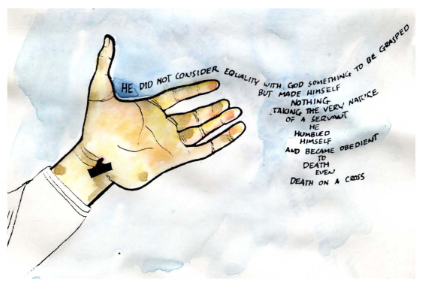
his hand

I heard a sermon once and it changed my life.  The time, location and circumstances have faded with the memory but the vision has remained clear. It was in the letter that Paul wrote to the Christians in Philippi, in the second chapter where he quotes a hymn:

Christ was truly God. But he did not try to remain equal with God. Instead he gave up everything and became a slave, when he became like one of us. Christ was humble. He obeyed God and even died on a cross. Then God gave Christ the highest place and honoured his name above all others. So at the name of Jesus everyone will bow down, those in heaven, on earth, and under the earth. And to the glory of God the Father everyone will openly agree, “Jesus Christ is Lord!”

It was a picture that was thrust into my mind and burned into my memory, of a hand that could have grasped, could have held on, but let go, willingly let go.  There were lots of questions: What kind of person would willingly let go of his right and come to this life where he would suffer be tortured and die?  For what purpose?  And what did it mean for me? The thought, uninvited, which broke into my ordered world, carried an unavoidable and unmistakable challenge. It was about attitude, about my attitude. Paul was saying: we should have the same attitude as Christ Jesus.

Many years later sitting with a group of international students, some believers and followers of Jesus, other unsure, while others Buddhists, Atheists, Hindus and various strands of religious background, we were thinking about Peter and the call from Jesus at the side of the lake to “come and follow me”. One of our international friends asked “If I decide to follow Jesus, will I have to give up everything too?” As usual I didn’t know how to answer the question, others stepped in to do that, but afterwards thinking about it, I knew. The answer had to be “Yes”. Yes it did mean giving up everything and yes it did mean not grasping what you thought was your right but letting go and giving it up.  It would look different for different people.  What it meant for others was not my business. I knew what it meant for me.

Now as almost everyone pitches in with their take on the life of Nelson Mandela, there is one thing that strikes me, more than anything else, about the man: his humility. How he seemed to continually stress that he was not a prophet or a king, but a servant. That is true greatness.

Crawford Mackenzie

Covenant Love

I listened to a very powerful and moving sermon last night. It was about marriage. It was not about the how to, the problems, the disintegration, the redefinition, or about the pathetic futility of trying to play around with, tamper or trample over something so precious and so beautiful. It was about a wedding that the whole of history and the cosmos is preparing for. It was about the pictures, the drama, the songs, the poetry and the demonstrations of covenant love woven through the pages of the bible, from beginning to end. It was about the one single event around which the whole purpose of existence is focussed, stretching, longing and aching for. It was about the ultimate drama which shapes our lives and is lived out even in our fragmented, disintegrated and dysfunctional relationships. It was about the final consummation of the restless longing that is indelibly printed in our hearts. It would be very hard to think of a bigger or grander theme.  It was simply breathtakingly.

It was Mike Reeves on “The Lord’s Delight” and you can hear it at http://www.stpeters-dundee.org.uk/resources-media/sermons/

Crawford Mackenzie

Book Review

I was asked to review a book recently.  It was not for publication or distribution but a friend, who I care about,  had simply asked me to read and comment on a book she had read which had made a big impact on her.  She didn’t say if the impact was negative or positive, so I was given a clean slate and approached it with an open mind.

I have to confess that I don’t read a lot and am amazed by friends who can devour several books in a day, who carry a pile with them on holidays and have their kindles loaded up with, what seems like, whole libraries. The little I read tends to be more in the non-fiction than in the fiction section and I often re-read books a number of times. I am also a slow reader. My English teacher, at school, tried to teach me to skim read but I never learned and now I don’t want to. I prefer to savour the language and the thought and to remember the phrasing and give time for the ideas to sink in. So this was a special and a tough task.

The book was not new. It was first published in 1995 and is reputed to be an international best seller, but it was one of the worst books I have ever read. The writer claims to have had a revelation or series of revelations over some years, directly from God, in which god speaks in everyday language with words of wisdom, stories and humour, contemporary references and many quoted words and verses, mainly from the Bible.  But unlike other recognisable forms of literature, with parables, myths and allegory etc, this writer clearly wants the reader to believe that it was in fact God who was speaking directly to him. This is made clear in the introduction.  “It happened to me” he says “I mean that literally” and “it was for everyone and had to be published”. He describes it as “gods latest word on things”.  Now I have known and heard of many people who claim to have heard God speaking directly to them and I have no reason to doubt that these have been true and real experiences but, in each case, God was speaking to the individual and usually over something specific like a decision or a direction or a calling. In this book, the writer maintains that God is not only speaking directly to him but charges him with telling the message, spreading the word to others and specifically to do this by writing the books, of which there are three. “You will make of this dialogue a book, and you will render my words accessible to many people. It is part of your work”  If he is to be believed and if he is accurately reporting what God was saying, then the Bible is deeply flawed from beginning to end and Jesus was either deluded, mad or simply a fraud.

It would not be difficult to catalogue the ridiculous, bizarre and contradictory claims that are made throughout the book, but here are just some of them:

1)      There is no right or wrong only love and fear

2)      God is not the creator he is merely the observer

3)      There was no such thing as the ten commandments

4)      There is no sin

5)      There was no need for sacrifice

6)      There is no heaven

7)      There is no hell

8)      There is no devil

9)      Self is all there is

10)   We are gods or in the process of becoming gods

11)   Jesus is a master on a level with Krishna and Buddha.

12)   All the gospel writers lived and wrote their accounts long after Jesus had died

13)   We only suffer because we chose to. At any moment we could stop suffering. We could be healed, we could be perfectly at peace and happy if we chose to be.

I can well understand why people would be drawn to this book especially if they have been hurt, disillusioned or damaged in some way with organised religion. It would make them feel better about themselves but so would morphine or heroin or alcohol, for a time. The book is poison.

On the cover, were a number of review quotes. From the Mail on Sunday; “An extraordinary book“ I couldn’t put it down”.

It was extraordinary; I couldn’t get it into the bin fast enough.

Crawford Mackenzie

Why do people hate Jesus?

I was coming back from the shops with my oldest grandson, down the steep cobbled lane with the early morning Saturday sun hitting our faces, past the tiny gospel hall and the Hindu temple next door, looking down towards the river with the railway bridge snaking its way round into Fife; when he stopped, retraced his steps, and said “Look”.  Pointing to the noticeboard on the wall he read “I am the way the truth and the life – Jesus“  Having recently discovered the new world that had opened up to him through the joy of reading, he read everything. “Good” I said and trundled on. “No!” he said pulling me back to the spot “Look” and pointed to a large “X” scratched across the glass. “Someone has done that – someone who doesn’t like Jesus” We walked on for a bit and then he asked “Why do people hate Jesus?”. At once two thoughts rushed into my mind;  “out of the mouths of babes and children… “ and  “Why do they always have to ask such difficult questions” and so I mumbled something like “I don’t know, but I think it is because Jesus is so good that people hate him”.  He was silent for a time and then, totally unconvinced, responded  with a “So that is it?”

As always happens, I thought about the question afterwards. I tried to come to a better answer but the more I did the more I became convinced that that was, in fact, it. People hate Jesus because he is good. Good people are often admired but seldom liked. It is as if  a good life points up how shallow, selfish and self-centred is our own and faced, with a pure one, we are so aware of our own hypocrisy, greed, lust, deceit  and pride. It is best to keep a good person at a distance. It might actually bring out hatred. At the root of most of the emotion is not so much over what Jesus said or who he was but what he did. What he did when he allowed himself to be led through the suffering and torture to his execution on a rubbish tip outside of Jerusalem 2000 or so years ago. I remember listening to a tirade from someone about the film “The passion of the Christ”. They hated it and went on and on about the violence. Somehow they could take Tarantino excesses in their stride but Mel Gibson’s portrayal of Jesus’ suffering was just too much to stomach. I am not a fan of Mel Gibson nor the film but was taken aback at the ferocity of the attack.  Violent the film certainly was, gratuitous perhaps, but the context and meaning of the film was clearly stated in the words from Isaiah, shown in the opening sequence -“by his stripes we are healed” and I think that was what caused the most offence. If the son of God should have justly suffered all of this, and if it was for me, then I must be totally messed up. My life a hopeless sham and the good that I thought I was, could be nothing more than pathetic childish pretences, what Paul calls “filthy rags”. That truth is hard to swallow and so much easier to ignore. But because it is true, then we hate every reminder of it and hate the person who, by their very presence and existence, reminds of it. That, I think, is why people hate Jesus.

Crawford Mackenzie