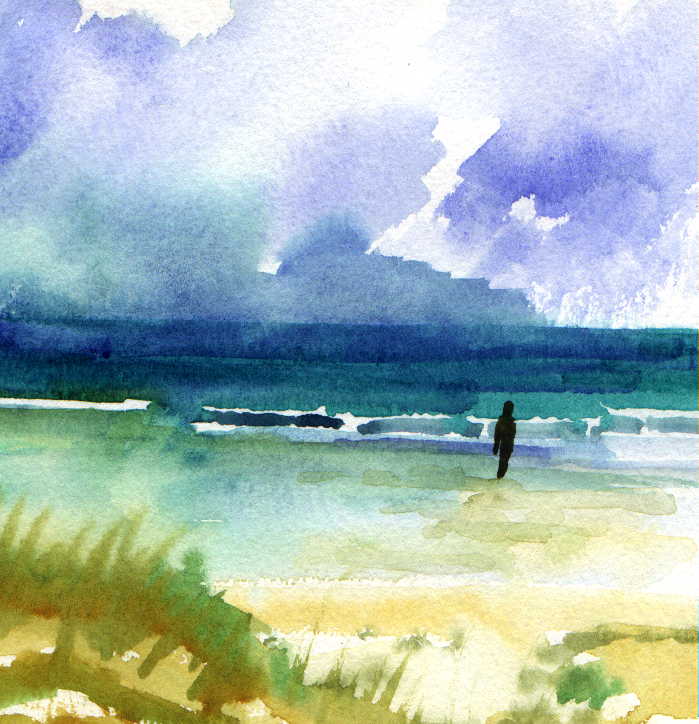
IN THE SILENCE

Autumn was our favourite time/Picking fruit and kicking leaves/By the long walks in the afternoons/And our games between the trees/Now the branches stiff and bare/And the hills so cold and plain/losing you was losing everything/But it must be heaven’s gain

It’s a massive hole as big as Rubislaw quarry where the granite was gouged out to build the silver city. You can peer over the edge but you can’t see the bottom. It’s as deep as the Mariana trench and I don’t know how it could ever be filled. Words and music and poetry don’t cut it and only serve to accentuate and magnify the loss. Art and architecture and doing things are simply distractions. Even the extravagant love of friends and family and neighbours won’t do it either. Another love? The idea is both preposterous and, in this moment, obscene. My imagine can’t stretch that far. Someone has said “Why don’t you get a dog?” In the biblical picture two have become one flesh. How then do you cope when half your flesh has been ripped out? A fellow travel has said perceptively “ I knew who we were, but I don’t know what I am”. Others have said “ Yes, it is a massive hole but you learn to live with it” I don’t want to learn to live with it.

It is the silence that is unbearable. I can speak. I can say the words out loud but I know she won’t reply. I can tell her all about my day but she won’t respond. She is not here. I don’t want to be the one who goes up each week to that beautiful spot on the south slope with the hedge of trees in the horizon to lay new flowers on the ground and speak to her as if she was there. That’s what they do in the movies. Its not a game I can play.

Strange how the words people say to comfort are no comfort at all. Wonderful words of scripture. I know they are good, solid and true. I know they are God’s words, they are the words of life, I believe them with all my heart, I truly do, but, and this is the thing, I don’t feel it. I don’t feel it and I have to feel it to be comforted. These are somehow harder to bear than the lies written on cards. “Those we love don’t go away, they walk beside us everyday”, heartfelt, well-meaning, loving words, but I know they are lies. She doesn’t walk beside me every day, she has gone away.

Yet there is so much I want to tell her and keep telling her:  how thrilling it was to meet up with A and see how she had grown and matured into such a lovely confident young woman, how kind it was of G+J to think and to ask and to invite me round for diner, how nice it was that F said nothing just offered a hug when we met in the street, how thoughtful of C to take time out of her very busy life to come round and talk, how special that A was up for a long walk along the front and speak about deep things. how nervous I was to be with our group and yet how easy it was in that time, how I desperately didn’t want to be the sad old man in the corner, how easily I was hurt by some of the things folk said and did or didn’t do, how possessive I felt when they spoke about you as if they knew you better than I did myself, how people promised to pray and I know they did and more so much more: the lovely walk with S through the carpet of leaves that jewel the ground along the burn with the translucent red and yellow ones still hanging in space or the way the sun rose over Fife and  cast its shimmering light across the river while the morning car lights twingled as they sped over the bridge.  How blessed I am, and how lost.

In the silence, I call out “Where are you?” But there is no reply.

And then barely audible at first but soon as clear as day I hear a voice, a still small voice. “I am here, I have been here all along, long before you ever knew me.  I loved you from the beginning and I know all about your pain and your loss but come to me, speak to me, take this new found time and space I have given you to share with me to listen to my voice and learn of me, for my yoke is easy and my burden is light and there you will find rest for your soul”

And I find John Newton’s letter he wrote to Mrs Talbot on the death of her husband in March 1774:

“…Though every stream must fail, the fountain is still full and still flowing. All the comfort you ever received in your dear friend was from the Lord, who is abundantly able to comfort you still…The lord who knows our frame does not expect or require that we should aim at a stoical indifference under his visitations. He allows that afflictions are at present not joyous, but grievous; yea, He was pleased when upon earth to weep with his mourning friends when Lazarus died. But he has graciously provided for the prevention of that anguish and bitterness of sorrow, which is upon such occasions, the portion of such as live without God in the world; and has engaged that all shall work together for good, and the yield the peaceable fruits of righteousness. May he bless you with a sweet serenity of spirit, and a cheerful hope of the glory that shall shortly be revealed.”   
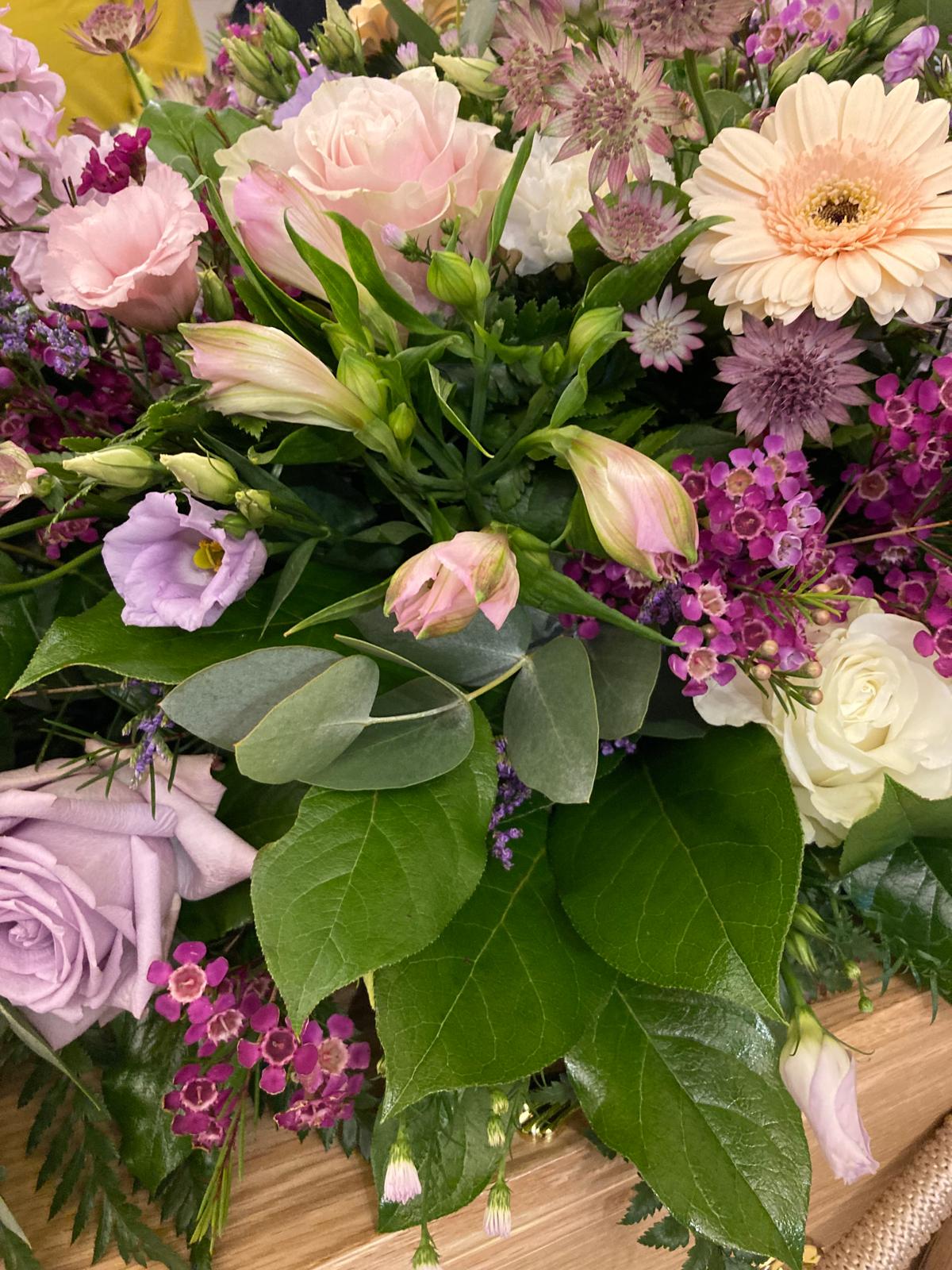
PRECIOUS AND BEAUTIFUL THINGS

THE PAINFUL REALITY

It was not how I had it planned. It was not the way it was meant to be. I was to be first. When the evil mass took hold of my liver three years before and left me surrounded with doctors and nurses in full-on emergency gear, trying  to keep me alive, I was convinced that this was it. But it was not to be. With their skill, the prayers of the people and the good and gracious hand of our God, I survived. But later, later that same year, the cancer made its presence known in her body. From then it continued its sinister and relentless pincer movement throughout her delicate frame, spreading its tentacles to the most important organs, till there was nothing left that could be done.  The painful reality had to be faced, it was just a matter of time. Despite the treatment, the chemo, the radio, and immunotherapy, this thing inside her was slowly killing her and it would not let go.

HEARING BUT NOT LISTENING
I had three years to prepare for this event, but I wasn’t prepared. Even when the consultant told us it was weeks rather than months, I wanted to scream out in disbelief. Yet she knew and she tried so hard to tell me, to prepare me, to help me see, but I wasn’t listening and I didn’t see. It seemed like the cancer had been kept at bay. Life was as normal, nothing had changed and we could go on like this for years, maybe even decades. Yet she knew, she was right all along and I was wrong.

Nobody had told me about it how it would be or how I would feel. No one had explained to me what bereft actually meant. But, the thing is, they had, in words, in books, in poetry, in songs. It was all there it was just that I hadn’t listened. I couldn’t hear. I even wrote these songs myself. Ten years ago I wrote a song about bereavement through the seasons, but I never knew what it meant until now. I remember reading Bob Dylan’s comments on songs on one of his early album, which were preoccupied with death. He said he was too young to write songs like that, so they must have come from somewhere else.

THE EVENINGS
In the evenings, when we are alone and nothing else was happening, we would read the bible, with a devotional book someone had given her and we would pray together. It was a practice that was fitful at best throughout our married life but became a regular habit in the later years. It made me so happy. Each time I heard her pray, I cried. It was in the evening too, that we talked. We talked about the things we did that day and played the game “ Guess who I saw in town today?”  A song by John Sebastian of the Lovin’ Spoonful came to mind. It was written back in the sixties and called “Darlin be home soon”. The recording seemed a bit cheesy, even at the time, but the song got to me then and strangely it came back to me now, with the opening lines “Come, and talk of all the things we did today/Hear, and laugh about our funny little ways..”   It occurred to me too that this was what happened in the garden. It was in the evening of the day that God came and walked and talked with Adam and Eve. It is in the evenings that I feel most bereft.

HOW SHORT HOW SHORT

It all happened so quickly in the end. Sunday, we were sitting out having lunch in the garden. Monday brought an emergency GP appointment and a swift referral to the oncology ward. She was visibly relieved to lie down on that bed and be surrounded with the care she needed.  By the Wednesday evening, I was so exhausted and distracted, she pleaded with me to go home and rest. On the Thursday morning, I was taking notes with her instructions of things to do that day, while she was messaging people with arrangements for a meeting in the following week. It was a busy day, people were coming and going and I had now grasped that time was short. I resolved to be awake when I returned in the evening and to make sure that I packed my bible and the book. When we were alone in the stillness , when the buzz of the ward had quietened down, we could read and pray together, just as we had done before. But it was not to be. By lunchtime she was gone.

THE EMPTY HOUSE
When I opened the door of the empty house for the first time, I was hit with the banal absurdity of it all. What was this place now for? What was the point of it? It was our home, now it wasn’t. It was my “stop all the clocks” moment. There was no need for this anymore. The newly decorated room, the restored windows, the Morris paper, the walnut floor, the Louie Poulsen lighting, the hand-crafted kitchen the carefully selected colours and fabrics, they were all about a place, our home, where friends and family from far and near would be welcomed, to share a meal, a rest for the night or longer. We wanted to be like the Shunamite woman who had a room with a bed, a chair, a table and a lamp for the prophet Elisha when he passed that way. Now it’s purpose has dissolved and I don’t know what to do.

THE OBSERVATION

Too soon, much too soon I read again C S Lewis’ “A Grief Observed”. It was brutal: grief was being like a “rat caught in a trap”, the bereaved were such a problem, maybe “they should be isolated in special colonies like lepers”, God must be a “giant vivisectionist” and worse. But he works his way through all of that in the most astonishing way. He climbs through the self-indulgent grief the self-pity, the flawed images and the house of cards to finally seeing “ I need Christ not something that resembles him” I hope I can get there.

THE PRECIOUS AND BEAUTIFUL THINGS
I love the proverb in the Book of Proverbs 24:3+4 partly because of its architectural reference. It goes: “By wisdom a house is built/By understanding it is established/By knowledge the rooms are filled with precious and beautiful things”. Together we built the house, she filled it with precious and beautiful things and the precious and beautiful things were people. My task is to cherish these precious and beautiful things.

FIRST THEY CAME FOR THE LANGUAGE

If you want to make something distasteful into something more palatable, changing the name helps a lot. It might not be etymologically correct, but if you get it accepted in everyday discourse your battle is pretty much won. You can change people’s view of something by changing the name. That has long been the case. We used to build large tower blocks and call them “courts” which they never were, but it sounded better to live in a court than a tower.  Killing civilians in wartime didn’t seem so bad if we called it “collateral damage”. Same sex marriage could get over the line if we called it “Equal marriage”. If you are pro-abortion a “foetus” sounds better than an expected baby. You know how it works. Flipping it the other way, also works.

Nothing epitomises that more than the media and governments inversion of language when it comes to the current war in the Middle East. Here you have a whole slew of descriptive words that have not only drifted from their original meaning but been upended and become part of almost everyone’s conversation. Our language has been so massaged that we end up adopting terms that bear no actual relation to reality. The power of the media with its subtle infiltering of a mindset pulls us into the absurd situation, where we find ourselves believing something which is manifestly untrue and the simplest of investigation would show it to be so.

Images play a big role here.  The manipulation is clearly effective.  People will protest  “We have all seen the pictures daily on our screens” without a second questioning if what we see on these screens might not actually be true.  We have this strange ambivalence to the visual image, be it still or moving. We have no trouble seeing videos of Putin and Trump romping around on sledges in the snow and hugging polar bears in Alaska, knowing that they are fabricated. At the same time, we are convinced that a picture of an emaciated child in the rubble of a building, tells a true story. A story of deliberate mass starvation, even when the picture in question, featured on the front page of the New York Times is completely false, as the paper later acknowledged.  It was too late, of course. The picture was false but the narrative was believed.  

You know the words: ethnic cleansing, starvation, indiscriminate, massacre, apartheid, and genocide. These are universally used across the board and accepted as fact without question. When I hear the media use these words in the context of Israel’s war against Hamas, I realise they are speaking a different language from the one I know. In their classic usage they bear no resemblance to reality and are an inversion of it. It makes it hard and pretty much impossible to discuss or engage with the issue in any rational way.  When the common language is lost, we are left with shouting, name calling, flag waving, flag burning and the babel of hatred, with Jackboots waiting in the wings.

First, they came for the language, but it was only words, so I said nothing.

A CLUTTER OF CONUNDRUMS

1 The Death Cult

On an evening last week, I watched the late evening news broadcast on the BBC. You will probably wonder why I do or why I still pay the licence fee, when the corporation is, in my view, unashamedly institutionally biased. But it’s complicated. I am not the only one in our household and I also want to hear how the BBC report the news. I want to know what they say, how they say it and what they don’t say. On that evening there was a report by their medical editor, Fergus Walsh on his trip to California to see how Assisted Dying was doing there. They interviewed a man who had chosen to die and he explained the reasons why. He didn’t have long to live, he hated hospitals and didn’t want to be hooked up to tubes and machines etc. He apparently suffered from a multitude of serious, chronic and painful conditions, although in the interview he looked remarkably good. There are times when I have looked a lot worse. It was all the usual less-than-subtle propaganda we are well used to from the corporation. But what followed still shocked me to the core. The crew came back to film a second interview but this time it was to allow us to witness his death in real time. The horror was compounded by how reasonable and even compassionate it was portrayed. It was simple and easy a mixture of white powder in a jar (guaranteed to be fatal) with some fruit juice. He swallowed it closed his eyes and that was that. 30 minutes the doctor said. The family hugged and the crew left with a sweet shot of a bamboo branch waving in the wind against a cloudless Californian sky, but I felt sick to the bottom of my stomach. 

Tell me please, if you can, because I can’t make sense of it.

We are exercised about harmful material on- line, we have an on-line safety bill and an on-line regular in place ready to take action against a pro-suicide forum which is believed to promote and facilitate suicides, has tens of thousands of members and is linked to more than 50 deaths including children. (I got that from the BBC) . At the same time the main evening news shows the video of an actual suicide, someone taking their own life and explains how it was done.

There is something here that I just can’t make sense of. How can you hold these two things together without doing violence to any sense you might have of reason or integrity?

If you can explain it, I would love to know.