Bankie’s Bairns

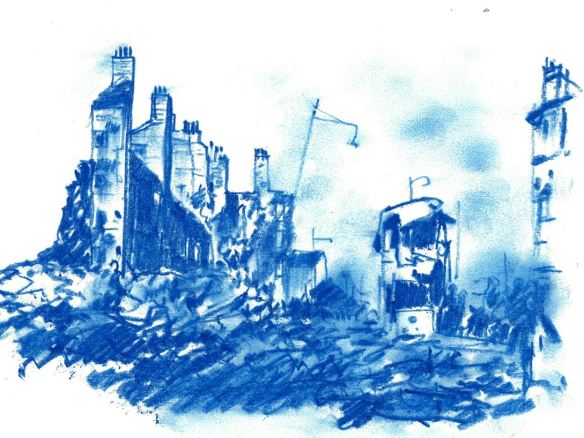
Dunbarton RoadI was reminded, this week, of a series of programmes produced by Radio Scotland, that I listened to  some years ago entitled “The people’s war”. It was a simple collection of interviews and voices of ordinary folk who had lived through and survived the Second World War. They were not soldiers, officers, politicians or important players but folk caught up in an event quite beyond their control. I was deeply moved by the simple ordinariness of the stories in the face of great horrors. I wrote to the BBC afterwards expressing my appreciation and asking if they would repeat the series. They said they had no plans to do so and I have tried several times to find the recordings on archives with no success. But I remember the stories very clearly.

They focused on the experience of nurses at Strathcathro hospital, the land girls in Angus and the Clydebank blitz. It was the later which I found quite riveting. Over the nights of 13 and 14 March 1941, Clydebank was largely destroyed by a series of air raids. It was the worst destruction and civilian loss of life in all of Scotland. The true death toll is thought to have risen above 1,200, with over 1,100 seriously injured and upwards of 35,000 people made homeless.

My mother was one of them and I remember listening to her speak about the experience. I was interested in the Anderson shelters, built half in the ground and covered with corrugated iron; a simple design to offer some form of protection against the worst effects of shrapnel and exploding buildings. I also remember asking why they didn’t make it more comfortable with seats a carpet, maybe table and lights. But I’d quite missed the point. It was a refuge a place to go to where you might be safe during an air raid. She spoke of the eerie sound of the sirens which still gave her a sense of dread when she heard them years later from a factory yard, the terror of the whistling bombs that went silent just before they struck, and the incendiaries. One hit the home of folks they knew near bye and the whole interior of the building was lit for a split second, as by a floodlight, displaying all the newlyweds’ furniture and decoration, before incineration. Her own home was destroyed in a similar fashion and it was some time before the family was reunited.

One man interviewed in the recordings told how he and his brother, as boys, instead of heading to the shelter with the others, skipped off to check that their doos (pet pigeons) were all right. When they returned, they learned that the shelter took a direct hit and the rest of the family were killed. One survivor told how her three brothers died in a raid. Her mother was bereft and would not speak about it during her life time. Chatting to her, in a retired home not long before she passed away, she summoned up the courage to broach the subject. ” Mum” she said, how did you… how did you manage… how did you cope when my brothers were killed…. how did you manage to go on?”  Her reply deeply moved me at the time and it chokes when I think about it still. ” I never understood” she said ” …I never understood why The Lord took my Bairns from me, but I always understood why he gave me you.”

Crawford Mackenzie

Heroes

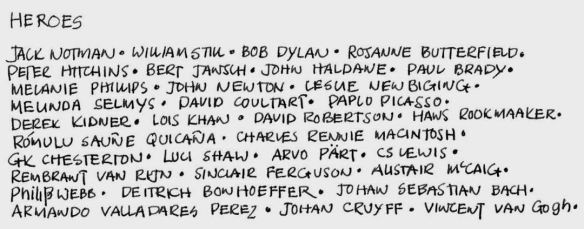
I was with an American friend after a walk along the north sands at St Andrews and casually mentioned that this was where the opening scenes from ”Chariots of Fire” were shot.  His eyes lit up, “Eric Liddle” he said “was my hero”.  After a pause he asked “and who is your’s, who is your hero?” It is of course one of these impossible questions to answer like “name your top ten films” “what was the highlight of the holiday?” “If your home is on fire and you could rescue three things, what would they be?” (I remember Ricky Gervais being asked that same question on a radio chat show . He parried it by saying he had no idea. But the interviewer pressed him so he said “well, maybe, my golf clubs.” Pressed again he said “my CD collection” he couldn’t think of a third but the interviewer pushed him hard so finally he said “well, one of the twins”.)  I just couldn’t think, at the time, but did later and this is my list. They are all flawed of course.  I don’t know most of them personally and principally through the medium of their work. I wouldn’t necessarily agree or stand with them on every issue but I regard them as heroes nevertheless.  I have left out family and close friends and my only true hero, Jesus Christ, but here is the list, in no particular order:

heroes-2

The Battle with Scrooge

wise-men

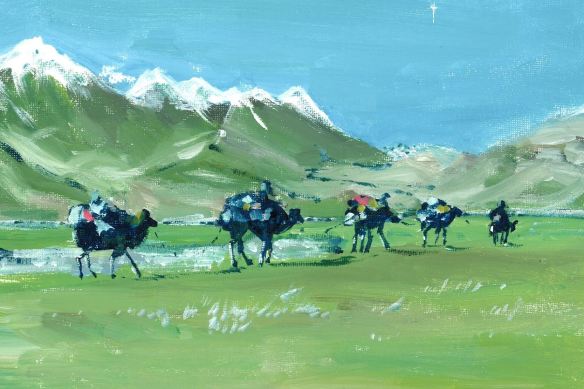
Like many people, I suspect, I have a love hate relationship with Christmas which shows a predictable pattern. It is a battle between Santa and Scrooge right up until the last minute. The hatred in the early weeks of December is intense; eclipsed only by the even greater hatred in November. I resent the imposition. I dislike the diary terrorism and the one-upmanship and the self-induced and foolish anxiety over cards and gifts, turkeys and trees. I fully understand the sentiments of those who want just to be left alone, away from it all.  To hibernate, blank it out and simply get on with their lives. But I also sympathise and understand those, for whom it is the highlight of the year. The event they plan and take delight in preparing for, often with great creatively, thinking of others and how they can enjoy the time together. It can only be a good thing and yet I don’t want to be dragged into it against my will. Not just yet, that is.  As in most things, I am a late developer. (which is a kind way of saying I am slow) and so I know that despite my latent protestations and as sure as night follows day, come the time my little heart will melt and I will be lost in the wonder and the awesomeness of it all. Just don’t tell me about it now. I am still on the way.

Crawford Mackenzie

Beautiful Zimbabwe

livingston

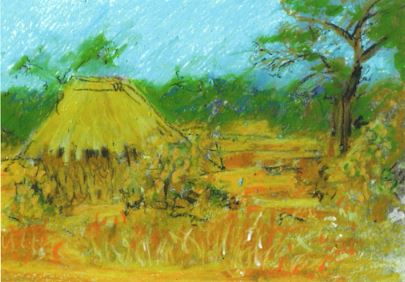
Before 1965, Rhodesia was, for me, a pink land on a school atlas somewhere in Southern  Africa, but as a sixteen year old knowing little about very much, it all changed on the 11th of November of that year when Iain Smith the prime minister and leader of the ruling Rhodesian Front party declared Unilateral Independence (UDI) from the UK. This singular event stirred in me an interest in that nation and Southern Africa that has remained and grown over the years.

I was still at school at the time and didn’t know what UDI was, but I quickly understood that it was an attempt by the colonial whites who represented a mere 5% of the country to hold on to power indefinitely. I remember the front page story in the newspaper and I followed Harold Wilson’s hapless efforts on HMS Tiger. On my landlady’s TV I watched a news programme which bizarrely showed plans of the warship and the complicated allocation of rooms to avoid an embarrassing meeting of the two politicians, at night, in their pyjamas.  I also followed the role of sanctions to bring the Rhodesian Front to recognise universal suffrage and I was convinced then and now that had the UK government taken decisive military action at that point, then the whole history of the nation could have been so different.  The declaration could have been nipped in the bud and with the implementation of  universal suffrage, Zimbabwe could have become a shining beacon in a troubled continent. Sadly it was not to be, even a labour government, it seemed, albeit with a tiny majority, didn’t have the will or stomach to stand up to Iain Smith and his Rhodesian Front Party.  They were after all our “kith and kin” a blatantly racist phrase that was to haunt British relations with the continent for decades and, in my view, contribute in some way to the years of war, oppression, famine, terror and tyranny. To the mind of this sixteen year old, the situation was uncomplicated and clear cut – Britain had a moral duty to intervene and if that meant war planes and troops on the ground then so be it.

I think I got that moral certainty from my mother. She had a deep interest in the plight of the injustice in Africa. While travelling from The UK to Australia as a young girl leaning over the deck of the ocean liner docked in Cape Town she witnessed a drunk black man slip off the pier and struggle in the water. To her shock a crowd gathered and laughed at the pathetic flapping of the drowning man before a driver lept from his truck, dived in and saved the man. It left an indelible mark on her mind. Life was cheap if you were black.

Despite all the peace-making efforts, it seemed that both sides in the Rhodesian conflict were committed to war and convinced that this was the only way to achieve their ends. I read the fascinating biography of Abel Muzorewa and had great sympathy for his stance, but his compromise with the Smith regime was not tolerated and led to his demise. He just seemed to slip from the scene. At the same time I watched a TV documentary which took an inside look at the independence struggle and focused on Robert Mugabe and what was to become ZANU. It was a heartening story of loyalty between comrades and a genuine desire for freedom and their beloved Zimbabwe , then Rhodesia. It included a visit to the Zimbabwe ruins and songs around the camp fire. One which I recall at the time I can still remember:

Beautiful Zimbabwe/Beautiful Zimbabwe/Oh no, I’ll never forget/Beautiful Zimbabwe

 Long live comrade Mugabe/Long live comrade Mugabe/Oh No I’ll never forget/Long live comrade Mugabe

In 1968 with our young family, we visited close friends working in Zambia. It was astonishing trip. We visited Mosi-Oa-Tunya “The smoke that thunders” and saw the railway bridge across the ravine where the failed negotiations took place. We crossed the border on several occasions and were struck by the richness of Zimbabwe in contrast to Zambia’s relative poverty. On one occasion we visited a farm where the children in a white family had just come from acting as extras in a film. We were told that Richard Attenborough was making a film about Cecil Rhodes. It did seem strange to me at time. Later we realised the film was “Cry Freedom” and the story of Steve Biko.  Against this background it was easy to be caught up in the swelling optimism, the prospect of a new dawn for the whole continent. Unknown to us and most of the world, Mugabe, was at this time deploying the infamous fifth brigade, trained by North Korea, and carrying out systematics slaughter against their own people in Matebeland. The Gukurahundi genocide was happening not many miles away from where we sipped our cokes on the banks of the Zambezi.  The full scale of this horror was  inconveniently suppressed, downplayed and denied and not fully catalogued until The Catholic Commission for Justice and Peace produced their report “Breaking the Silence”  in 1997.

Earlier this year David Coltart a Zimbabwean human rights lawyer published his own account of the past 50 years in Zimbabwe’s history – “The Struggle Continues – 50 years of Tyranny in Zambabwe” . It is a massive volume, over 600 pages long, with a confusing and baffling barrage of names and acronyms. But it is a riveting story.  As any good lawyer would, the details are catalogued with uncompromising accuracy and there is a transparency, openness and fairness in all that he says. His integrity shines through every page and his honest reporting of the radical changes that occurred in his own thinking as well as in his own faith is quite remarkable. His own story is woven between the events with just enough detail for you to know that it is real and true. Reaching the conclusion, it has been the most encouraging, uplifting and hopeful things I have read about Africa. Coltart takes his title from Frelimo’s cry “A vitória é certa” which was adopted by ZANU PF and epitomises the hope for Beautiful Zimbabwe. “In the pursuit of democracy there is never a final victory because democracy is a process not an event. Even countries that have had democratic institutions  for over a century, experience the same evolution and, on occasions, reversal of democracy. Zimbabwe, as a young emerging democracy, is no different. The struggle continues – yes, it does indeed.”

Crawford Mackenzie

A Purposeful Habit 4

Reading the Bible.

IMG_1542

It is hard to speak about private daily devotions, because they are, just that, private. In some ways it is an intimate thing. It is better to be doing it than talking about it. Sometimes sharing on the subject can be singularly unhelpful. When hearing about the person who gets up at 5am and reads through the whole of Jeremiah, one of the Gospels and Psalm 119, before spending two hours in prayer, for lists of people in their prayer book, you are tempted to say “Oh come on, get a life”. They are not usually people who have been up half the night dealing with a vomiting child, struggling to get a teenager out of bed, living with a flatmate who left the kitchen in a tip, coping with a husband on the drink, caring for a demanding elderly relative or someone who has to work night shifts.  These testimonies are given with an encouraging intention but the effect is demoralisation. You might just want to give up. So we are treading on thin ice, walking over glass here. It’s just a shame that we find it so hard to talk or enquire about. In all my Christian life no one has asked me “How are you finding your daily reading of the Bible, Crawford?”  I wish they had. There again, I guess I might have told them just to mind their own business.

I have been a Christian a follower of Jesus for as long as I remember. So it’s maybe quite strange and even shocking, (it’s shocking to me) that it is only in the past year or so, that I have finally learned something about the practice of daily bible readings. Something I should have known years ago. It was not that I was never taught, more that I was never listening.

With the strong influence of Scripture Union, Churches and other organisations, I have tried to follow schemes compiled to help us find a way through the bible. Often these would be supplied with helpful notes and encouragements to think through the passage as well as to see how this impacts our life with pointers for prayer. But I always found the imposition of this kind of discipline from outside hard to deal with, which probably says more about my stubbornness than anything else. The critical point came when I would embark on a scheme with very good intentions and then fail and fail again and it led to a spiral of discouragement and resignation.  That way of doing things clearly works for so many people, maybe be most Christians. I don’t know. But they didn’t work for me.

It was when a wise pastor told me, while in my teens, that the Christian life was an integrated life and not a disconnected deconstructed series of activities with boxes to tick, that the light dawned. A “quiet time” could be useful, but not if it became just another thing to do. Something to gain points and help make you feel better about yourself. That, like much of what this pastor said was liberating and I felt a tremendous freedom and a new delight in reading God’s word. Yet in this freedom there still needed to be some discipline, some order, some plan, some direction. It was easy to find yourself in the books of the bible that you liked, parts that suited your temperament. For me it was the Psalms, Proverbs, Ecclesiastes, Mark’s Gospel and Paul’s “happier” letters to the Thessalonians and Philippi. I didn’t go naturally to Romans or Ephesians, avoided Hebrews and pretty well ignored large swathes of the Old Testament. It was also easy to pick out nice helpful bits here and there, often quite out of context.

So over the years my bible reading has at best been sporadic, reading to prepare for something: preaching, leading a group, giving a talk, a children’s’ holiday club, working on material for a song, or anything that took my fancy.   Please don’t get me wrong. You do learn so much when you are trying to teach others. Sometime you only fully grasp a truth when you are trying to communicate with others. But the practice of daily bible reading, unconnected with any preparation or activity, for me, was a very hit and miss affair and there was no pattern to it.

So what has changed and what made the difference?
IMG_4113

Well a number of things. Coming to the church we now belong to, was one of them.  It was not the reason for coming, (that is another story) and in a way there was nothing especially different about it, but it was under the ministry of David Robertson that I found a new focus on the Bible as God’s word. It was not that the Bible was not central in the churches where we had previously belonged.  It was.  But here, for me, it took on a new dimension. It was moving up a gear. It was being pulled nearer to where I should have been. It was having my ears syringed. It seemed that the whole of the church’s life was soaked in the whole of God’s word. It was never an add-on.

Another was reading a book by Sinclair Ferguson “From the mouth of God”, which I can’t commend highly enough to anyone who wants to read the bible. It is straightforward, easy to understand, follow and demonstrates with great clarity why we can trust the Bible, how we read it and how we can apply it to every aspect of life.

Another was a comment by Dominic Smart in a monthly letter to his congregation in Aberdeen. It was that reading the bible should be first before anything else. Hearing what God has to say should be before listening to anyone else.

Another was something Billy Graham said in a video, following a campaign some years ago, when he described his daily practice of reading a psalm each day to re-orientate himself with God, and reading the Proverbs to relate to the world we live in.

Another was something from a book, I didn’t read, but which was quoted to me, on meditation and the serious contemplation of Scripture.

So this is what I try and do:
IMG_3326

I try, each day, to make God’s word the first thing that enters my mind: before reading what other people say about it, before listening to, or reading the news, before hearing the musings of clever people or the prattling of a radio commentator, before social media, before listening to music, because music itself speaks to you. Before all these I want to hear God’s voice.

So I read through books of the Bible, generally a chapter a day, with the intent of covering and continuing to cover the whole: a gospel, one of Paul’s letters, one of the prophets, a book of history or wisdom or from the Pentateuch. Then I read a Psalm, working consequently through the ancient songbook and finally I read a chapter from the book of Proverbs which is helpfully divided into 31 so you know where you are in the month. The practical wisdom alone in the later speaks right into the day whether it is work or any other activity.

Then I get outside for a walk: for the the fresh air, to meditate, to let the words, the thoughts, the pictures, the poetry, the wisdom soak into my being and to wonder at the reality of God’s presence and  bask in his love.

That is what I try to do but even as I write this, it sounds almost formulaic, prescriptive and the very thing I was railing against earlier in this piece. But I know that the experience, the reality and the blessings that pour from this purposeful habit, however that habit is integrated in a life, cannot be measured.

Crawford Mackenzie


The Village Fire

zambiaI don’t where I heard it, or from whom, but it was about a wise Nigerian pastor who was preaching to a congregation of restless young men in a town north of Abuja on the Jos plateau. They were disaffected, frustrated and angry young men and he was struggling to get through to them and beginning to lose their attention. Some had been drawn to a new awakening in the old religions in the demonstrable power of the witch doctor, Some were stirred by Marxism while others were beginning to see Islam as the one true religion.
He told them a story.

There was a fire in a village up north in the bush. The flames tore through the fabric of roundavel so quickly that all the family inside were burned to death but, in the melee in the darkness, somehow, a two month old baby was plucked out of the inferno and was carried away alive. It was cared for by one of the families and miraculous survived unscathed.  The next morning the elders gathered to decide what to do. The most pressing issue concerned what was to happen to this child who the gods had so clearly blessed. Many wanted the honour of adopting and approached the elders with their claims. One said that he was rich and with money, could ensure a prosperous future for the child. Another said that he was educated and could give the child something that money could not buy. A third said that his wife had already raised six children; she had vast experience and was best placed to look after this special infant. The fourth claimant came forward but said nothing. When they asked him to speak, he showed them his arms. They were charred black with open wounds and third degree burns. He was the one who had plucked the child from the fire.

The pastor leaned over the makeshift pulpit and fixed the eyes of his congregation. “I don’t doubt” he said “ that the old religions, the religion of our ancestors are powerful, that they have much to teach us about the way we should live in harmony with nature and that the witch doctor is able to do amazing things, I don’t doubt that that we can learn much from Marxism especially in our post-colonial world, I don’t doubt that Islam is a great religion acknowledging that there is only one God and worthy of much respect, but…… you see…… I have to follow Jesus, because my God has charred arms. My God has nail holes in his hand. He is the one who plucked me from the fire.”

Crawford Mackenzie

The Prison

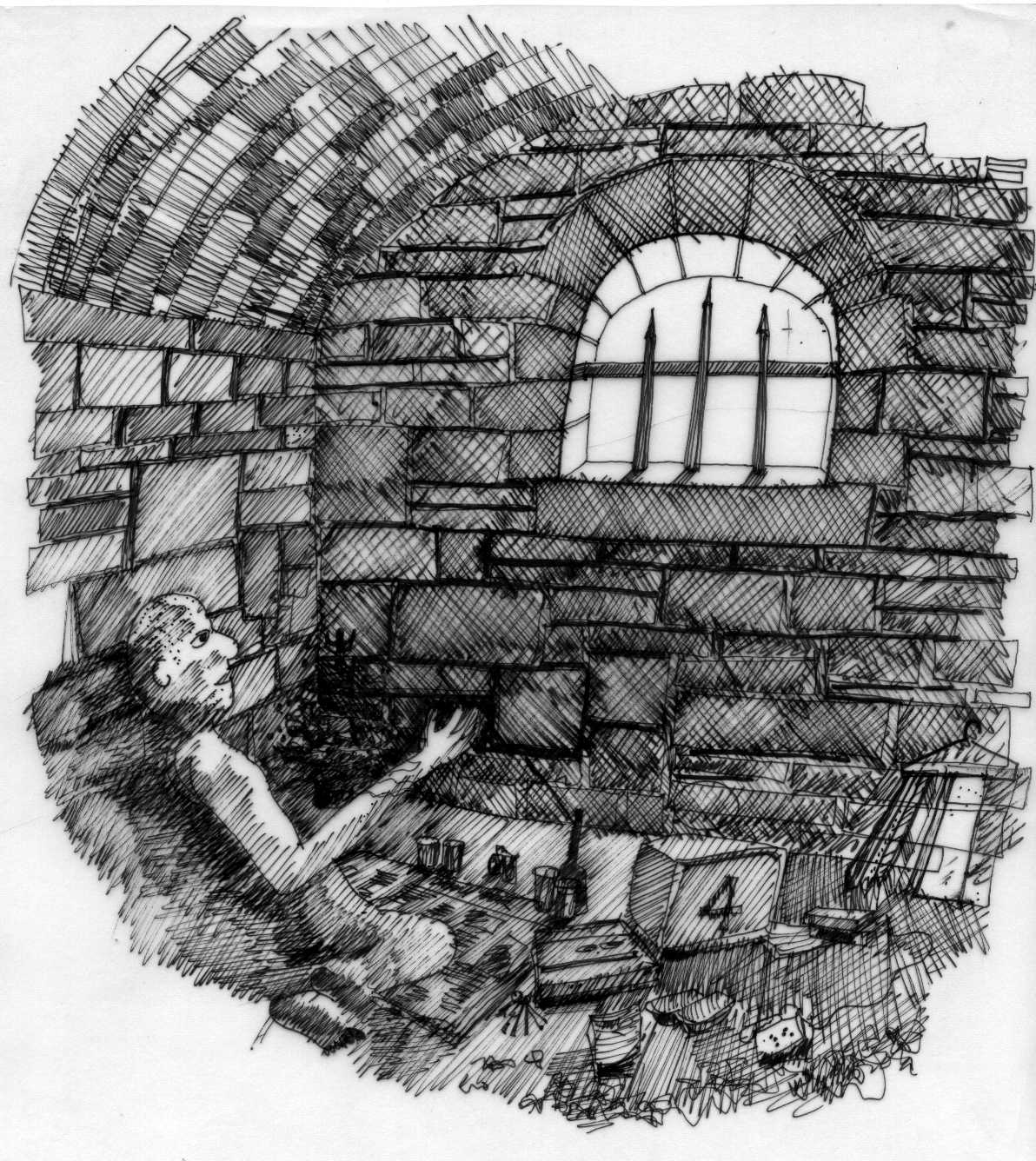
cellThe prison that I used to visit was just a few miles down the road.  With other volunteers we went there every Wednesday evening, to meet the men who had gathered, to share coffee and tea, to chat to study the bible and to pray together. It was the highlight of my week. There was something special and refreshing about these times. We were able to talk about real things, about things that mattered about families, sorrow and regret, loneliness and fear, life and death, heaven and hell.  There was no need to pretend. One of the officers was very supportive of us and on the way in one night he took me aside and said.  “You know what you folk do is really good. What these guys need is religion”  I didn’t have the wit to respond to him then but I thought about it afterwards. Religion was the last thing these guys needed. They needed a Saviour. We need a Saviour. One of the amazing truths that this week reminds us of is that there is that Saviour.
Crawford Mackenzie

Let us haste to Kelvingrove

They don’t ask me now, but people used to pose the question “As an architect and a Christian, wouldn’t you like to design a Church Building”   They were generally disappointed when I said “No, not really”  You see, I had no desire, inspiration or passion to design a church.  I had always believed (and still do) that the church is not a building.  It is the people of God wherever they are and wherever the met. The building was and is incidental.  That is not to say that I was not deeply affected and sometimes awe struck when visiting great church buildings: with the sheer majesty of the cathedral church of Notre-Dame de Reims, with the intimacy and simplicity of the parish church on Papa Stour, with monasteries in Romania and reformed churches in Hungary, with the work of Alvar Aalto and Corbusier especially with Notre Dame du Haut and many many more. Yet my appreciation of these building was perhaps esoteric and detached and I would have no conviction that they related at all to a real and living church, a gathering of God’s people for worship and service. There was a disconnect in my mind.

trinity church 1

I had qualified in 1973 and worked for 7 years with the late Jack Notman in Glasgow.  His output as far as building was not prolific but I learned much during my time with him. I still follow the principles that I learned then: designing buildings, that were of quality and would last, that would provide comfort and convenience and would be life affirming for those who use them, that were designed using the simple elements of space, light, materials, colour and textures, examining how spaces connect with each other, how people move though a building and what it says about who we are and what we are about. The aim was always to achieve something of real value with a timeless quality.

trinity church 3

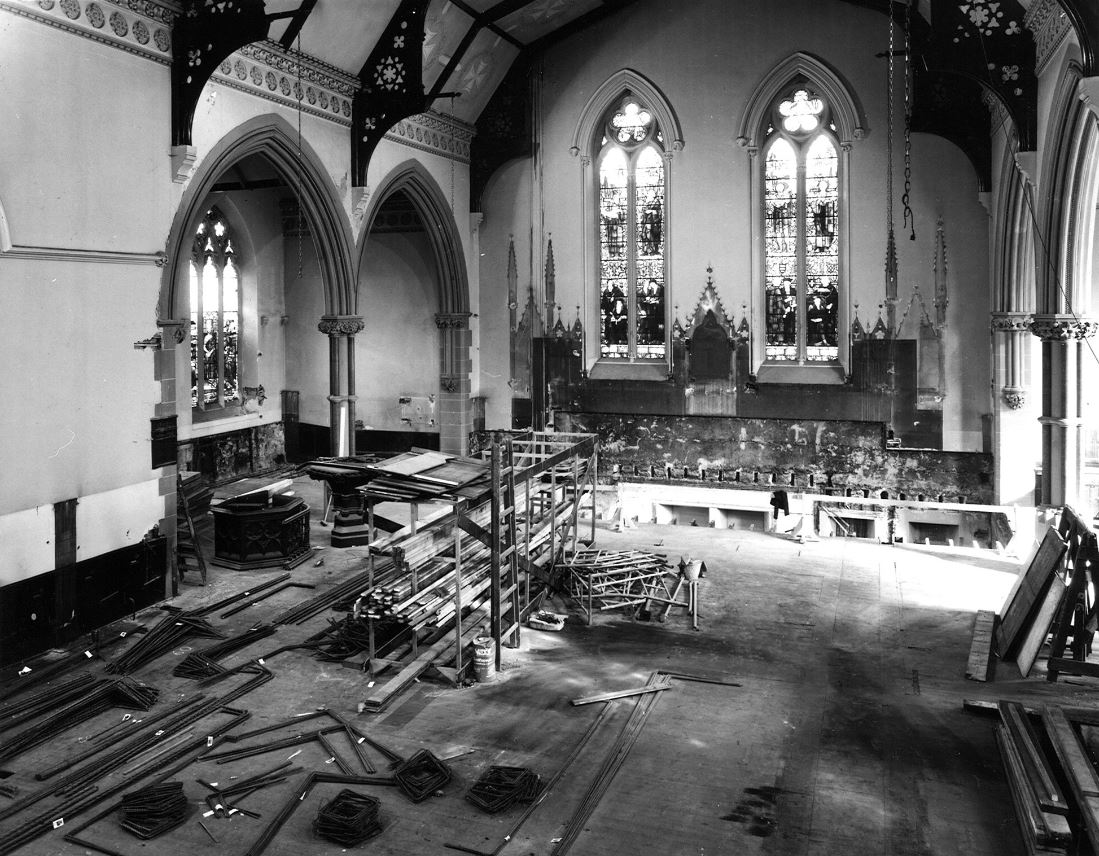
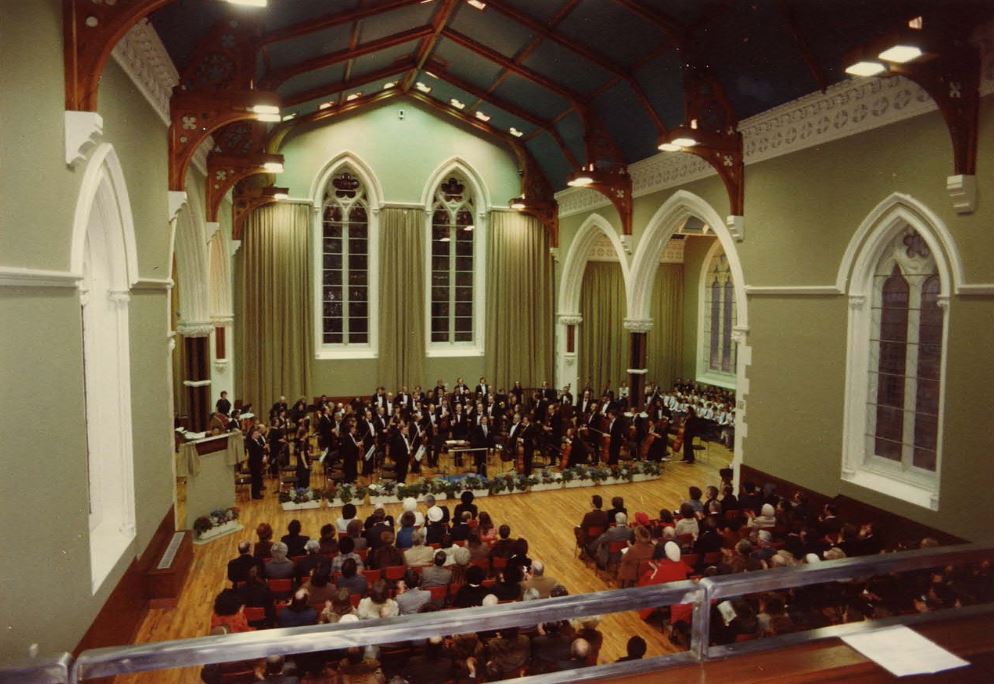
Towards the end of my time with Jack Notman, I was involved in a number of significant projects, among them, the conversation of  Trinity Congregational Church, in the west end of Glasgow, as a rehearsal and concert hall for the then Scottish National Orchestra (now the RSNO). It was a very interesting project as it involved changing the role of the building from an ecclesiastical one to an arts and entertainment one. It was challenge to de- ecclesiasticise the structure, while retaining its character. It was opened by Princess Margaret in 1978, became a very successful project, won several awards and remained the home for the orchestra up until very recently.   Not long after it was opened, I was at a concert with a friend, who was a minister and, during the interval, he turned to me and said “This would make a good church”.  The throw-a-way comment stuck with me and I came to see that Church Buildings are, in fact, important. They do matter and like the clothes we wear, affect how we feel about ourselves and how others view us.  So began, for me, a new direction in the adapting and refurbishing of church buildings, altering, extending, re-ordering, refreshing , preparing feasibility studies and designs for new buildings which has extended to over 50 individual projects for a wide variety of Christian denominations.

trinity church 2

So it is not difficult to understand my surprise and my delight when I heard, just this week, that Trinity Congregational Church designed by John Honeyman in 1863, converted into the Henry Wood Hall by Jack Notman in 1978 was to begin a third life as a Church Building in 2016 as The Tron Kelvingrove.

Crawford Mackenzie

(I was not the Job Architect on this project but helped with drawings and details. The person who was, and who did all the real work on it, was Nigel Duncan)


An Indian Summer

IMG_3327A morning walk through Magdalen in the eye of the storm under a clear blue sky, with a twin prop glinting on its descent  to the west, the Edinburgh train slowly snaking over the river, a dog walker in the distance and a thrush in song just feet away in the hawthorn, is shouting to me  “Spring” . But It could be an Indian summer, that surprising, delightful experience when after the dark depressing days, of winter you are treated to an unseasonal and unpredicted period of unbounded joy and colour, freshness, stillness and the unrestrained chatter of life.

This has been my Indian summer, one that is hard to describe and maybe impossible to put into words so it has to be in part metaphor.

It is climbing up a steep and unrelenting slope with small shafts of light through the trees the short rests and diversions before once again getting the head down,  up and up  with no hint of a summit or even a false summit.  You are fixed on the task, persistent and persevering. Then suddenly and surprisingly you come into a clearing, a plateau where the trees divide and the full strength of the sun breaks through and showers the ground and you in warmth and colour.   The soft wind circles among the leaves and the undergrowth, with the smell and taste of the finest wine, the clearest water the unmistakable sense of life. You know it’s not the end of the journey, it’s not even the beginning of the end, there are dark places still to pass through, swamps to cross  and a host of struggles to overcome but for now…..for now it is a time for refreshment and a simple basking  in the wonder of it all.

It is liberation from the dead hand of all the isms the world can conjure and the lifting of a cloud that had silently and subtly distorted the vision, fudged the issues and hid the horizon.

It is being open in a new way to the Holy Spirit’s leading into better places.

It is a new interest and thirsting for God’s word. The Word that created all things came to us, to save, heal, restore and call us to be his children. The Word that we find within the pages of the Bible, that treasure trove of never-ending wisdom and delight.  That Word that I want to hear first thing every morning, before the BBC, the Guardian, Al Jazeera or anything that the clever people might say.  That Word, not fully grasped or yet fully understood, I want to meditate upon and align my thoughts and will with it, through the long hours and until the day ends.

It is a new passion for prayer, for conversation with a heavenly father and these special moments when it is shared with others.

It is a new delight and unfettered joy in the experience of being one small part of the family of believers, that crosses every continent, every culture and language, every strata of society.

It is a new spring in the step not dictated by outside change nor brought about by circumstance induced euphoria, but from the sheer relief of touching reality

It is a sense of being pulled gently but firmly back to where I should have been all along. It is a new desire to live a holy life.

So in the plethora of mixed metaphors, through the long dark winter, this has been the Indian summer of my life.

Crawford Mackenzie

black watch

Living in the Compound

Stepping into the third world is a strong experience: like venturing beyond the garden gate for the first time, like being blindfolded and swung round in a party game. It is disorientating. All the comforting re-assuring things we rely on to guides us through normal life are gone. We find ourselves in a world without the norms and mores we expect and take for granted: of language, culture, food, smells, toilet and sleeping arrangements, customs, services, institutions and time, especially time. It is as if we are set loose in a wild landscape where nothing is certain any more.

In the west, it seems, we have a very skewed view of the reality of world. We describe the third world as if it were an undeveloped part of our world, when in fact it is the world and we are only a tiny part of it. We are in a very small walled garden, a compound with its walls, gates and barbed wire. Inside we are protected, safe and warm and free to think and discuss and plan and be creative without the crippling business of surviving.

My sense is that the walls of our compound will not, in time, be able to hold out against the inevitable tide which will overrun them. We will not be able to protect our way of life forever. It is not sustainable. Anyone can see that. It is patently clear, yet the impression I get is that we are in denial. We have confidence that we are able to respond to crises that come our way and carry on with our lives. Whether it is a financial collapse, a terrorist threat or the current refugees’ crisis we feel we will be able to sort it out and it won’t threaten our existence. (Interestingly enough the big three still very much threaten us and don’t show any sign of going away.) Even using the word “crises” suggests that they are nothing more than temporary irritants and so we are seduced into thinking that everything will be ok and our culture, so strong, it will see off all comers. Witness Andrew Neil’s rant on BBC (https://www.youtube.com/watch?v=WIKg3Qexn7U), following the Paris attacks. It is a belief that our democracy and civilisation will not only last for a thousand years but for ever.  This unashamed arrogance is astonishing as it is breath-taking in its blindness. We seem to have a collective short memory and are wilfully ignorant of the reality of history and of biblical prophecy.

So my heart is not in reinforcing the walls and securing the gates. My heart is for reaching out, sharing what we have left, while we still have it. All the good things:  our education, culture, structures and institutions, laws and orders, the sense of the common good, honesty and integrity in public life, what we have learned and found to work, most of which has, it has to recognised,  come from the Bible.  Sharing as much of it as we can before the wreckers and vandals destroy it completely. In my experience it is what the people of the world want. It is what they come here for. It is not for the weather. The business of trying to protect and shore up our way of life, our British values, whatever they might be, by building walls, and bolting doors is in itself a hopeless and futile project. It is futile because the destruction of our way of life is happening from within. The vandals are home grown. Bit by bit we have chipped away at the foundations, grubbed out the roots and the structure has become very unstable. It won’t take much to push it over. We have broken away from our moorings and set adrift in an uncertain sea, scrambling about for anything, any common denominator (usually the lowest)  that will hold the thing together. Yet still we carry an over inflated confidence in our ability to ride out any storm. We believe that our way, the way of liberal democracy, is somehow invincible. It isn’t.

This is not the time for erecting fences, getting the wagons into a circle or retiring into a lager. That will only prolong the agony and the inevitable fall. This is the time for breaking out. It is the time for opening our hearts and our lives and telling the Good News while people are still listening.

Crawford Mackenzie