Ounaminthe

street scene 2

Earlier this month I joined Ross McFarlane, a Trustee and Treasurer of Mission International (http://mission-international.org/) on a trip to Ounaminthe in Haiti. Ounaminthe is on the border with the Dominican Republic and we flew to San Domingo before taking the long bus journey across the country to Dajabon on the border. The Dominican Republic though itself a poor country is in stark contrast to Haiti. Everything changes when you cross the border. The lush vegetation with fields of rice, coffee plants and sugarcane give way dramatically to an arid landscape devastated by years of deforestation. It suddenly feels hotter, even in winter, and the atmosphere feels oppressive and tense. The whole business of crossing the border is a minefield of form filling waiting, passport checks, moving through gates, crossing the Massacre River, more forms more checks and all done with the aid of motorcycle taxis carrying any number of people and any load. The whole business was smoothed out, however, and eased through with the guidance of Pastor Rolex Poisson. He met us in San Domingo, saw us through and found us a room in a hotel just over the border.

hotel ideal

This was my second visit but I still wasn’t used to the shock of it. The grinding poverty gets you somewhere beneath the stomach. Visiting people in their homes and hearing some of their stories draws you face to face with the reality of life for so many people, perhaps the majority of people in the world. There was one visit that will haunt me for a very long time. The lady lived in house built from rusting steel panels, odd pieces of plywood and some cardboard. It was no more than 2.0m square with a double bed and no other furniture other than a tiny dresser with a few personal items a small box and some photographs. The interior was lined in places with plastic posters incongruously advertising petrol and perfume. Washing, toileting and cooking happened outside and there was little sign of any food being stored or even utensils. She had children, I don’t recall how many, and a husband who worked long hours in the “ free trade zone” reportedly manufacturing garments for Levi Strauss, Timberland, Tyco and others, no doubt for a pittance. But she didn’t complain or ask for money. Her worry was a neighbour who wanted her house, was determined to have it and threatened to kill her for it. He put a voodou curse on her and she would wake in the morning to find the bodies of dismembered dogs and cats strung around her door. The sense of evil was tangible.  Before travelling I read an article in the Guardian newspaper extolling the virtues of voodou (the soul of the Haitian people), showing how it has had such a bad press and how the Christians had caused so much harm by demonising it. The trouble was, what this woman faced was real demons and raw evil. There was nothing nice about it. She wanted us to pray for her, that the one true God would protect her and her family. For me, it pointed up the great divide between the musings of a privileged liberal tourist, living in the comfort and security of the west, free to pontificate on his take on “indigenous” religion, over against and the gruesome reality on the ground. We did the one thing we could do. We prayed. My colleague led us in prayer, against the forces of evil, for protection of the home and the family and also, following Jesus’ command, for her enemies the ones who had set out to kill her. The prayer was that they too would have their eyes opened and find mercy and forgiveness through Jesus.

courthouse scene

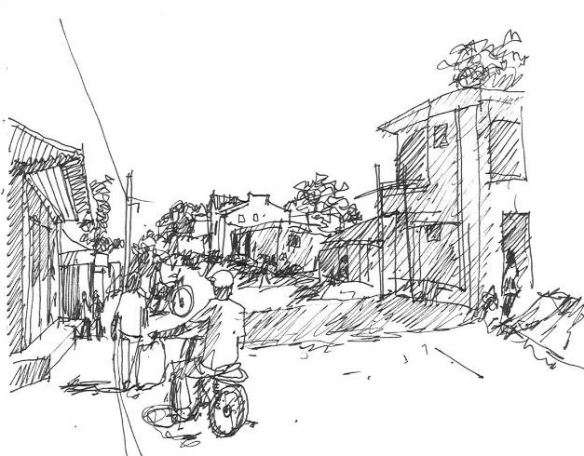
The church building is a large concrete box with a tin roof and arbitrary holes in the walls which let in air and light. It had been partially destroyed and the first team who came out from Scotland, six years ago (a video explain the story is at http://mission-international.org/projects/the-haiti-project/guild-information/), helped rebuild and enlarge it. It is on side street close to the courthouse and busy with stalls cooking and selling food, motorcycles, wheelbarrows, women with spectacular loads on the heads walking with incredible poise, children coming to and from school in smart uniforms and local folk just sitting in the shade chatting, checking mobile phones or simply watching the world go by. The church building is always open and a place to come to sit, and pray or simply lie out on the benches, in the relative cool and calm. There are services at midday and prayer praise services in the evening. On our second night we joined the 400 hundred, or so, people crammed into the building for the second half of a three hour service.  It was loud and riotous with hands in the air and heaving bodies swaying from side to side. It was led by the pastor’s assistant, an otherwise quiet and retiring young man, but here transformed into an astonishing firebrand preacher lifting the people to even greater heights of praise and at the same time bringing them down to almost complete quietness in sincere prayer. The cacophony of sound reminded me of Gaelic singing in the western Isles when it seems that voices come from all over the place rise, join together in remarkable harmonies and ebb as waves of the sea. Here the volume was of another order and pumped up by an energetic four piece band, the drummer with sweet pouring from his brow was crashing his cymbals like it was his last. Every volume was cranked up and the speakers could have come from a U2 concert. Now and again, but not often, it seemed the band were playing the same and sometimes in the same key. Well into the last hour, I was beginning to wilt, I crossed my legs and closed my eyes as if to pray but soon nodded off. I was woken by a young woman gripping my thigh and motioning me to uncross my legs. It was done very graciously and I took the lesson. The crossing of legs in front of an elder is extremely rude and especially disrespectful in God’s house.

The purpose of our visit was to meet with the pastor and elders to discuss plans for the school/church/community building and to finalise the deal for the purchase of the land. The project is the subject of a fundraising effort and you can read about it at http://mission-international.org/projects/the-haiti-project/ . The site itself is narrow and long and restricted on three sides. We were trying to design something that would accommodate a school and a church in an overlapping arrangement and at the centre create a small oasis of light and air and water as a gathering mingling space, linking all the accommodation together. It was good to be able to explain this in detail, with the elders, and talk over the plans in person. We also met a local engineer with experience in construction who would oversee the project. There are still many issues that will have to be resolved: How sure can we be that water sourced form a well on the site will not be contaminated? How much electricity could be generated form solar panels and by generation and the very obvious issue of designing a structure that would withstand an earthquake. We were able to revisit the site in town, to check measurements and another site on the edge of town which may be used as a retreat/health/sports facility. We also visited an America school in Ounaminthe,  set up by an American Missionary Society. It was on a completely different scale but it was comforting to note that the building had been designed with much the same principles. Being able to take a close look at the construction was immensely helpful. Apart from the size the project we are helping with is different in that it will be built by, and owned by, the local church for its work and witness within the community. It will mean that many children who would not otherwise receive an education will be able to participate in that most basic human right.

The most uplifting and most encouraging thing I took away from my visit was the children -the boys and girls walking to and from school carrying an air of promise of confidence and hope for a new future. It was not simply that they were smartly dressed, which they were, but that they walked with their heads held high and with a remarkable confidence that was striking; striking in comparison to the others- the half naked children playing and foraging among the garbage, who cannot share this privilege. The church’s plan then to build a school and, through a child sponsorship scheme, make it possible for children from the poorest of families to open a door into a world of learning and gain a foothold on a ladder of exploration through knowledge and understanding, cheered my little heart. That it would be a school inspired and run by local Christian believers, in the face of unbelievable difficulties, gave me special grounds for optimism.

On the journey back I picked up a copy of Malala Yousafzai’s story to read on the plane from Atlanta. It is a heart-warming tale and chimes so much with what I had been seeing, feeling and had experienced. Her story is shot through with faith, soaked in prayer and punctuated with acknowledgements of God’s hand on her life.  “We human beings don’t realise how great God is. He has given us an extraordinary brain and a sensitive loving heart. He has blessed us with two lips to talk and express our feelings, two eyes which see a world of colour of beauty, two feet which walk on the road of life, two hands to work for us, a nose which smells the beauty of fragrance and two ears to hear the words of love…. I thank Allah for the hardworking doctors, for my recovery and for sending us to this world where we may struggle for our survival… One person bullet hit me. It swelled my brain, stole my hearing and cut the nerve to my left face in the space of a second. And after that one second there were millions of people praying for my life and talented doctors who gave me my body back… I always prayed to God , ‘I want to help people and please help me to do that’” My prayer is that she and hundreds of children in Ounaminthe would one day know Jesus too.

Crawford Mackenzie

woman and barrow

Don’t Follow Your Heart

dont follow your heart“Don’t Follow Your Heart: God’s Ways Are Not Our Ways”    A book review

I am not a fan of books that are collections of reflections, meditations or devotional aids, the sort of thing that is so packed with anecdotes it is hard to find that thread that supposedly holds the whole thing together. I picked up Jon Bloom’s book  a month ago on the strength of a recommendation. I knew nothing about the author other than that he is connected with the “Desiring God” website http://www.desiringgod.org/ . I flicked through it, but was disappointed and put it down. It felt just like the kind of devotional book I disliked. More recently, however, I took it up again and decided to give it a fair try. I am glad I did. It is superb.

Jon Bloom is not a Dietrich Bonhoeffer, nor a G K Chesterton nor a John Flavell nor a C S Lewis, but he is able to communicate distilled biblical wisdom in an intensely practical and contemporary way.

The theme from the title is the exposure of that hopeless philosophy that says all you have to do is to follow your heart. “It is the creed embraced by millions of people. It’s a statement of faith in one of the great pop-cultural myths of the Western world – a gospel proclaimed in many of our stories, movies and songs. Essentially it’s a believe that your heart is a compass inside you that will direct you to your own true north if you just have the courage to follow it.” But Bloom says that the reality is something else. “Our hearts have sociopathic tendencies” if we actually think about it.

The 31 meditations are simple and short and many people will find them helpful. They are punctuated with pithy quotable sentences:
“When I am grumbling, I have lost touch with reality”
“The heart is a gauge not a guide”
“Your heart only tells you what you want, not where you should go”
“Our hearts cannot save us because what is wrong with our hearts is the heart of the problem”
“We find ourselves fighting an enemy that constantly seeks to alter our perception of reality…it seeks to make the most destructive things look desirable and tantalising”
“Jesus wants us to embrace the true prosperity gospel. He wants us to have treasure in heaven”

I would recommend it to any Christian, any follower of Jesus, who is seriously considering what it means to be a disciple today.

Crawford Mackenzie

In the clearing stands a boxer

boxer 2

Mez MacConnell  has an interesting and refreshing take on the Tyson Fury furore in his weblog. You can find it at http://20schemes.com/blog/. His main gripe is the way that the world heavyweight champion, suddenly thrust into the spotlight with cameras pointed at him and microphones thrust into his face, has been hung out to dry not just by the media and all the usual social pundits but by evangelical Christians who have taken him to task over his poor theology. MacConnell suspects, as do I, that the problem is not the boxer’s theology but his brashness, his coarseness, his lack of appropriate measured responses. He just says it. He is not bothered by what people think. He is not crippled by the fear of causing offence. He is a boxer and he throws punches. He is not a politician or a preacher. He is not the archbishop of Canterbury. He is simply a very young Christian in need of discipleship, support and prayer. I suspect that the people who didn’t like Tyson Fury won’t like Mez MacConnell either and probably for the same reasons. Yet his voice is one that needs to be heard if the church is to reach beyond its cosy comfortable culture to make disciples of all peoples in a world desperate to hear the good news.

.

Bartlett and the Bible

Glynn Harrison has written an extraordinary article in the new edition of “Solas”  “The long shadow” http://www.solas-cpc.org/wp/solas-resources/solas-magazine-launch/ with a very telling insight into the impact of the sexual revolution on our society, from a Christian world view. It is a challenging critique of how the church has failed to respond to this revolution, been caught napping and generally been unable to speak the good news into it. “Our culture has a good sense of what we are against, but what are we for?”  With some noble and notable exceptions, the church has, in the heat of the debate, been found wanting. There has been a deficit in intellectual integrity, a deficit in creativity, a deficit in articulation and a deficit in humour. In contrast the sexual revolution, which was a revolution of ideas, held all the cards and knew how to present the case: the use of the media, being one of the principal planks of that presentation.

For me, nothing exemplifies this more than “Bartlett and the Bible” a scene from the television series “The West Wing”. Jed Bartlett is the president of the USA and throughout the series he exudes a quality of humanity that somehow you do not expect in a politician, far less in the leader of the “free world”. You cannot but warm to him and take to the way he acts, how he responds to his aids and his family, how he seems to genuinely care for the people and takes the responsibility of his office so seriously and even how he shows his failings. It is very endearing. He comes over as such a genuinely good man that people often say they would vote for him if his name was on the ticket. Many have even tried to persuade Martin Sheen, who is a real person, to do just that to stand for president.

The scene in question can be found at https://www.youtube.com/watch?v=3CPjWd4MUXs but there is hardly any need to supply the link as you would have to be a stranger to YouTube or social media not to have come across it.  It is a very clever, funny and accomplished display by the president of the United States of America where he wipes the floor with the priggish upstart of a radio presenter, in what has become an iconic put down. At a stroke he exposes the inconsistency, hypocrisy, sheer stupidity, and the censorious and unloving attitude of the conservative biblical right. It’s a great laugh and so often as I have engaged with a facebook discussion on the subject it has been brought in to the thread to prove a point and it does just that. It is the killer punch which finally finishes off the argument. There is no more that can be said. The argument is won and lost.

But take a moment to look at the clip, for it is a perfect example of how the media can be used, not simply to make a point but, to close an argument. Ged Bartlett is a fictional character and the scene has been invented in someone’s mind. The dialogue has been written. It is not a real discussion. In fact it is not a discussion at all more of a monologue in which the president berates the limp presenter with a series of quick fire questions.  He does not allow her space or even the opportunity to answer the questions. The implication is clear. There are no answers. Any fool would see that.  He roundly castigates, viscously mocks and abuses her verbally, in way that would make any misogynist proud. It is a blatant display of merciless bullying by a powerful man, while his staff and advisors stand pathetically bye, sheepishly silent, unwilling or unable to take him to task. It ends when he completes the ritual humiliation by forcing her to stand, as everyone must do, in his presence. It is from every angle an appalling display yet I have heard nothing but applause for it and the way people continue to share the clip shows that they see nothing wrong with that aspect of it.

Leaving the bullying and the abuse to the side, the fact that there is no space for a response, a challenge or even offering answers to the questions, shows how propagandist the piece really is. Given the space and the opportunity, which any fair minded person would, there are very obvious responses that could be made. There are answers to the questions too. Timothy Keller at http://www.thegospelcoalition.org/article/making-sense-of-scriptures-inconsistency gives a perfectly reasoned and convincing response to the charge of inconsistency and others have done so too. But in the media world, these voices are hardly ever heard and it is left to a few to speak out, to challenge the omnidirectional flood of thought, to stick a head above the parapet and face the torrents of abuse and even death threats that come with the territory.

Glynn Harrison’s challenge to the church is simply to tell the good news into this long shadow. “The good news that God has not left us alone. In scripture he not only reveals who he is, but he shows us who we are: he speaks our identity to us.”. That will need resourcefulness, intellectual integrity commitment, creativity and courage, but more than anything, belief in it.

Crawford Mackenzie

The Home Report

section survey 2

I am quite sure there a lot of excellent ones out there, scrupulously prepared, clearly presented and most importantly relevant and helpful but, the trouble is, I haven’t seen or heard of one yet ….The Home report.  They were introduced by the Scottish Government in 2008 and with so much new legislation they were brought in with every good intention to deal with a perceived problem in the business of buying and selling property. If you are buying or selling a house in Scotland you will have to deal at some point with one. I don’t have the authority to say if it has helped or not. I cannot say if it has made the process of buying or selling easier or cheaper but in terms of helping to establish the actual condition of a property, I doubt if they are really worth the paper they are written on, or Kb’s of memory they take up.

In my experience they are often inaccurate, focus on relative trivialities and most worryingly overlook aspects which can be quite serious. The layout, which has generally been adopted, follows a model suggested by the Scottish Government with diagrams to explain what a roof is and what a window looks like and most of the actual text is taken up with exclusions and list of things that the report is not reporting on. The actual assessment of condition is cursory and simplified to a 1,2 or 3. This, certainly, makes it easy to understand but as far as a judgement on the state of the property is concerned, it is pretty well useless.

The worrying thing is that many prospective buyers place a lot of weight on the Home Report wrongly assuming that it is valuable assessment of the building’s fabric. It is not. I have had many clients who have been frustrated, sometimes angry and often bewildered when they discover, sometimes to their great cost, that serious and obvious issues have been overlooked or simply not spotted. The reports are written in such a way, with so many disclaimers, it is almost impossible to seek redress from the surveyor.

So my advice to the purchaser? Get the report read it and then bin it . If you want to find out about the building and what you might be committing yourself to, get someone who knows, to take the time to survey it, to think through the whole structure in all its aspects, to lift carpets, get under the floors through the hatches and up on the roof.  Be prepared for some disruptive investigations also, if these are called or. In many ways it is just like a medical examination, but one where you would want to know the full story and not simply be told you are a 1, 2 or a 3.

Crawford Mackenzie

roof survey 3

No Fool

An unusual package came to our island home on Eigg in the Western Isles sometime in the early sixties. It was a package of books. How they arrived there, who brought them or where they came from I do not know. It may have been a gift from someone or it may have been brought by Robert Crawford, a colporteur for the Bible Society who travelled around the islands of Scotland on a heavy Raleigh bicycle, carrying with him a selection of bibles and Christian literature. He often lodged with us while passing our way. There were four hardback titles with missionary themes. Two, “When iron gates yield” and “God holds the key” were written by Geoffrey Bull, a Christian missionary to China who had spent several years close to the Tibetan border before it was joined to the republic. During that time he was arrested, believed to be a spy and spent years in prison where he endured persistent brain washing techniques. The other two were devoted to the life of an American missionary, Jim Elliott who, along with four others was killed by the Huaorani in the Amazonian jungle of Ecuador in 1956.

IMG_0301

This was brought to mind when I heard, earlier this week, of the death of Elizabeth Elliott, who was Jim Elliott’s widow, and the author of “Through Gates of Splendour”  now recognised as an international best seller.  It was Jim Elliott’s story that captivated my young mind and I remember pouring  over the pictures, photographs of the men and their families blissfully happy, the jungle from the air,  the light aircraft, the landing strip, the days making their temporary home on the river bank and the graphic shots of bodies floating facedown in the water after the massacre. I was haunted by the look on the wives faces as they were trying to comprehend the tragic news

.IMG_0324

Later, I became enthralled by the story of these young men with their young wives and families and there calling to go to a remote and almost inaccessible part of the Amazonian jungle to tell the good news to the people there, a people untouched by any other civilisation and reported to be extremely hostile and murderous. I followed the preparation, the language study, the careful finding of a suitable landing site, the first forays, the landing, the first promising contact, the radio reporting back to their wives, and then the thrill of meeting a large number of the people who were making their way to where the missionaries had set up camp on the sandy bank of the river. There were great expectations of that meeting…and  then.. silence.IMG_0326

It was soon discovered that all five had been murdered. While the party who came up the river to retrieve the bodies were armed and warning shots were fired into the jungle, the missionaries themselves took with them no means of protection against a possible attack. They had come to bring the good news of Jesus Christ and the thought of being armed would have been anathema to them. They died at the hands of those they had come to reach with the Gospel.  They were true martyrs. I was fascinated by their story and later, as I read it for myself,  by the person and character of Jim Elliott as told by his wife in “The shadow of the Almighty”.

There was something about the man that tugged at my heart. His unbounded joy and delight in life in all its fullness and his love for his Lord. He was a true hero and someone that I, though still some years off being a teenager, wanted to emulate. I can still recall incidents from his life, as Elizabeth Elliott recorded them.  Incidents that showed this joy and excitement even in simple things when he threw himself into some activity, following the wisdom of Solomon:

“Whatever your hand finds to do, do it with all your might”,

when he saw with the hymn writer George Robinson:

 “Heav’n above is softer blue/ Earth around is sweeter green/Something lives in every hue”

and in his most famous quote  based, I am sure on Paul’s “for me to live is Christ to die is gain” :

“He is no fool / Who gives what he cannot keep/To gain/What he cannot lose”

There was something about the driving logic of this truth that was inescapable and impossible to deny. It in itself provided, for me,  a guiding light , a clearing, as I found my way through the jungle of teenage and adult life with its many traps, pitfalls and near disasters. It was a constant reminder that here we have no lasting city, but we seek the city that is to come.

IMG_0302The books like almost all of our parent’s possessions were lost, given away or simply thrown out. I’d have loved to have them still and to pour over them once again. But it doesn’t matter, I have them in my memory and am so grateful to Elizabeth Elliott for  recording them for us.

Crawford Mackenzie

What no Lines?

A Story Retold

ferrals le momtagne

It was a story C S Lewis told. Where, I do not know, although I am sure a trawl would find it. Like so much of what the great master has written and which I never tire of reading, it explained so beautifully and so clearly something that that has eluded my understanding for so long.  He could tell it so that the ordinary guy, me, could understand. But this story had a special significance, because it was about lines and I am a dealer in lines. Ever since, as a toddler, my mother shoved a pencil into my hand and directed it towards a sheet of paper, I have found my hand drawing. The call of the pencil pulls me. There is something about that newly sharpened point, not the boringly uniform cone from a pencil sharpener, but the hand formed chiselled point with its broad and short edges, long bluntness and wild sharpness and the virgin whiteness of blank cartridge which calls out, beckons me to explore, once again a new world of endless possibilities.

tioram

The lines define the space between them and they together tell the story. They are not the thing but only a hint of the thing. It is somewhere else. It is the lift of the wave in that moment before it crashes over the dark rocks, the memory of the sun drenched day high up on the ridge, the secrets hidden in the dark brooding wood, the fear, the love the joy  and the feeling you are trying to express. I earn my living by lines. Most often they are lines that define something which is not yet there. It is something that is yet to be and hoped for. The lines describe in two what becomes a reality in three. Most never get that far but are aborted abandoned and remain as frozen images in a gallery of lost causes. But what joy, when the lines come together with the spaces they define and with the graft and effort become a reality, a building  with real spaces and light and shapes and textures and movement and colour a home, a work place, a teaching space, a worship space, a healing place, a garden.

merton door

She was a woman of great courage, vision, intergrity and compassion. She cared and carried the heavy burden not just of her family but of her people in their plight.  She spoke out against the injustice, committed herself to the long haul and relentless and tirelessly pursued the rightness of the cause.   She put her life on the line. So it was, that her enemies frustrated in every attempt to silence her, finally had her arrested on a false charge and committed to a life in prison with no prospect of release. Fearful that they would have a martyr on their hands, they took great care of her and in her prison, provided for her health and safety, convenience and comfort. They gave special care as she carried her child and in the delivery she was offered the best facilities and support.  The little boy was born into a safe protected world with everything he needed and plenty of stimulus to grow and learn but with one major handicap. He did not see, or breathe or taste the outside world. All he knew was the square of blue above the exercise yard, the square of light  that Oscar Wilde describes in Reading Jail:

“I never saw a man who looked/With such a wistful eye/Upon that little tent of blue/That prisoners call the sky”

As the cheery lad grew his mother wanted to tell him of the outside world and prepare him for the time when he would be released, even if she never saw it herself. She was not an artist but she knew how to draw and with pen and paper she taught him each day, drawing from her memory the animals, flowers, mountains and waters, towns and cities and people at work and play, of explorations and discoveries, and as the boy grow he was totally enthralled in this world she had described and looked forward to the day when he would see it.  He loved the stories and they provided great joy and release in their limited environment. And then it happened. One day as she was drawing and describing a scene, he said something which brought her up with a jolt. It dawned on her that he had not grasped anything she had been teaching him.  She stopped and began to explain that the real world was not pictures, not pencil and ink, lines of paper, not shapes in two dimension but real things. For the first time in his life great sadness creased across his face and a look of terrible disappointment clouded his eyes.

“What…in this real world there are no lines?”


Crawford Mackenzie


A Purposeful Habit 3

Telling the Good News

leaving 2

It was a bright Saturday morning in September. With a fresh breeze and a clear sky we were sailing across the Clyde from  Ardrossan to Brodick, coming late to join a team on a mission to bring the Good News to the hordes of young folk from Glasgow crowding into the Island for one last fling before the winter . It was “Operation Arran”. We were not the only ones who missed the connections the night before and we gathered on the top deck to get reconnected. Among us was Captain Stephen Anderson. He was an evangelist, a former farmer and soldier whose parents had high hopes, at one time, that he would become  the Raj of India, before independence changed all that. He had turned his back on his former life and worked full time, to use the gift that God had given him, to tell the Good News of Jesus to the high and mighty, the ordinary folk and odd balls, the smart guys and rough diamonds and anyone and everyone he met, wherever he went.

Our paths had crossed before on two occasions. One was at Port Seaton holiday camp on the forth estuary. I clearly remembered arriving at the site and being dropped off by my future in-laws who, on seeing the down at heel huts and the noisy crowds made a quick exit. I was to sing for a children’s event outside the tiny wooden chapel at the centre of the camp. An evening service had been interrupted the previous week when a motorcyclist drove throughout the main door up the aisle and out through the south door. It was hot and sweaty and the crowds of children loud and sticky and over enthusiastic would hug you and leave you with the strong desire to start scratching. When I came to sing, I was crowded in and could hardly hear my own voice far less the guitar but when I began something strange happened. The crowd of children and young folk and hangers on were suddenly hushed and seemed to be hanging on every word and when I finished my set Stephen spoke to this rapt audience about Jesus and in his characteristic winsome way.

The second was in the BBC studios in Queen Street Edinburgh, to record a series for “thought for the day” on what was then called the Home Service. The equipment seemed ancient and the microphone looked like it came from the ark. There were lots of tests and misfires before the recordings were put down. I had simply to sing a line of a song as an intro and then stop. There was no cutting and pasting.  While we were sitting in the studio with the producer and technician next door, trying to sort things out,  Stephen suggested we pray. So right there in the dark panelled draughty room with the floor covered in coiled cables and  strange pieces of equipment and quite unaware than anyone was listening,  we bowed our heads and  prayed that God would use this time to bring the message to many across  Scotland . When the team came through to get us started, they were clearly moved.  The prayer had come right through to the monitor.

So there we were, up on deck with crowds of others in the warm sun gliding across the Clyde when Stephen said ” Do you have your guitar with you? Get it out and let’s sing” I was shocked and didn’t like the idea but he was persuasive and we did. Others pulled their instruments from there cases and we gathered in a circle and sang through many of the songs that had become part of our life. Now everyone was listening and Stephen used that moment to speak directly to the crowds of fellow travellers, sitting on the benches and hanging over the deck and gazing out to sea , to tell them who were we were, why we were going to Arran and in the simplest and natural way  why Jesus. On the Sunday afternoon at three when the pub up the hill, discouraged its customers, we were sitting around in the local church hall. Many revellers were diverted into the hall and joined in with the singing, taking over the venue. It became very raucous and we felt we had just about lost control. One of the girls sang “Amazing Grace” recently made into a hit by Judy Collins and the crowd became strangely silent. When she finished, a hush descended and once again Stephen seized the opportunity and speak directly to the crowd.

I learned so much from the man and this was all brought back to mind recently, when I was asked to convene the evangelism committee in our local church. I knew I was not an evangelist. That gift had not been given to me. I do know those for whom the gift has been given and it is a wonderful thing to see, but I knew that was not me.  But reading Paul’s letters, I discovered that Timothy didn’t seem to be an evangelist either yet Paul still encouraged him to “do the work of an evangelist”. So it is for everyone who is a follower of Jesus. We may not have the gift but if we love him, it must be part of our DNA to tell the Good News, for that is what evangelism is.  Leslie Newbigin put it succinctly when he was talking about the difficulties in communicating the gospel to the people of his inner city parish in Birmingham

“How can this strange story of God made man, of a crucified saviour, of resurrection and new creation become credible for those whose entire mental training has conditioned them to believe that the real world is the world that can be satisfactorily explained and managed without the hypothesis of God? I know of only one clue to the answering of that question, only one real hermeneutic of the Gospel: congregations who believe it.

Does that sound too simplistic? I don’t believe it is.  Evangelism is not some kind of technique we use to persuade people to change their minds and think like us.  Evangelism is the telling of good news, but what changes people’s minds and converts their wills is always a mysterious work of the sovereign Holy Spirit and we are not permitted to know more than a little of his secret working.  But – and this is the point – the Holy Spirit, is present in the believing congregation gathered for praise and the offering up of spiritual sacrifice, scattered throughout the community to bear the love of God into every secular happening and meeting.”

 So we could ask ourselves why is that, as followers of Jesus, we seem to be so poor at this task? Why do we seem so reluctant to tell this Good News? Why do we drag our feet and need to be coerced and organised into doing it? The answer, which we would probably not really want to think about and could be quite disturbing, is that maybe we are not ourselves sure if we believe it.

In the past week, I met up with people on two occasions who bounded up to me, their faces full of joy and excitement, with a generous hug and desperate to tell me-  “I’ve got Good News!” One was over a new job the other that her mother’s visa had at last come through and she was able to come and visit.   And I thought “Yes – that’s it”

Crawford Mackenzie

leaving

Bearing Shame

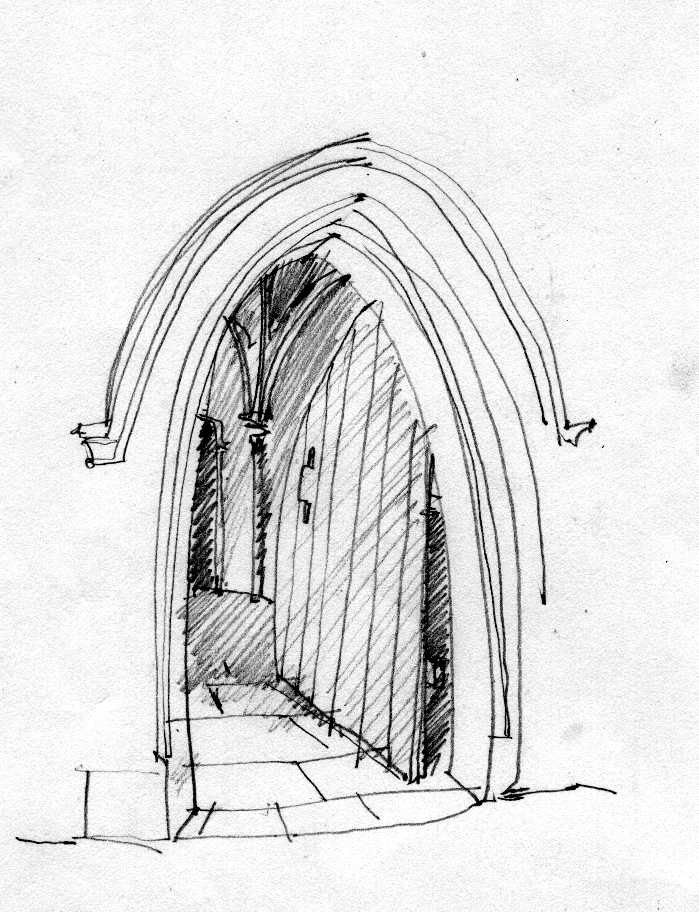
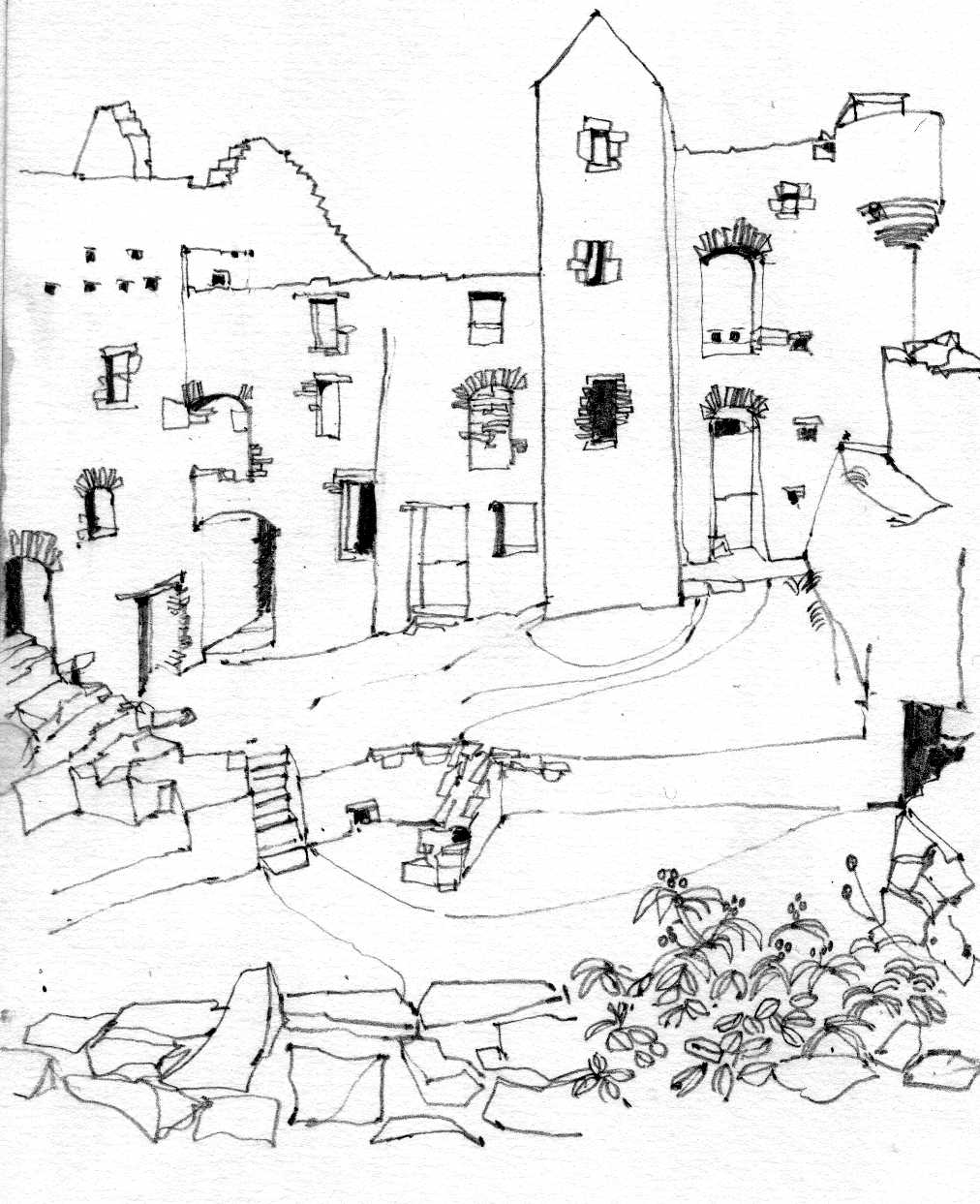
Jerusalem

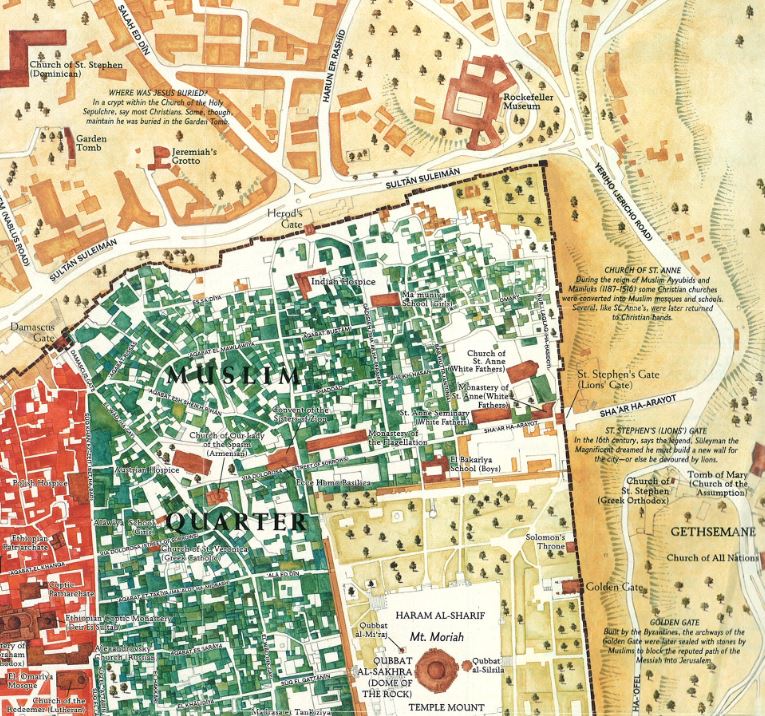
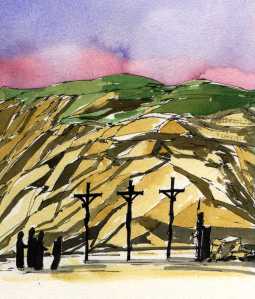
At the back of the hotel, where we were staying, just outside the walls of the old city and close to the Damascus gate there was a marshalling yard where buses were turning, reversed and revving with cars and taxis horns from early in the morning.  You couldn’t sleep after that.  At the edge of the yard was an outcrop of limestone rock pitted and hollowed with small caves and vegetation. If you looked closely it would not be too difficult to imagine the shape of a face or a skull in the fissured rock. I fancied it was here.  I somehow imagined it as a place like this, not up a hill, but on a principal artery leading out of Jerusalem to Damascus, a very public place for a very public spectacle, deliberately chosen by the Roman occupiers to make examples of those who would defy their authority, to terrorise any would be rebels and subdue these troublesome Jews.  The chosen execution of nailing the criminal through the hands and the feet to a wooden post was itself designed to inflict the greatest pain and prolonged suffering. But the greatest terror was the shame of it, the curse of it. The words written on the cross in three languages were “The King of the Jews”  but the word written across this whole defining scene, as if in six foot letters or in indelible ink was “SHAME”.

 They say that shame is an emotion that has been banished and eradicated from our contemporary life. I don’t believe it. I have seen it deeply ingrained on the faces of the men who I used to visit in prison. The awful sense of having been so bad that the punishment was incarceration, with their freedom removed and the forced separation from the friends, family and their normal lives. I found it a very powerful and strange experience on these visits and very hard to deal with. The worst point was when you said your farewells and left, they to their cells and we to our freedom. I have also known shame in my own heart: the emotion that goes beyond an awareness of guilt provoked by an active conscience that could not be silenced. It goes beyond the sense of failure and foolishness to the shock and realisation that you could be such a person who would think these thoughts say these words and do these deeds.  It is one, if not, the most powerful emotion in the human spirit, which has the ability to permanently cripple and ultimately destroy any sense of self-worth or value. It is present in the memory of punishments being meted out, the beltings, the penalties, the exclusions, the reprimands, the forfeit of freedom and, in the ultimate case, the forfeit of one’s life.

 There is something here that is so difficult to comprehend. It is hard to begin to feel yourself into the situation.  It is hard to make sense of it and it proffers a very disturbing and unsettling problem. The prospect that you could be found guilty of a crime so heinous that it could justify the forfeiting of your life, stirs at something so deep and so worrying, way beyond any fear or distress and I think it touches the rawness of shame.   You would have to be a clinical rebel if you could shut your heart to its sting.

 So on this day, this Good Friday and on every day, I want to remember the one who took my shame who bore it willingly so that I can stand guilt and shame free before the Holy God now and when I see him face to face.

calvary

As Philip Bliss has it:

Bearing shame and scoffing rude,

In my place condemned He stood…

Hallelujah,   What a saviour!

Crawford Mackenzie

A Purposeful Habit 2

cellThe Four Disciplines

I met Dan (not his real name) some years ago when I was visiting a local prison not far from where I live.  I was with a small group of volunteers who went into the prison once a week to meet, chat, share coffee and biscuits and have a bible study  with the men who were interested enough to come. Dan shared in the sessions and we talked a lot. He seemed genuinely interested in discovering Jesus and, I believe, came to faith in him over that time. As volunteers we would often ask after home, and family and work and how long they had before release, but we had one self-imposed rule, which we rigidly kept to – never to ask why they were there. It was simply not our business or our concern. Occasionally, however, some would tell us and Dan let me see his papers: the documents that had been put together to process his appeal for parole.  As well as making an assessment on his character and his suitability for release, they described the actual crime in forensic detail. It involved arson and murder and made for chilling reading. It was hard to reconcile these awful facts with the man sitting beside me drinking coffee and the kind of person that your heart seems to go out to. But sharing in our study of the bible I knew and we knew that before God we were all in the same boat and neither of us had a leg to stand on.

When it came close to his release date or “liberation” as they called it,  Dan became more anxious about how he would be able to continue in his Christian life outside, when he was back in his old environment and under the influence of his old friends. He feared that he would simply return to his old ways.  “I don’t think my faith is strong enough” he would say, “I don’t think I have a good enough hold on God”. I did my best to reassure him by pointing out that it was God who had a hold of him and I tried to offer some practical advice. I suggested four things that were essential in the Christian life: things that you had to work at and make your habit, because they didn’t come naturally. At times it would be a struggle, often a battle as malign and subtle forces pitted against you, intent on damaging your new life and your new desire to follow Jesus Christ.  You had to practice them and continue practising, so that they would become part of you. It had to be a discipline and a regular one – weekly, daily, hourly, and at all times.

If you know anything about the Christian Faith you will know that they are:

  • Praying to God by his Spirit in Jesus’ name
  • Reading the Bible, recognising it as God’s Holy Word, inspired by His Spirit proclaiming Jesus
  • Meeting with other followers of Jesus, to worship God
  • Doing Good, as an expression of your love for God, by serving others, with the help of his Spirit, in Jesus’ name

They are not, were not and never were rule things. Things you had to do to please God. Things if you do better and longer with more zeal and effort would somehow achieve for you a higher place in the scheme of things. It is not the legalism that Paul, in his letters, exposes with such ruthlessness, but aids, means, helps and the essential life blood, food, and fresh air to live a life in gratitude to God.

I lost contact with Dan soon after his release and often wonder where he is and how he is doing. I see him in my dreams sometimes. I keep praying for him, I have never forgotten him and I am slowly learning to listen to my own advice to him – to practice these disciplines.

Crawford Mackenzie