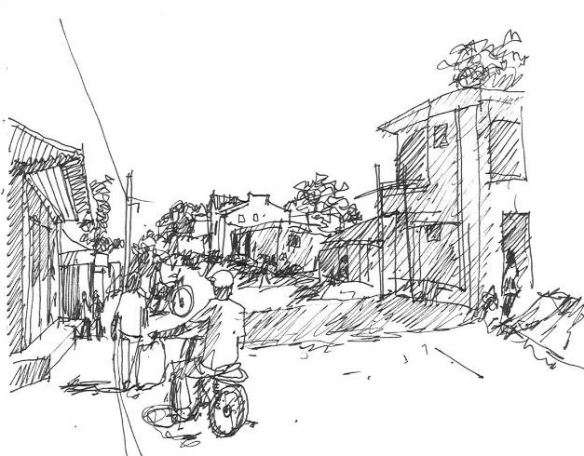
Earlier this month I joined Ross McFarlane, a Trustee and Treasurer of Mission International (http://mission-international.org/) on a trip to Ounaminthe in Haiti. Ounaminthe is on the border with the Dominican Republic and we flew to San Domingo before taking the long bus journey across the country to Dajabon on the border. The Dominican Republic though itself a poor country is in stark contrast to Haiti. Everything changes when you cross the border. The lush vegetation with fields of rice, coffee plants and sugarcane give way dramatically to an arid landscape devastated by years of deforestation. It suddenly feels hotter, even in winter, and the atmosphere feels oppressive and tense. The whole business of crossing the border is a minefield of form filling waiting, passport checks, moving through gates, crossing the Massacre River, more forms more checks and all done with the aid of motorcycle taxis carrying any number of people and any load. The whole business was smoothed out, however, and eased through with the guidance of Pastor Rolex Poisson. He met us in San Domingo, saw us through and found us a room in a hotel just over the border.
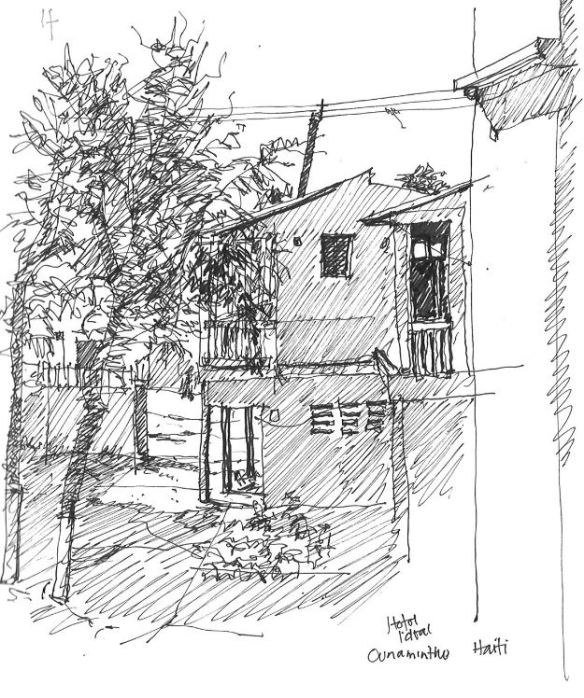
This was my second visit but I still wasn’t used to the shock of it. The grinding poverty gets you somewhere beneath the stomach. Visiting people in their homes and hearing some of their stories draws you face to face with the reality of life for so many people, perhaps the majority of people in the world. There was one visit that will haunt me for a very long time. The lady lived in house built from rusting steel panels, odd pieces of plywood and some cardboard. It was no more than 2.0m square with a double bed and no other furniture other than a tiny dresser with a few personal items a small box and some photographs. The interior was lined in places with plastic posters incongruously advertising petrol and perfume. Washing, toileting and cooking happened outside and there was little sign of any food being stored or even utensils. She had children, I don’t recall how many, and a husband who worked long hours in the “ free trade zone” reportedly manufacturing garments for Levi Strauss, Timberland, Tyco and others, no doubt for a pittance. But she didn’t complain or ask for money. Her worry was a neighbour who wanted her house, was determined to have it and threatened to kill her for it. He put a voodou curse on her and she would wake in the morning to find the bodies of dismembered dogs and cats strung around her door. The sense of evil was tangible. Before travelling I read an article in the Guardian newspaper extolling the virtues of voodou (the soul of the Haitian people), showing how it has had such a bad press and how the Christians had caused so much harm by demonising it. The trouble was, what this woman faced was real demons and raw evil. There was nothing nice about it. She wanted us to pray for her, that the one true God would protect her and her family. For me, it pointed up the great divide between the musings of a privileged liberal tourist, living in the comfort and security of the west, free to pontificate on his take on “indigenous” religion, over against and the gruesome reality on the ground. We did the one thing we could do. We prayed. My colleague led us in prayer, against the forces of evil, for protection of the home and the family and also, following Jesus’ command, for her enemies the ones who had set out to kill her. The prayer was that they too would have their eyes opened and find mercy and forgiveness through Jesus.
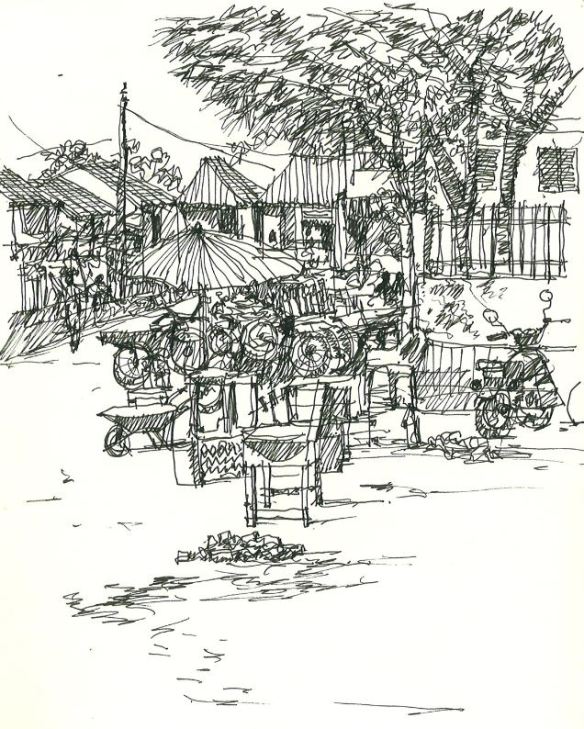
The church building is a large concrete box with a tin roof and arbitrary holes in the walls which let in air and light. It had been partially destroyed and the first team who came out from Scotland, six years ago (a video explain the story is at http://mission-international.org/projects/the-haiti-project/guild-information/), helped rebuild and enlarge it. It is on side street close to the courthouse and busy with stalls cooking and selling food, motorcycles, wheelbarrows, women with spectacular loads on the heads walking with incredible poise, children coming to and from school in smart uniforms and local folk just sitting in the shade chatting, checking mobile phones or simply watching the world go by. The church building is always open and a place to come to sit, and pray or simply lie out on the benches, in the relative cool and calm. There are services at midday and prayer praise services in the evening. On our second night we joined the 400 hundred, or so, people crammed into the building for the second half of a three hour service. It was loud and riotous with hands in the air and heaving bodies swaying from side to side. It was led by the pastor’s assistant, an otherwise quiet and retiring young man, but here transformed into an astonishing firebrand preacher lifting the people to even greater heights of praise and at the same time bringing them down to almost complete quietness in sincere prayer. The cacophony of sound reminded me of Gaelic singing in the western Isles when it seems that voices come from all over the place rise, join together in remarkable harmonies and ebb as waves of the sea. Here the volume was of another order and pumped up by an energetic four piece band, the drummer with sweet pouring from his brow was crashing his cymbals like it was his last. Every volume was cranked up and the speakers could have come from a U2 concert. Now and again, but not often, it seemed the band were playing the same and sometimes in the same key. Well into the last hour, I was beginning to wilt, I crossed my legs and closed my eyes as if to pray but soon nodded off. I was woken by a young woman gripping my thigh and motioning me to uncross my legs. It was done very graciously and I took the lesson. The crossing of legs in front of an elder is extremely rude and especially disrespectful in God’s house.
The purpose of our visit was to meet with the pastor and elders to discuss plans for the school/church/community building and to finalise the deal for the purchase of the land. The project is the subject of a fundraising effort and you can read about it at http://mission-international.org/projects/the-haiti-project/ . The site itself is narrow and long and restricted on three sides. We were trying to design something that would accommodate a school and a church in an overlapping arrangement and at the centre create a small oasis of light and air and water as a gathering mingling space, linking all the accommodation together. It was good to be able to explain this in detail, with the elders, and talk over the plans in person. We also met a local engineer with experience in construction who would oversee the project. There are still many issues that will have to be resolved: How sure can we be that water sourced form a well on the site will not be contaminated? How much electricity could be generated form solar panels and by generation and the very obvious issue of designing a structure that would withstand an earthquake. We were able to revisit the site in town, to check measurements and another site on the edge of town which may be used as a retreat/health/sports facility. We also visited an America school in Ounaminthe, set up by an American Missionary Society. It was on a completely different scale but it was comforting to note that the building had been designed with much the same principles. Being able to take a close look at the construction was immensely helpful. Apart from the size the project we are helping with is different in that it will be built by, and owned by, the local church for its work and witness within the community. It will mean that many children who would not otherwise receive an education will be able to participate in that most basic human right.
The most uplifting and most encouraging thing I took away from my visit was the children -the boys and girls walking to and from school carrying an air of promise of confidence and hope for a new future. It was not simply that they were smartly dressed, which they were, but that they walked with their heads held high and with a remarkable confidence that was striking; striking in comparison to the others- the half naked children playing and foraging among the garbage, who cannot share this privilege. The church’s plan then to build a school and, through a child sponsorship scheme, make it possible for children from the poorest of families to open a door into a world of learning and gain a foothold on a ladder of exploration through knowledge and understanding, cheered my little heart. That it would be a school inspired and run by local Christian believers, in the face of unbelievable difficulties, gave me special grounds for optimism.
On the journey back I picked up a copy of Malala Yousafzai’s story to read on the plane from Atlanta. It is a heart-warming tale and chimes so much with what I had been seeing, feeling and had experienced. Her story is shot through with faith, soaked in prayer and punctuated with acknowledgements of God’s hand on her life. “We human beings don’t realise how great God is. He has given us an extraordinary brain and a sensitive loving heart. He has blessed us with two lips to talk and express our feelings, two eyes which see a world of colour of beauty, two feet which walk on the road of life, two hands to work for us, a nose which smells the beauty of fragrance and two ears to hear the words of love…. I thank Allah for the hardworking doctors, for my recovery and for sending us to this world where we may struggle for our survival… One person bullet hit me. It swelled my brain, stole my hearing and cut the nerve to my left face in the space of a second. And after that one second there were millions of people praying for my life and talented doctors who gave me my body back… I always prayed to God , ‘I want to help people and please help me to do that’” My prayer is that she and hundreds of children in Ounaminthe would one day know Jesus too.
Crawford Mackenzie


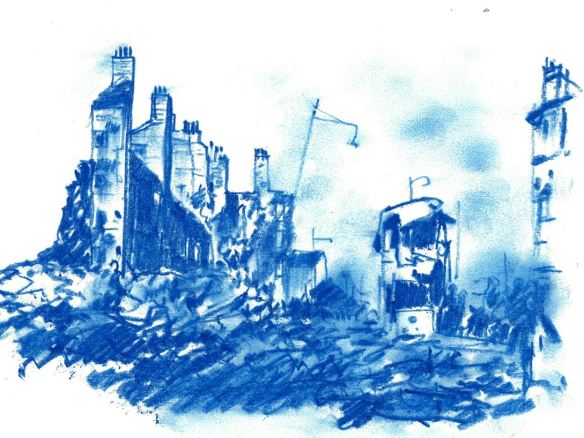 I was reminded, this week, of a series of programmes produced by Radio Scotland, that I listened to some years ago entitled “The people’s war”. It was a simple collection of interviews and voices of ordinary folk who had lived through and survived the Second World War. They were not soldiers, officers, politicians or important players but folk caught up in an event quite beyond their control. I was deeply moved by the simple ordinariness of the stories in the face of great horrors. I wrote to the BBC afterwards expressing my appreciation and asking if they would repeat the series. They said they had no plans to do so and I have tried several times to find the recordings on archives with no success. But I remember the stories very clearly.
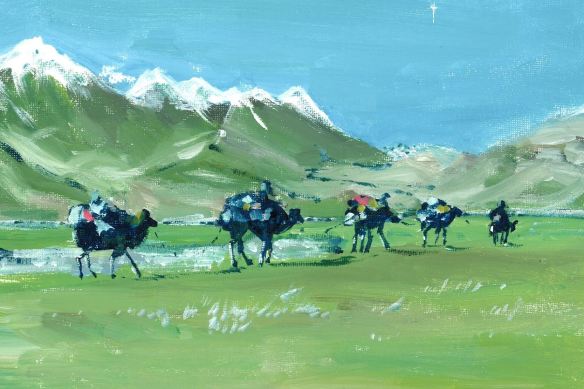
 I don’t where I heard it, or from whom, but it was about a wise Nigerian pastor who was preaching to a congregation of restless young men in a town north of Abuja on the Jos plateau. They were disaffected, frustrated and angry young men and he was struggling to get through to them and beginning to lose their attention. Some had been drawn to a new awakening in the old religions in the demonstrable power of the witch doctor, Some were stirred by Marxism while others were beginning to see Islam as the one true religion.
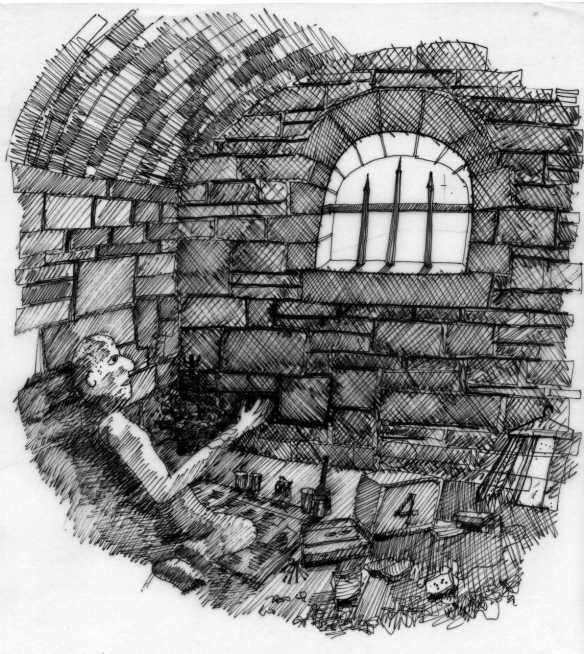 The prison that I used to visit was just a few miles down the road. With other volunteers we went there every Wednesday evening, to meet the men who had gathered, to share coffee and tea, to chat to study the bible and to pray together. It was the highlight of my week. There was something special and refreshing about these times. We were able to talk about real things, about things that mattered about families, sorrow and regret, loneliness and fear, life and death, heaven and hell. There was no need to pretend. One of the officers was very supportive of us and on the way in one night he took me aside and said. “You know what you folk do is really good. What these guys need is religion” I didn’t have the wit to respond to him then but I thought about it afterwards. Religion was the last thing these guys needed. They needed a Saviour. We need a Saviour. One of the amazing truths that this week reminds us of is that there is that Saviour.
 A morning walk through Magdalen in the eye of the storm under a clear blue sky, with a twin prop glinting on its descent to the west, the Edinburgh train slowly snaking over the river, a dog walker in the distance and a thrush in song just feet away in the hawthorn, is shouting to me “Spring” . But It could be an Indian summer, that surprising, delightful experience when after the dark depressing days, of winter you are treated to an unseasonal and unpredicted period of unbounded joy and colour, freshness, stillness and the unrestrained chatter of life.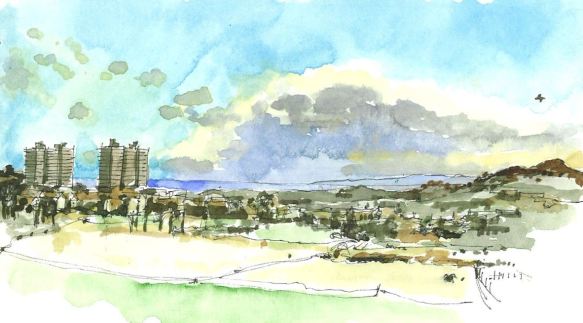
 “Don’t Follow Your Heart: God’s Ways Are Not Our Ways” A book review
 Restless Spirit