An Indian Summer

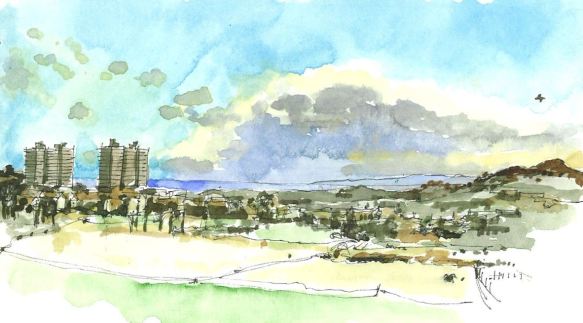
IMG_3327A morning walk through Magdalen in the eye of the storm under a clear blue sky, with a twin prop glinting on its descent  to the west, the Edinburgh train slowly snaking over the river, a dog walker in the distance and a thrush in song just feet away in the hawthorn, is shouting to me  “Spring” . But It could be an Indian summer, that surprising, delightful experience when after the dark depressing days, of winter you are treated to an unseasonal and unpredicted period of unbounded joy and colour, freshness, stillness and the unrestrained chatter of life.

This has been my Indian summer, one that is hard to describe and maybe impossible to put into words so it has to be in part metaphor.

It is climbing up a steep and unrelenting slope with small shafts of light through the trees the short rests and diversions before once again getting the head down,  up and up  with no hint of a summit or even a false summit.  You are fixed on the task, persistent and persevering. Then suddenly and surprisingly you come into a clearing, a plateau where the trees divide and the full strength of the sun breaks through and showers the ground and you in warmth and colour.   The soft wind circles among the leaves and the undergrowth, with the smell and taste of the finest wine, the clearest water the unmistakable sense of life. You know it’s not the end of the journey, it’s not even the beginning of the end, there are dark places still to pass through, swamps to cross  and a host of struggles to overcome but for now…..for now it is a time for refreshment and a simple basking  in the wonder of it all.

It is liberation from the dead hand of all the isms the world can conjure and the lifting of a cloud that had silently and subtly distorted the vision, fudged the issues and hid the horizon.

It is being open in a new way to the Holy Spirit’s leading into better places.

It is a new interest and thirsting for God’s word. The Word that created all things came to us, to save, heal, restore and call us to be his children. The Word that we find within the pages of the Bible, that treasure trove of never-ending wisdom and delight.  That Word that I want to hear first thing every morning, before the BBC, the Guardian, Al Jazeera or anything that the clever people might say.  That Word, not fully grasped or yet fully understood, I want to meditate upon and align my thoughts and will with it, through the long hours and until the day ends.

It is a new passion for prayer, for conversation with a heavenly father and these special moments when it is shared with others.

It is a new delight and unfettered joy in the experience of being one small part of the family of believers, that crosses every continent, every culture and language, every strata of society.

It is a new spring in the step not dictated by outside change nor brought about by circumstance induced euphoria, but from the sheer relief of touching reality

It is a sense of being pulled gently but firmly back to where I should have been all along. It is a new desire to live a holy life.

So in the plethora of mixed metaphors, through the long dark winter, this has been the Indian summer of my life.

Crawford Mackenzie

black watch

Ounaminthe

street scene 2

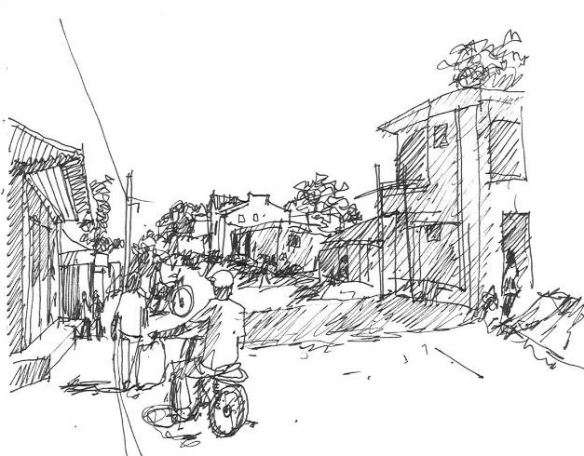
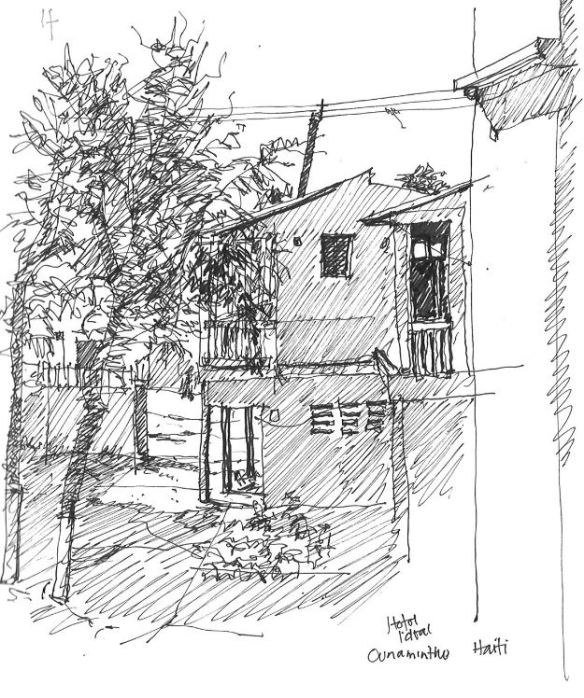
Earlier this month I joined Ross McFarlane, a Trustee and Treasurer of Mission International (http://mission-international.org/) on a trip to Ounaminthe in Haiti. Ounaminthe is on the border with the Dominican Republic and we flew to San Domingo before taking the long bus journey across the country to Dajabon on the border. The Dominican Republic though itself a poor country is in stark contrast to Haiti. Everything changes when you cross the border. The lush vegetation with fields of rice, coffee plants and sugarcane give way dramatically to an arid landscape devastated by years of deforestation. It suddenly feels hotter, even in winter, and the atmosphere feels oppressive and tense. The whole business of crossing the border is a minefield of form filling waiting, passport checks, moving through gates, crossing the Massacre River, more forms more checks and all done with the aid of motorcycle taxis carrying any number of people and any load. The whole business was smoothed out, however, and eased through with the guidance of Pastor Rolex Poisson. He met us in San Domingo, saw us through and found us a room in a hotel just over the border.
hotel ideal

This was my second visit but I still wasn’t used to the shock of it. The grinding poverty gets you somewhere beneath the stomach. Visiting people in their homes and hearing some of their stories draws you face to face with the reality of life for so many people, perhaps the majority of people in the world. There was one visit that will haunt me for a very long time. The lady lived in house built from rusting steel panels, odd pieces of plywood and some cardboard. It was no more than 2.0m square with a double bed and no other furniture other than a tiny dresser with a few personal items a small box and some photographs. The interior was lined in places with plastic posters incongruously advertising petrol and perfume. Washing, toileting and cooking happened outside and there was little sign of any food being stored or even utensils. She had children, I don’t recall how many, and a husband who worked long hours in the “ free trade zone” reportedly manufacturing garments for Levi Strauss, Timberland, Tyco and others, no doubt for a pittance. But she didn’t complain or ask for money. Her worry was a neighbour who wanted her house, was determined to have it and threatened to kill her for it. He put a voodou curse on her and she would wake in the morning to find the bodies of dismembered dogs and cats strung around her door. The sense of evil was tangible.  Before travelling I read an article in the Guardian newspaper extolling the virtues of voodou (the soul of the Haitian people), showing how it has had such a bad press and how the Christians had caused so much harm by demonising it. The trouble was, what this woman faced was real demons and raw evil. There was nothing nice about it. She wanted us to pray for her, that the one true God would protect her and her family. For me, it pointed up the great divide between the musings of a privileged liberal tourist, living in the comfort and security of the west, free to pontificate on his take on “indigenous” religion, over against and the gruesome reality on the ground. We did the one thing we could do. We prayed. My colleague led us in prayer, against the forces of evil, for protection of the home and the family and also, following Jesus’ command, for her enemies the ones who had set out to kill her. The prayer was that they too would have their eyes opened and find mercy and forgiveness through Jesus.
courthouse scene

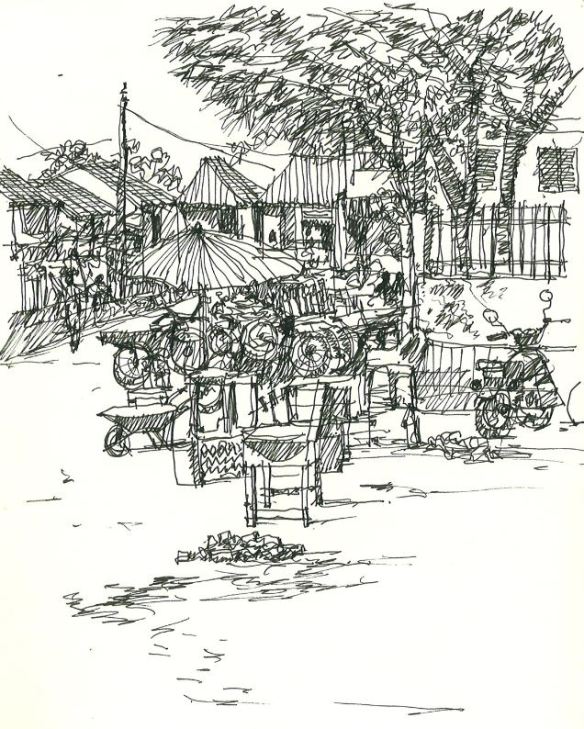
The church building is a large concrete box with a tin roof and arbitrary holes in the walls which let in air and light. It had been partially destroyed and the first team who came out from Scotland, six years ago (a video explain the story is at http://mission-international.org/projects/the-haiti-project/guild-information/), helped rebuild and enlarge it. It is on side street close to the courthouse and busy with stalls cooking and selling food, motorcycles, wheelbarrows, women with spectacular loads on the heads walking with incredible poise, children coming to and from school in smart uniforms and local folk just sitting in the shade chatting, checking mobile phones or simply watching the world go by. The church building is always open and a place to come to sit, and pray or simply lie out on the benches, in the relative cool and calm. There are services at midday and prayer praise services in the evening. On our second night we joined the 400 hundred, or so, people crammed into the building for the second half of a three hour service.  It was loud and riotous with hands in the air and heaving bodies swaying from side to side. It was led by the pastor’s assistant, an otherwise quiet and retiring young man, but here transformed into an astonishing firebrand preacher lifting the people to even greater heights of praise and at the same time bringing them down to almost complete quietness in sincere prayer. The cacophony of sound reminded me of Gaelic singing in the western Isles when it seems that voices come from all over the place rise, join together in remarkable harmonies and ebb as waves of the sea. Here the volume was of another order and pumped up by an energetic four piece band, the drummer with sweet pouring from his brow was crashing his cymbals like it was his last. Every volume was cranked up and the speakers could have come from a U2 concert. Now and again, but not often, it seemed the band were playing the same and sometimes in the same key. Well into the last hour, I was beginning to wilt, I crossed my legs and closed my eyes as if to pray but soon nodded off. I was woken by a young woman gripping my thigh and motioning me to uncross my legs. It was done very graciously and I took the lesson. The crossing of legs in front of an elder is extremely rude and especially disrespectful in God’s house.

The purpose of our visit was to meet with the pastor and elders to discuss plans for the school/church/community building and to finalise the deal for the purchase of the land. The project is the subject of a fundraising effort and you can read about it at http://mission-international.org/projects/the-haiti-project/ . The site itself is narrow and long and restricted on three sides. We were trying to design something that would accommodate a school and a church in an overlapping arrangement and at the centre create a small oasis of light and air and water as a gathering mingling space, linking all the accommodation together. It was good to be able to explain this in detail, with the elders, and talk over the plans in person. We also met a local engineer with experience in construction who would oversee the project. There are still many issues that will have to be resolved: How sure can we be that water sourced form a well on the site will not be contaminated? How much electricity could be generated form solar panels and by generation and the very obvious issue of designing a structure that would withstand an earthquake. We were able to revisit the site in town, to check measurements and another site on the edge of town which may be used as a retreat/health/sports facility. We also visited an America school in Ounaminthe,  set up by an American Missionary Society. It was on a completely different scale but it was comforting to note that the building had been designed with much the same principles. Being able to take a close look at the construction was immensely helpful. Apart from the size the project we are helping with is different in that it will be built by, and owned by, the local church for its work and witness within the community. It will mean that many children who would not otherwise receive an education will be able to participate in that most basic human right.

The most uplifting and most encouraging thing I took away from my visit was the children -the boys and girls walking to and from school carrying an air of promise of confidence and hope for a new future. It was not simply that they were smartly dressed, which they were, but that they walked with their heads held high and with a remarkable confidence that was striking; striking in comparison to the others- the half naked children playing and foraging among the garbage, who cannot share this privilege. The church’s plan then to build a school and, through a child sponsorship scheme, make it possible for children from the poorest of families to open a door into a world of learning and gain a foothold on a ladder of exploration through knowledge and understanding, cheered my little heart. That it would be a school inspired and run by local Christian believers, in the face of unbelievable difficulties, gave me special grounds for optimism.

On the journey back I picked up a copy of Malala Yousafzai’s story to read on the plane from Atlanta. It is a heart-warming tale and chimes so much with what I had been seeing, feeling and had experienced. Her story is shot through with faith, soaked in prayer and punctuated with acknowledgements of God’s hand on her life.  “We human beings don’t realise how great God is. He has given us an extraordinary brain and a sensitive loving heart. He has blessed us with two lips to talk and express our feelings, two eyes which see a world of colour of beauty, two feet which walk on the road of life, two hands to work for us, a nose which smells the beauty of fragrance and two ears to hear the words of love…. I thank Allah for the hardworking doctors, for my recovery and for sending us to this world where we may struggle for our survival… One person bullet hit me. It swelled my brain, stole my hearing and cut the nerve to my left face in the space of a second. And after that one second there were millions of people praying for my life and talented doctors who gave me my body back… I always prayed to God , ‘I want to help people and please help me to do that’” My prayer is that she and hundreds of children in Ounaminthe would one day know Jesus too.

Crawford Mackenzie

woman and barrow

Don’t Follow Your Heart

dont follow your heart“Don’t Follow Your Heart: God’s Ways Are Not Our Ways”    A book review

I am not a fan of books that are collections of reflections, meditations or devotional aids, the sort of thing that is so packed with anecdotes it is hard to find that thread that supposedly holds the whole thing together. I picked up Jon Bloom’s book  a month ago on the strength of a recommendation. I knew nothing about the author other than that he is connected with the “Desiring God” website http://www.desiringgod.org/ . I flicked through it, but was disappointed and put it down. It felt just like the kind of devotional book I disliked. More recently, however, I took it up again and decided to give it a fair try. I am glad I did. It is superb.

Jon Bloom is not a Dietrich Bonhoeffer, nor a G K Chesterton nor a John Flavell nor a C S Lewis, but he is able to communicate distilled biblical wisdom in an intensely practical and contemporary way.

The theme from the title is the exposure of that hopeless philosophy that says all you have to do is to follow your heart. “It is the creed embraced by millions of people. It’s a statement of faith in one of the great pop-cultural myths of the Western world – a gospel proclaimed in many of our stories, movies and songs. Essentially it’s a believe that your heart is a compass inside you that will direct you to your own true north if you just have the courage to follow it.” But Bloom says that the reality is something else. “Our hearts have sociopathic tendencies” if we actually think about it.

The 31 meditations are simple and short and many people will find them helpful. They are punctuated with pithy quotable sentences:
“When I am grumbling, I have lost touch with reality”
“The heart is a gauge not a guide”
“Your heart only tells you what you want, not where you should go”
“Our hearts cannot save us because what is wrong with our hearts is the heart of the problem”
“We find ourselves fighting an enemy that constantly seeks to alter our perception of reality…it seeks to make the most destructive things look desirable and tantalising”
“Jesus wants us to embrace the true prosperity gospel. He wants us to have treasure in heaven”

I would recommend it to any Christian, any follower of Jesus, who is seriously considering what it means to be a disciple today.

Crawford Mackenzie

In the clearing stands a boxer

boxer 2

Mez MacConnell  has an interesting and refreshing take on the Tyson Fury furore in his weblog. You can find it at http://20schemes.com/blog/. His main gripe is the way that the world heavyweight champion, suddenly thrust into the spotlight with cameras pointed at him and microphones thrust into his face, has been hung out to dry not just by the media and all the usual social pundits but by evangelical Christians who have taken him to task over his poor theology. MacConnell suspects, as do I, that the problem is not the boxer’s theology but his brashness, his coarseness, his lack of appropriate measured responses. He just says it. He is not bothered by what people think. He is not crippled by the fear of causing offence. He is a boxer and he throws punches. He is not a politician or a preacher. He is not the archbishop of Canterbury. He is simply a very young Christian in need of discipleship, support and prayer. I suspect that the people who didn’t like Tyson Fury won’t like Mez MacConnell either and probably for the same reasons. Yet his voice is one that needs to be heard if the church is to reach beyond its cosy comfortable culture to make disciples of all peoples in a world desperate to hear the good news.

.

A Deep Stain

My colleague who has travelled throughout Africa and inspired many significant projects with partners in Kenya, Burundi and Rwanda made the striking comment as we experienced Haiti for the first time. “It’s as if a chunk of Africa has been lifted and dropped in the Caribbean” he said. In people terms, this is exactly what has happened. In the history of the colonialist’s insatiable lust for the third world’s resources, the pillaging and raping of the land, nothing compares to the evil of the slave trade. It remains the deepest stain on our history. That individuals, people who have been made in the image of God, and who, solely because of their race and where they came from, could be dragged from their homes and land, bought and sold and disposed of, as property, as things, is both hideous and despicable. That governments could collude and benefit from the trade and the Christian church provide the necessary theology to back it up, makes it all the more damning.

The true depth of that stain can be felt here in Haiti. Brought from west Africa by the French to work the land they rose up and defied their masters to become the first independent nation in Central America with a government made up of former slaves. At first first few countries recognised them and they could only begin trade with their former colonial masters by paying a crippling fine as compensation for their loss of earnings – the loss of their slaves. The cruel irony and absurdity of what was happening is hard to swallow. They were obliged to pay their previous owners for the freedom to live in a land which had already been raped. (The deforestation that took place during the colonial period contributes enormously to Haiti’ current problems). At times in their history the Haitians were treated cruelty by their neighbours in the Dominica Republic. The darkest episode took place in 1937 when, under Trujillo’s orders, 10-20 thousand Haitians were slaughtered in a heinous act of genocide and ethnic cleansing. The Rio Massacre, which serves as a border between the two countries, at points, was literally flowing with blood. The recent earthquake and the series of coups and despots only serves to pour salt on the sore of this wounded nation.

Today the colonialists have been replaced with multinationals who have the Haitians by the throat. The innocent sounding “free trade zone” at Ouanaminthe where goods are produced for well known clothing brands, blatantly uses cheap labour in sweat shop conditions.

It is and remains a great stain and an inescapable burden. If you cared at all what could you do ? How could you respond?

For many, catharthis is found in political action when the anger and indignation at injustice propels them into raising the issue, getting people to listen. pillaring governments, writing letters, signing petitions and every legal method of forcing those in power to change corrupt and unjust business. For me it has to be another way. And what I observed my colleagues doing, on the ground at an individual human level, working and helping local people, partners in the communities, epitomised that.

The great stain won’t be removed with money or with years or with good intentions or with penance. The victims will only lose their victimhood when they find their true worth their true value their self respect and their unshakable dignity. That was what my colleagues were working towards and that was what inspired them.

The Fan

Why is that people use fans to cool things downs (hand fans or mechanical propeller fans in the ceiling) when our oven has a fan that seems to heat things up. A wind in winter can make you feel colder due to its chill factor but the chicken must feel even hotter in the fan assisted oven. So air movement cools thing down but also heats things up. There must a turning point where it flips over from one to the other. The reason why I am thinking this is I am trying to sleep with a fan blowing air around me. It is meant to cool me down but at times I feel I am in fan assisted oven.

The White Man

The White Man
One of the things that I hate about visiting a poor country (and let’s face it, that is most of the world) is being the white man. The assumption is that you are rich which is true (sometimes obscenely so in comparison) and that you are cleverer and wiser and more intelligent which it is manifestly not. This is such a big thing that it would put me off travelling all together It stands in the way of making true friends. But I am saved by one thing, and that is language. Once people find out that your knowledge of their language is patchy and ragged, the relationship shifts its footing. You become something a kin to a child needing to learn. Someone who needs to be taught new words and have conjugations and cases corrected. It is a swift change of roles and one more likely to form the basis of a good and lasting friendship. That more than anything else makes it worthwhile travelling.

San Domingo

We flew separately to San Domingo. ( I am not sure why. Maybe it was the royalty thing – we were two important to share the same plane or maybe there wasn’t one big enough for the three of us -you take your pick) . I had forgotten (not deliberately) my regulation tee shirt and just hoped I would spot Pastor Poisson (I had seen him on video). The arrival hall was packed as it always is in these occasions with family and friends eagerly awaiting their loved ones retun and screeching and cheering with children running wildly as the exiles came through the door. One couple met half way down the ramp and embraced and quite lost themselves in the unbounded joy of the union. They seemed quite oblivious to the throngs watching till they were finally brought back to reality with the spontaneous applause they provoked. One group was met with a little band accordion, drum, shaker and clapping that surrounded them and followed them out of the building into the balmy night. But I couldn’t find the pastor. I asked two look likely suspects but neither were him. By a miracle, going back and forward through the crowd, I spotted a small piece of ripped-off paper in someone’s hand with the word “Crawford” on it and I smiled.

Unclear Nuclear

nuclear

I have never been on an anti-nuclear march. I have never been on a protest march of any kind, for that matter, and expect I never will. Not that the issues don’t concern me. They do. But I have never felt, for me, joining a protest march or sit-in, was either a relevant or effective way of making a point and of influencing opinions and decisions. The issue of Nuclear Weapons, a big thing in many people’s mind with the possibility of an independent Scotland, presents a particularly vexing dilemma

You don’t need to have much imagination to grasp the unspeakable horror that would be unleashed in the event of a nuclear conflict. I have read the books and watched films. One of my closest friends comes from Nagasaki. I have a very vivid imagination and these images and records have been indelibly printed in my mind so that they won’t go away.  Because of the scale, the might, the inevitable indiscriminate nature of the beast, no cause could ever be important enough to justify their use. And if you have no intention of using them how can you ever justify having them?  That the other side have similar weapons is, for me, no argument either. I would accept facing a major nuclear assault on my own nation, my own people, my own family, with all the horror that that would entail and still refuse to respond in kind. But then, nothing is ever that simple. Or is it?

When you look at the issue dispassionately, (if you can) a curios but relevant fact comes into play. While millions of people (2-3 million) have been killed in wars since 1945 with bombs, missiles, rockets, shells, kalashnikovs and machetes not one single person has died as a result of a nuclear weapon being used in anger. This is an astonishing statistic and despite current East/West jumpiness and the possibility of a terrorist group laying hands on the goods there is nothing to suggest that these weapons are ever likely to be used. Many would even suggest that the presence of these weapons has, in fact, kept us from all-out war over this period.  If that is so, and it is a big if, then the argument shifts from morality to money. Maintaining a nuclear arsenal, or being covered by a nuclear umbrella, when there is never the intention of using either, does seem quite insane.  It can only be regarded as a foolish and obscene waste of money, time and expertise, resources that would much better be employed in more worthy causes.

But to the dismay, no doubt, of many of my friends and family, I am still not convinced that the campaign for nuclear disarmament is a necessary element in the pursuit of world peace. At the end of the day, a nuclear missile is an inanimate object and of itself has no moral character. It is certainly a weapon and the vilest kind. (Although I expect evil minds can and will produce even worse). The person behind the weapon is, on the other hand, a moral being, capable of distinguishing between right and wrong. In a way it doesn’t matter if they are pushing a button, or firing a shell, dropping a bomb or wielding a machete, the end result is the same. The difference is only in method and scale.

So the campaign that I want to be involved and committed to is for the changing of hearts and the resistance of evil. This is essentially a work of God and of His Holy Spirit but I believe that Jesus has called his followers to be part of and instruments of, that work. This, for me, is the most relevant and most effective way of engaging in this struggle.  The struggle: the campaign, the fight and the battle, which is not against people, or governments, or political parties or societies, or nations, but against the spiritual powers of darkness.

Crawford Mackenzie