Big Brother Chronicles III The Attic

the attic

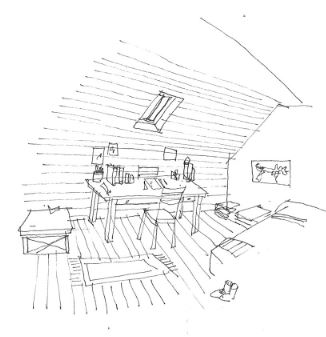
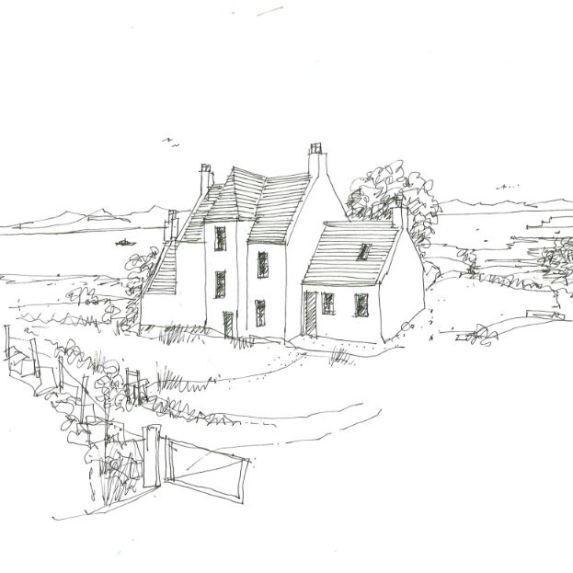
Iain had an attic room above the kitchen with lay-ins and a skylight. You got to it by climbing up a vertical ladder fixed to the wall through an open hatch at the back door. It was somewhere we seldom went and only by invitation. I remember the first time he called me up. Popping my head through the hatch, it was at once a magical place. While the rest of the rambling three storey house, that was the manse, was either chaotic and untidy or stripped bare and sterile, this was a space of calm order for work, reflection and enquiry. Books were carefully arranged on makes shift shelves pictures, photographs and maps, stones and shells from the beach.  On a desk an open book with a leaf as a book mark and a pad of white writing paper with what looked like an essay drafted in miniature writing with even smaller scribbles at the side, notes and small cartoons, explaining the thought process. A fountain pen with an open bottle of Quink black ink lay at the side. There was a neat rug on the floor with bare floor boards and the most striking thing, to my young eyes, in the middle of the floor, on an upturned fish box, acting as a coffee table, lay a pound note. I had seen a pound note before but there was something outrageously  defiant in the way it just lay there, gently rising and falling in the warm breeze through the skylight window, well used and creased but with such poise. It was the stamp of a character on a room. It was something that I never forgot. Somehow, and no doubt unconsciously my big brother had opened a door in my mind to a new world ripe for exploration, and discovery.

iain portmahomack April 2000

Big Brother Chronicles II The Dinghy


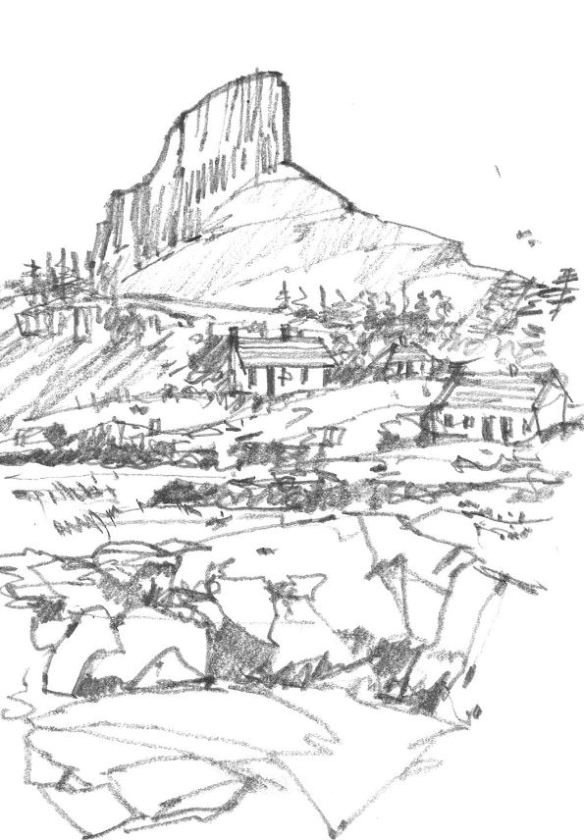
sgurr

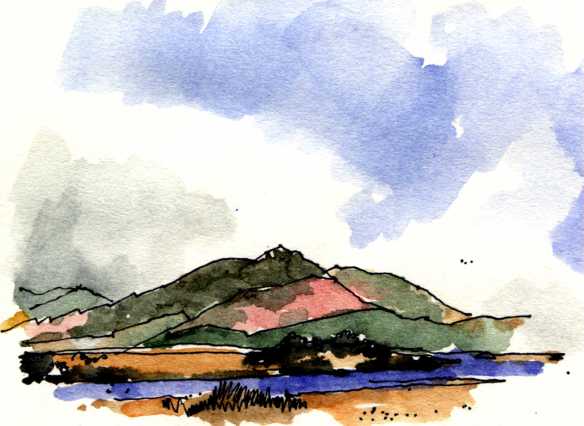
Later he took me fishing. We borrowed a dinghy from the shore and set off round the coast on a balmy summer evening. Iain was at the front rowing, I at the back, occasionally bailing out the sea water that seeped through the clinkers. We caught no fish but had a great time. Leaving the jetty and castle island far behind, we explored the Grulin coast from the sea, rowing into tiny inlets and scraping the keel off the rocks as we looked for a good place to land. On the shore we collected buoys and odd bits of flotsam that they sea constantly threw up. We spotted a yacht moored not far from the shore and went to investigate. The man on deck was friendly. He was fishing too but catching and he invited us on board. The little yacht was magical inside. A tiny kitchen and a tinier bathroom, a little lounge with portholes, a low table with a bowl of fresh fruit. All brass and polished wood, fitted together perfectly with no space wasted and a warmth and luxury that entranced us. We were entertained for ages with tea and stories of their escapades around the western isles. The previous year they had moored in the harbour and were trapped on a sand bank. We didn’t notice the time nor the boat gradually rock to and fro and it was only when we were about to leave clutching our gifts, a week old Scotsman, a banana and two mackerel, that we became aware of the serious squall that was building up. Rowing back into the wind was hard.  The storm was growing in strength and at times we seemed to be hardly moving at all. The boat rocked and we were repeatedly soaked when waves crashed against the side. But to a little person it was still fun.  Iain was struggling to get to the bay so we decided to stop over on Castle Island in the hope that the storm would slack. It didn’t, it looked like it was getting worse, so we made one last dash for the harbour. It wasn’t far but the sea was now at its wildest. Finally after a mammoth struggle Iain pulled us round into the calmer waters of the bay where a crowd had gathered to welcome us.   Later we learned that the whole island were alerted and in a state of alarm. Several boats had been out searching for us. They had been scouring the shore for the missing sailors and were beginning to fear the worst. Years later, I understood the very real danger that we were in and how close to tragedy our little expedition was, but the thought didn’t bother me then, nor now. I was with my big brother and I knew it was going to be ok.

iain portmahomack April 2000


Big Brother Chronicles I The chair

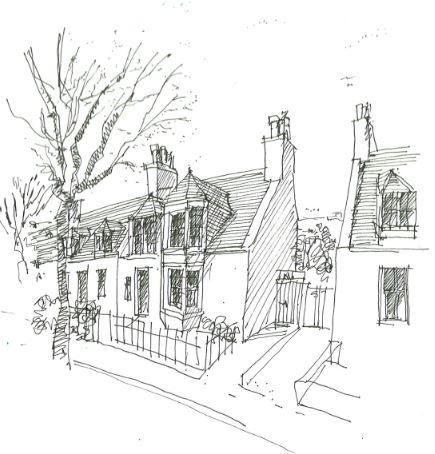
On Easter Day ten years ago my brother Iain died, after a short, painful and distressing few months of cancer.  He was my elder by 11 years and he was already an adult, a man and had left home by the time I knew him. He was always my big brother and while I became an adult too, there was always these twelve significant years between us. In the aftermath of his death I tried to put together a series of snapshots to chronicle something of what he was to me. Trying to sum up one person’s life, even with the finest of tributes, is a hopeless task. Inevitably, it is patchy, flawed, and one dimensional. When reading or hearing a tribute, I come away with the feeling “is that it?” “was that all?” These chronicles, which will follow, are not attempts to sum up a life but simply lantern slides capturing a moment in time when the character transcends the simple story revealing the person that was and is my brother.the manse

David said he learned to ride a bike down the slope to the hen house but I learned by freewheeling from the top of the hill behind the manse. There was only one size of bicycle – large. Small bikes and stabilisers were unknown and the trick was to carry a chair up the slope, support the bike with one hand, sit on it and push off. With feet only reaching the high point of the pedals you free-wheeled down, zigzagging through the grass and jumping clear just before the bike keeled over in a heap. Then you picked up the heavy beast, pushed it back up the hill and started all over again. Needless to say, when tired of the runs, the chair was left solitary on the hill and when the call for tea came, I was told to go back for it. Tired and reluctant and most likely complaining, I started for the door but Iain pushed past me. “I’ll get it” he said as he sprinted up the hill in his rolled up shirt, grey flannels and sandshoes. I watched in amazement at his astonishing agility. It seemed like nothing as he galloped down the hill with the chair in his hand. I was struck then by the unbounded joy he showed in this selfless act. My little heart glowed. It was so good to have a big brother

iain portmahomack April 2000

Death Star

death star

I am sitting in the pick-up queue at the station, waiting for the Glasgow train, looking up at the dark mass of our new icon, parked ominously on the river’s edge like the Death Star itself. I am trying hard to make sense of what it is and what it will eventually be, but I can’t. Plans, sections, elevations, the understanding and visualising of three dimensions is my trade but still this edifice remains a mystery. I would really like it to work. I do earnestly hope it will be a success and be a talisman of rejuvenation and revitalisation of our beautiful city on the Tay, so long a sad forth in Scotland and the butt of so many jokes. I really do. But try as I might I can’t quite stamp out the scepticism, the growing doubts and the deep unease.

It is hard, almost impossible to express these doubts in some quarters, because so much is invested in the building. It is already an “icon”.  In the age when people are legends before they reach reaching thirty, Nobel peace prizes awarded before any peace work is done, buildings can be iconic before any concrete is poured. My niggling fear is that it will become a concrete folly in a desolate vandalised landscape, with ugly spoilers for seagulls hoping to nest on the ledges, grotesque barriers to discourage would be climbers attempting to scale the “cliff face” and the very real worry that a panel might fall off. This cliff face, which in concept, represents “the long dialogue between earth and water” is made up of cast concrete panels stuck on to the façade. They don’t, as you would expect, run through to the interior. They are unashamedly fake. The building is pretending to be something it isn’t and yet that doesn’t seem to matter. The sloped walls themselves are explained by the architect as a means of drawing people in. Straight walls repel, apparently.  Yet to my eye, the scale and slope on the exterior has a distinctly threatening air about it. It almost frightens me. The interior which is also devoid of any reference to human scale, seems to be a series of anonymous spaces with disturbingly raked walls and absolutely nothing to say about what actually will be in it.

I hope, I do hope , I am wrong. Please tell me I am wrong.

Crawford Mackenzie

Bankie’s Bairns

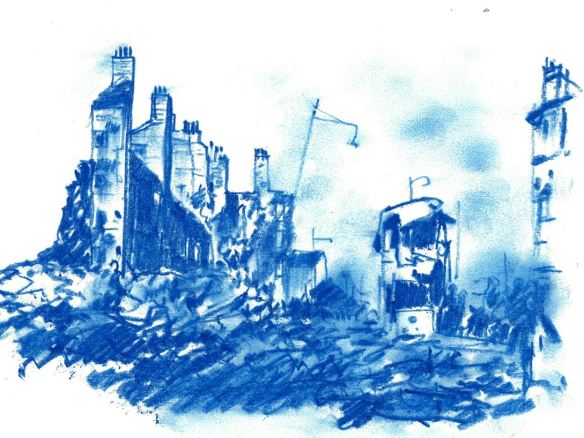
Dunbarton RoadI was reminded, this week, of a series of programmes produced by Radio Scotland, that I listened to  some years ago entitled “The people’s war”. It was a simple collection of interviews and voices of ordinary folk who had lived through and survived the Second World War. They were not soldiers, officers, politicians or important players but folk caught up in an event quite beyond their control. I was deeply moved by the simple ordinariness of the stories in the face of great horrors. I wrote to the BBC afterwards expressing my appreciation and asking if they would repeat the series. They said they had no plans to do so and I have tried several times to find the recordings on archives with no success. But I remember the stories very clearly.

They focused on the experience of nurses at Strathcathro hospital, the land girls in Angus and the Clydebank blitz. It was the later which I found quite riveting. Over the nights of 13 and 14 March 1941, Clydebank was largely destroyed by a series of air raids. It was the worst destruction and civilian loss of life in all of Scotland. The true death toll is thought to have risen above 1,200, with over 1,100 seriously injured and upwards of 35,000 people made homeless.

My mother was one of them and I remember listening to her speak about the experience. I was interested in the Anderson shelters, built half in the ground and covered with corrugated iron; a simple design to offer some form of protection against the worst effects of shrapnel and exploding buildings. I also remember asking why they didn’t make it more comfortable with seats a carpet, maybe table and lights. But I’d quite missed the point. It was a refuge a place to go to where you might be safe during an air raid. She spoke of the eerie sound of the sirens which still gave her a sense of dread when she heard them years later from a factory yard, the terror of the whistling bombs that went silent just before they struck, and the incendiaries. One hit the home of folks they knew near bye and the whole interior of the building was lit for a split second, as by a floodlight, displaying all the newlyweds’ furniture and decoration, before incineration. Her own home was destroyed in a similar fashion and it was some time before the family was reunited.

One man interviewed in the recordings told how he and his brother, as boys, instead of heading to the shelter with the others, skipped off to check that their doos (pet pigeons) were all right. When they returned, they learned that the shelter took a direct hit and the rest of the family were killed. One survivor told how her three brothers died in a raid. Her mother was bereft and would not speak about it during her life time. Chatting to her, in a retired home not long before she passed away, she summoned up the courage to broach the subject. ” Mum” she said, how did you… how did you manage… how did you cope when my brothers were killed…. how did you manage to go on?”  Her reply deeply moved me at the time and it chokes when I think about it still. ” I never understood” she said ” …I never understood why The Lord took my Bairns from me, but I always understood why he gave me you.”

Crawford Mackenzie

Heroes

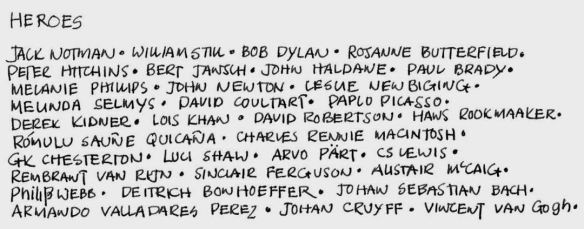
I was with an American friend after a walk along the north sands at St Andrews and casually mentioned that this was where the opening scenes from ”Chariots of Fire” were shot.  His eyes lit up, “Eric Liddle” he said “was my hero”.  After a pause he asked “and who is your’s, who is your hero?” It is of course one of these impossible questions to answer like “name your top ten films” “what was the highlight of the holiday?” “If your home is on fire and you could rescue three things, what would they be?” (I remember Ricky Gervais being asked that same question on a radio chat show . He parried it by saying he had no idea. But the interviewer pressed him so he said “well, maybe, my golf clubs.” Pressed again he said “my CD collection” he couldn’t think of a third but the interviewer pushed him hard so finally he said “well, one of the twins”.)  I just couldn’t think, at the time, but did later and this is my list. They are all flawed of course.  I don’t know most of them personally and principally through the medium of their work. I wouldn’t necessarily agree or stand with them on every issue but I regard them as heroes nevertheless.  I have left out family and close friends and my only true hero, Jesus Christ, but here is the list, in no particular order:

heroes-2

The Battle with Scrooge

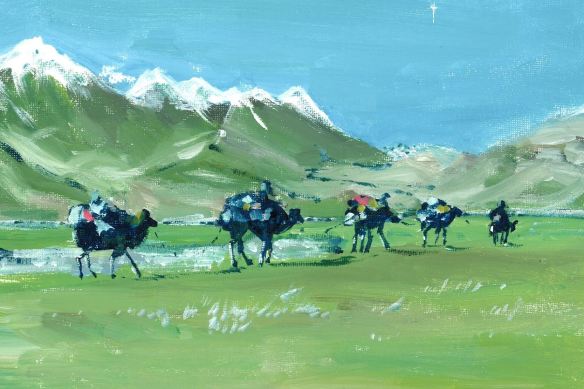
wise-men

Like many people, I suspect, I have a love hate relationship with Christmas which shows a predictable pattern. It is a battle between Santa and Scrooge right up until the last minute. The hatred in the early weeks of December is intense; eclipsed only by the even greater hatred in November. I resent the imposition. I dislike the diary terrorism and the one-upmanship and the self-induced and foolish anxiety over cards and gifts, turkeys and trees. I fully understand the sentiments of those who want just to be left alone, away from it all.  To hibernate, blank it out and simply get on with their lives. But I also sympathise and understand those, for whom it is the highlight of the year. The event they plan and take delight in preparing for, often with great creatively, thinking of others and how they can enjoy the time together. It can only be a good thing and yet I don’t want to be dragged into it against my will. Not just yet, that is.  As in most things, I am a late developer. (which is a kind way of saying I am slow) and so I know that despite my latent protestations and as sure as night follows day, come the time my little heart will melt and I will be lost in the wonder and the awesomeness of it all. Just don’t tell me about it now. I am still on the way.

Crawford Mackenzie

The Village Fire

zambiaI don’t where I heard it, or from whom, but it was about a wise Nigerian pastor who was preaching to a congregation of restless young men in a town north of Abuja on the Jos plateau. They were disaffected, frustrated and angry young men and he was struggling to get through to them and beginning to lose their attention. Some had been drawn to a new awakening in the old religions in the demonstrable power of the witch doctor, Some were stirred by Marxism while others were beginning to see Islam as the one true religion.

He told them a story.

There was a fire in a village up north in the bush. The flames tore through the fabric of roundavel so quickly that all the family inside were burned to death but, in the melee in the darkness, somehow, a two month old baby was plucked out of the inferno and was carried away alive. It was cared for by one of the families and miraculous survived unscathed.  The next morning the elders gathered to decide what to do. The most pressing issue concerned what was to happen to this child who the gods had so clearly blessed. Many wanted the honour of adopting and approached the elders with their claims. One said that he was rich and with money, could ensure a prosperous future for the child. Another said that he was educated and could give the child something that money could not buy. A third said that his wife had already raised six children; she had vast experience and was best placed to look after this special infant. The fourth claimant came forward but said nothing. When they asked him to speak, he showed them his arms. They were charred black with open wounds and third degree burns. He was the one who had plucked the child from the fire.

The pastor leaned over the makeshift pulpit and fixed the eyes of his congregation. “I don’t doubt” he said “ that the old religions, the religion of our ancestors are powerful, that they have much to teach us about the way we should live in harmony with nature and that the witch doctor is able to do amazing things, I don’t doubt that that we can learn much from Marxism especially in our post-colonial world, I don’t doubt that Islam is a great religion acknowledging that there is only one God and worthy of much respect, but…… you see…… I have to follow Jesus, because my God has charred arms. My God has nail holes in his hand. He is the one who plucked me from the fire.”

Crawford Mackenzie

The Prison

cellThe prison that I used to visit was just a few miles down the road.  With other volunteers we went there every Wednesday evening, to meet the men who had gathered, to share coffee and tea, to chat to study the bible and to pray together. It was the highlight of my week. There was something special and refreshing about these times. We were able to talk about real things, about things that mattered about families, sorrow and regret, loneliness and fear, life and death, heaven and hell.  There was no need to pretend. One of the officers was very supportive of us and on the way in one night he took me aside and said.  “You know what you folk do is really good. What these guys need is religion”  I didn’t have the wit to respond to him then but I thought about it afterwards. Religion was the last thing these guys needed. They needed a Saviour. We need a Saviour. One of the amazing truths that this week reminds us of is that there is that Saviour.

Crawford Mackenzie

Let us haste to Kelvingrove

They don’t ask me now, but people used to pose the question “As an architect and a Christian, wouldn’t you like to design a Church Building”   They were generally disappointed when I said “No, not really”  You see, I had no desire, inspiration or passion to design a church.  I had always believed (and still do) that the church is not a building.  It is the people of God wherever they are and wherever the met. The building was and is incidental.  That is not to say that I was not deeply affected and sometimes awe struck when visiting great church buildings: with the sheer majesty of the cathedral church of Notre-Dame de Reims, with the intimacy and simplicity of the parish church on Papa Stour, with monasteries in Romania and reformed churches in Hungary, with the work of Alvar Aalto and Corbusier especially with Notre Dame du Haut and many many more. Yet my appreciation of these building was perhaps esoteric and detached and I would have no conviction that they related at all to a real and living church, a gathering of God’s people for worship and service. There was a disconnect in my mind.

trinity church 1

I had qualified in 1973 and worked for 7 years with the late Jack Notman in Glasgow.  His output as far as building was not prolific but I learned much during my time with him. I still follow the principles that I learned then: designing buildings, that were of quality and would last, that would provide comfort and convenience and would be life affirming for those who use them, that were designed using the simple elements of space, light, materials, colour and textures, examining how spaces connect with each other, how people move though a building and what it says about who we are and what we are about. The aim was always to achieve something of real value with a timeless quality.

trinity church 3

Towards the end of my time with Jack Notman, I was involved in a number of significant projects, among them, the conversation of  Trinity Congregational Church, in the west end of Glasgow, as a rehearsal and concert hall for the then Scottish National Orchestra (now the RSNO). It was a very interesting project as it involved changing the role of the building from an ecclesiastical one to an arts and entertainment one. It was challenge to de- ecclesiasticise the structure, while retaining its character. It was opened by Princess Margaret in 1978, became a very successful project, won several awards and remained the home for the orchestra up until very recently.   Not long after it was opened, I was at a concert with a friend, who was a minister and, during the interval, he turned to me and said “This would make a good church”.  The throw-a-way comment stuck with me and I came to see that Church Buildings are, in fact, important. They do matter and like the clothes we wear, affect how we feel about ourselves and how others view us.  So began, for me, a new direction in the adapting and refurbishing of church buildings, altering, extending, re-ordering, refreshing , preparing feasibility studies and designs for new buildings which has extended to over 50 individual projects for a wide variety of Christian denominations.

trinity church 2

So it is not difficult to understand my surprise and my delight when I heard, just this week, that Trinity Congregational Church designed by John Honeyman in 1863, converted into the Henry Wood Hall by Jack Notman in 1978 was to begin a third life as a Church Building in 2016 as The Tron Kelvingrove.

Crawford Mackenzie

(I was not the Job Architect on this project but helped with drawings and details. The person who was, and who did all the real work on it, was Nigel Duncan)