There is something about the events of the past week that seems to confirm that the game is now well and truly over. It wasn’t a re-run of Saigon, or Teheran or the Bay of Pigs, though it looked very much like it. It was far worse with a hint of finality about it. I had a hunch that when the great celebrations erupted with the defeat of Donald Trump, the devil we didn’t know was going to be much worse that the one we did and so it turned out to be.
They say that we get the leaders we deserve. Well now we know. Where is the Churchill, the De Gaulle the Mandela the Havel? There were those who said, that as far as the west was concerned, Donald Trump was our only hope. Its hard to believe, but there surely was some truth in that. Biden has simply replaced a loud mouth with a feeble one. Our own bungling buffoon styled himself on Churchill, but it was all bluff. There would be no fighting on the beeches or the landing grounds instead he chose to run, first from the illiberal mob on their diet of identity politics, then from the virus and now from the Taliban. Ahmad Massoud the only glimmer of light in the resistance is now isolated with his fighters in the Panjshir valley. The people of Hong Kong, Taiwan, Crimea, Ukraine and the Baltic states now know they are on their own. The Uighurs, Armenians and Kurds are not likely to get any help soon. We have pulled up the drawbridge and retired to our lager. But this time we are unlikely to defend even that. Our belief in our selves has gradually collapsed after decades of self-induced self-doubt, self-loathing and crippling guilt and we are ready to throw in the towel.
If western civilisation does implode, as it could well do, and all that remains are the architectural ruins of our cathedrals and cities, the lost symphonies, plays and novels the half-remembered philosophies, sciences and poetry and the faint recollection of a now forgotten way of life, what will the world look like then? It could be, as Churchill suggested, “the abyss of a new Dark Age made more sinister, and perhaps more protracted, by the lights of perverted science” This time that science in the control of politicians, would include the horrific might of nuclear and biological weapons and with an all-seeing all-knowing all-powerful technology. It could be a world fuelled by big pharma, big tech, big data, big-business and big-government whether as a centrally controlled totalitarian state or a worldwide Caliphate. Or it could be the demise of overgrown empires and a world scattered into small nations of little people. It’s impossible to know or second guess, but the times they are a changing, that’s for sure.
It was an act of mercy that God brought confusion on the people building their tower on Shinar plain, and he may do that again. It is certainly true that throughout history all empires, though they looked unmovable and unbeatable at the time, eventually, did fall and sometimes spectacularly so. In the Genesis account it was interesting that he didn’t destroy the tower. He confused their language so they couldn’t communicate easily. The parallel with the comprehensive and immediate communication available through the internet is striking and if this giant suffered a complete breakdown the world would be quite different altogether. That’s a strong possibility and not all that fanciful either.
Somehow, we suspected that there were dark forces at work. Somehow, we anticipated that, under the cover of a health emergency, the Scottish Government would move with stealth and skill to seize new powers and advance their progressive ideology. We were warned about this and we guessed that the claims of measure being purely temporary was disingenuous and deceitful at best.
What, however, takes us by surprise, as it always does, is the blatant duplicity of it all. It is quite breath-taking.
Today the Deputy first minster in Scotland John Swinney, announced the publication of a consultation paper, which details the government’s proposal to “give the Scottish ministers the same powers to protect the people of Scotland from any incidence or spread of infection or contamination which presents, or could present, significant harm to human health in Scotland, not just Covid. In addition to being able to impose future lockdowns and restrict gatherings, ministers would also be able to order school closures “during the remainder of the pandemic” or for any future outbreak of an infectious disease, so long as they believe it is “necessary and proportionate”, and the chief medical officer has been consulted. Among the plans for the justice system are calls for continued powers to permit the early release of prisoners and allowing people to avoid attending court in person by taking part remotely.”
The chilling bit is that minister will have these powers, no longer temporary but permanently enshrined in law “as long as they believe it is ‘necessary and proportionate’. So it’s a matter of belief about “necessity” and “proportionality”. Irrespective of any objective threat or reality, what matters is what the minsters believe and they will be the arbiters and the ones who will define what is necessary and proportionate. It’s about faith and feeling and fits perfectly with the progressive ideology.
It’s a “consultation” of course and everyone is encouraged to make their feelings known. But we all know about “consultations”. One a few years back revealed that the majority were opposed to the government’s proposal but they went ahead anyway and claimed that the consultation was not binding.
So that’s it, they want permanent powers to lock people in their homes, shut the schools and open the prisons. What’s not to like about that?
For those of us who are quite relaxed about government powers, who believe that those who govern are essentially good, altruistic, have access to the best advice and have our interests at heart, who are happy to sacrifice our personal autonomy and responsibility for the sake of the “common good” and who are untroubled by all of this, as long as we are kept safe, for us, it is no big deal and there is nothing to see.
Not long ago I was invited to join a local reading group. It was specific and specialised. The titles were limited to classic and contemporary Christian books grappling with fundamental theological issues and ranging from Augustine, Knox, Calvin, through Edwards, Flavell, Baxter, Chesterton and Bonhoeffer to Keller and Ferguson. I was only able to share in the monthly gathering for a short while but it kick-started me into reading in a new way and I was surprised by the thrill that I found in discovering, for the first time, writers whose names I knew, but whose words I had seldom ever read.
Among the gems that was uncovered for me was “The letters of John Newton” edited and compiled by Josiah Bull. Maybe it was the bight sized nature of the letters that appealed to my short attention span. But I was astonished at how accessible they were, how easy they were to read, what wisdom they communicated, what insight and what it said about the preacher’s pastoral heart. Written so long ago they are surprisingly contemporary and despite the odd word and archaic expression they are clear and uncluttered in a way that most present-day Christian literature is not.
Life in early 18th century England was harsh and brutal, especially for the poor. Cities lacked sanitation and drinking water was so nasty that beer was safer to drink. The availability of cheap gin was destroying lives and striking at the moral fabric of the country. Among the citizens, cock baiting and dog fighting were common place and tickets were sold for public executions. There was a yawning gap between the rich and the poor and crime was endemic in the cities where the desperate poor resorted to stealing, simply to keep body and soul together. Punishments were severe even for minor thefts of items of clothing or tableware and could include the death penalty. These were often commuted to imprisonment or banishment to the colonies. The prisons themselves were desperate places. Many prisoners were held in hulks off shore without water or proper sanitation. For the prisoners, men and women, sometimes with their babies, the journey to the other side of the world was a wretched one. David Hill in “Convict Colony” details the misery visited upon these poor souls and many died before they reached Botany Bay. All this time, the iniquitous Atlantic slave trade was burgeoning
It was into this dark world that the evangelical revival movements began, firstly with Whitfield and Wesley, who brought the light of the gospel in all its fullness to the common people. It could well be one of the reasons why England did not follow France in a bloody revolution. The revival led to changes in society, anti-slavery movements, prison reform, relief for the poor and the expansion of schools and hospitals throughout the land. Two years into Parliament, Shaftesbury commenced his efforts to alleviate the injustices caused by the Industrial Revolution, which included acts that prohibited employment of women and children in coal mines, provided care for the insane, established a ten-hour day for factory workers, and outlawed the employment of young boys as chimney sweeps.
It was in the later part of the 18th century, in what is described as the second wave of the revival, that John Newton, the converted slave trader and writer of what is possibly the most famous English hymn “Amazing grace” began as a preacher in the town of Olney. Because of his special gifts in explaining the gospel to ordinary folk his fame spread and people came from miles to hear him preach. “They found in him one who was a worse sinner than themselves and who could enter into their experiences with tenderness and sympathy”. Many who could not travel communicated with Newton by letter and it is these gems that remain as a testimony to his work.
In these letters there is humour and insight, there is constant pointing to and referencing of scripture. So soaked must he have been in the words of the bible and so well acquainted with its whole, that barely a sentence goes by without some reference direct or indirect or some allusion to the Word. In this, he was fulfilling God’s charge to Joshua not to let “This Book of the Law depart from your mouth, but you shall meditate on it day and night.”
Many of his letters were to other preachers, where his keen understanding of the treasures and the trials of the ministry were sympathetically spent
To Rev W B Cadogan:
“I have seen enough to remind me of the difference of setting out, and holding out to the end, and to warn me that we can have no security from gifts, labour’s, services, or suffering, from clear viewers, or past experiences from first to last only safety is in the power, compassion, and faithfulness of our great Redeemer“
To a Mrs Coffin he writes:
“religion does not consist in doing great things, for which few of us have frequent opportunities, but doing the little necessary things of daily occurrence with a cheerful spirit, as to the Lord.
Writing to a recently bereaved women (a Mrs Talbot) he shows remarkable tenderness and understanding, yet points to the only place where she can find real comfort:
“My heart is full, yet I must restrain it. Many thoughts which crowd on my mind and would have vent, were I to write to another person, would to you be unreasonable. I write not to remind you of what you have lost, but of what you have which you cannot lose…….
All the comfort you have ever received in your dear friend was from the lord, who is abundantly able to comfort you still; and he is gone but a little before you.
Some of his most touching letters are to his brother in law John Catlett, who was not a believer but who he tries to persuade in the most gracious way, making a specific appeal to reason.
“It is not reasoning but neglecting to reason and to extend conclusions to their just consequences, that I condemn as the vice of the age…Faith is the gift of God, but then he is always ready to bestow it. When I was first brought to consider the evil of my life, and to endeavour at amendment, the same difficulty lay in my way. I could not pretend to say in my prayers that I believed the gospel. Alas! I did not at that time believe a word of it! I was confounded but not convinced. However, it pleased God (as I am firmly persuaded) to lead me to the following resolution: Though I am not assured of the truth of the New Testament, yet I cannot be certain that it is false, I will endeavour, therefore, If I mistake, that it shall be on the safe side. I will take its truth for granted. I will study the promises and comply with the commands I find there, and if it did indeed proceed from God, He who revealed it, and sees my sincerity in trying to quit my prejudices may, nay, if that is his word indeed, he undoubtedly will, assist, me and enable me to understand it, by degrees, till at length I believe it with the bottom of my heart.”
On my desert island, as the radio game goes, you are given the Bible and the complete works of Shakespeare. In my isolation, I would want to have John Newton and his letters as my companion and pastor.
Right on cue, now that the doomsayer’s terror tactics over the virus has all but been exhausted, every ounce of fear mongering has been expended, the horror stories, the frightened eyes, the stats and graphs disappear from our screens, the media and governments, with their allies in big tech, big pharma, big data and big business now turn to the second card they hold in their hand – the climate crisis.
It’s “Code red for humanity”. It is “unprecedented”. (now where did I hear that word before?) it is “irreversible” and it is all our fault. Not the fault of the 20 thousand delegates who will be coming to Glasgow in their solar power yachts sailing up the Clyde, from red amber and yellow countries all quarantine at their own expense in guarded hotels for 10 days all double vaccinated and socially distanced with covered faces. No, not them. It’s the fault of the poor who need to feed themselves, who need to find shelter, warm their homes and support their families. These are the ones who are already subsidising the green revolution and who will have to make the sacrifices to “Save the planet”.
So be prepared for the next wave of doomsday divinations and the flooding of our screens with the climate meta narrative. Be aware that every clip of an iceberg melting, a wild fire, a flood, a superstorm or a drought will be milked dry until humanity is finally cowed and comes to heel.
There is, of course, a serious point here, but that will have to wait.
Oh, are you exempt or something? a disability? Do you have a card a lanyard?
Dissenter
No, I am not exempt
Compliant
But if you’re not exempt you have to wear one… what’s your excuse?
Dissenter
I don’t have one .. I don’t have to wear one…I don’t need an excuse…I’m just not wearing one
Compliant
Why not? You have to…
Dissenter
No, I don’t have to… you know as well as I do that they don’t do any good and a lot of harm. There is no reason why we should wear masks. A mask is a symbol of subjugation, a badge to humiliate. I am just not wearing one
Compliant
Ach, don’t give us this subjugation humiliation crap. Don’t be silly. Anyway It’s mandatory, it’s the law and you could be passing the virus on to someone else who could get ill and die – you could cause someone to die… its your civic duty to wear one
Dissenter
But I don’t have the virus
Compliant
You could have
Dissenter
I could, but I don’t
Compliant
But how do you know that you don’t.
Dissenter
I don’t have any of the symptoms that they tell you about, the cough, the fever, loss of….
Compliant
But you could be a carrier of it without knowing it.
Dissenter
I could be, but I am not
Compliant
But that’s crazy and stupid and reckless too! How do you know? Eh? Have you had the vaccine? Have you been double jabbed?
Dissenter
No I haven’t and I’m not getting it…and anyway it’s my decision
Compliant
But that’s selfish!!
Dissenter
Eh? Its selfish not to take something to supposedly protect myself?
Compliant
Its not about you!!! its your civic duty to get vaccinated
Dissenter
Oh so its all about civic duty? Well, that’s where you are wrong… It doesn’t prevent infection or transmission, we know that, the evidence is in. We had a perfectly controlled experiment on the Royal Navy flotilla. There were 100 cases of coronavirus among the crew on the Queen Elizabeth all of whom were double vaccinated and they stated that they were operating all the social distancing measures masks and hand sanitising etc. So, there you have it. With the vaccine I can still get infected and I can still pass it on so on that score it doesn’t work. Vaccination can only be purely for personal protection, and a personal choice to do with personal risk. There is absolutely no social obligation to get vaccinated to protect others, and the idea of vaccinating children is not just crazy and senseless its terribly terribly dangerous and irresponsible…
Compliant
Oh so you’re an anti-vaxer now too.. you’ll be a covid denier as well I suppose…
Dissenter
Oh, don’t give me these names, No!!! I am not anti-vaccination, I just don’t want this one. I am not sure if it safe…
Compliant
Of course it is… its been approved by all the important bodies and…
Dissenter
But it’s not licenced, it’s still experimental we have no idea what bad effects may come from it. I have no idea what effect it may have on my grandaughter’s baby if she gets pregnant. We have just no idea what effects it may have on child bearing women or on fertility. You see I remember Thalidomide the wonder drug that was developed by…and it’s hard to believe this … by a German company based on the work of a former Nazi who worked for Mengele.. it was a wonder drug that would sort out morning sickness and it was only when the babies were born that they discovered the horrors of what it did. This vaccine has been tested over something like 4 months and from what I remember it takes 9 months for a baby. So we can’t know if it’s safe…
Compliant
Yes we do. They wouldn’t say it was safe unless it was. The pharmaceutical companies would not risk any mishap. They would be sued out of existence if there was a problem…
Dissenter
Funny you should say that, because the drug companies were given special dispensation that they would not be sued if there was a disaster. They only took on the work on that basis. Anyway, I’ve read the literature that they give you about the jab and they more or less say that they don’t know if It’s safe…
Compliant
What! I don’t believe it… you’re havering there …
Dissenter
Well look I’ve got one hereNHS ScotlandIMPORTANT INFORMATIONplease read this leaflet before your get the vaccineunder “fertility” it says “There is no evidence to suggest that the Covid-19 vaccine will affect fertility in men or women”
Compliant
So it is safe – there is no evidence that it affects fertility…
Dissenter
You don’t get it do you? It’s a sleight of hand. What they say in the leaflet is absolutely true but it is written in such a way to make you think that there are no effects on fertility, when what it is actually saying is we don’t know if there are any. There is no evidence that there are. But there’s no evidence that there is not.
Compliant
Ach, it’s a waste of time talking to you…All these scientist and researchers all over the world can’t all be wrong… or do you think you are right and they are all wrong?
Dissenter
They could all be wrong and , of course there are a whole lot of others who say different and you probably won’t here about them because they are basically gagged or black listed or cancelled.
Compliant
Who?
Dissenter
Well… for a start… Sunetra Gupta, Mike Yeadon, Jay Bhattacharya, Martin Kulldorff, Robert Malone, Russel Blaylock, Peter MacCulloch, Karol Sikora, Peter Bregin,David Livermore, Carl Heneghan, John Lee… lots more…
Compliant
Oh I’m not sure why I bother… but look at it, the vaccine has broken the link between getting the virus and being sick. We know that for sure, So it works..
Dissenter
No, we can’t be sure about that
Compliant
What! Oh come-on! for goodness sake! you are just being cantankerous.You are sold on conspiracy theories…You should get out more and stop listening to the lizards and phone mask conspiracy seeking creeps..
Dissenter
I don’t and I’m not…. but back to the point…because one thing follows another doesn’t mean the first caused the second. It is a classic false philosophical argument – there is a name for it but I’ve forgotten what it is – something about correlation and causation – like, every time Grannie comes to tea it rains, so granny caused the rain. There might be a connection between the two but there is no proof that there is. It’s the same with Lock-downs. They say the restrictions work because once these are in place cases drop but they might have been dropping anyway…It can’t be proved one way or the other
Compliant
I was right, it’s a waste of time talking to you. You don’t really care do you? You want the virus to rip and if people die, too bad, as long as you can get to the pub and get on with your life. You are putting other people’s lives in danger. I can’t believe you would be so mean and so selfish. You are probably a grannie killer…
Dissenter
Oh!!! a grannie killer now! -You know that’s pretty rich. It’s the government who have been killing Grannies! you know that.. loading them off to care homes to get infected and die lonely and horrible deaths shut off from their loved ones. It is one the cruellest things about this whole debacle and there will be a reckoning. I am sure there will. When people find out what actually happened it could get very ugly… Someone must have known what they were doing. They weren’t interested in people’s lives they wanted to save the NHS and it’s all political. If you don’t see that, you must have blindly swallowed the whole thing. The NHS had to be protected at all costs to save the Tory party. If it collapsed under a Tory government, it would be a disaster for the party and the red walls would rise again. Care homes didn’t matter they were not the NHS. And all this nauseating clapping, sainthood, special services in St Paul’s Cathedral, oh dear,…. and now the George cross…
Compliant
I was right, it’s a waste of time talking to you… …. just keep away from me……please…
Laura Dodsworth has published a devasting and explosive book cataloguing her forensic ferreting into the dark art of behavioural science and its employment by the authorities in the past 18 months. “A state of fear” clinically exposes the government and the cartel of advisors, medics, scientists, public health experts, statisticians and modellers in their cynical weaponizing of fear to get the population to do what they want, without them knowing it.
While a lot of this has had some airing before, hardly any of it has reaches the main stream media or has been taken up by journalist or political opposition, the people who you would expect would notice. So, it is up to Laura a photographer, artist and author, not really known for journalism to step in to the breach, to scratch around, to push hard at the doors, to follow the evidence and get to the truth, while the rest of journalist, with some notable exceptions, have gone limp and supine. Even the rock and roll anti-establishment suspects, who are always quick to pounce on any titbit to throw at the establishment, have been strangely silent. It’s as if their mouths have been stuffed with gold or injected with drugs to stay quiet. Shout about anything they seem to be told, but don’t go there. There, however, is where Laura goes and when she has her teeth into the something she doesn’t let go. Funny, this is what I thought true journalism was all about. But it’s heartening, at least, to find someone who actually does it.
What is notable about the book is that it is sane and balanced. It isn’t fired by rage or anger. It isn’t an anti-vaxxers rant or the bleatings of a covid denier. It is simply the inquisitiveness of a curious mind and a nose that can smell a rat. She manages to interview significant figures close to the government, some anonymous but others willing to give their names, including notable people involved in the Scientific Pandemic Insights Group on Behaviours (SPI-B) who report to SAGE. What she finds is that fear was deliberately and specifically used to direct the behaviour of the population. Many of the advisors had deep misgivings about the morality and the ethics of the programmes, but never enough, it seems, to blow the whistle.
What is disturbing, to her, is the way the pattern mirrors that of a strict parent child relationship.
During the Covid epidemic, the UK government threated us with longer lock-downs or tougher restrictions if we misbehaved, and rewards such as the rule of six or garden meetings were dangled in front of us if all went well. The relationship between government and citizen is reminiscent of a strict parent and child relationship, with alternating use of the naughty step and then offering sweets for good behaviour. Citizens were not treated like adults. We were told frightening ‘Bedtime stories’ everyday via the news and Downing Street briefings to ensure compliance with a set of everchanging and sometimes bizarre rules.
“The weaponization of fear is a particularly destabilising tactic in the behavioural psychology toolbox
because it clouds our judgement, which in turn increases reliance on government, which then creates more fear, which paralysis us further, creating a self-perpetuating doom-loop.”
Naomi Wolfe goes further and puts it more graphically, in a recent interview, when she described it as an abusive domestic relationship where the partner, invested with the power, teases, controls, humiliates and infantilises the victim caught in a horrendous trap of dependency.
One of the SPI-B advisors explained this, as it related to mask wearing: “There is a behavioural science ‘reason’ for wearing masks, to increase a sense of collectivism. This is the feeling favoured by the psychologists that is entirely unrelated to the scientific evidence regarding transmission. Essentially, they want us to feel like we are ‘in it together’” So there you have it, from the horse’s mouth, so to speak.
Another from the same group explained “People are passive and biddable. A lot of people don’t question. Their thinking is shaped by other people, especially the media and social media and that is a dangerous thing. As a society we are set up to encourage a passive and biddable population.”
Throughout the book she slots in short interviews with ordinary people she meets on the way. They don’t make the story but illustrate it and they are exactly the stories I hear from individuals caught up in it all, bewildered, frustrated, frightened.
The bleak prospect in the end is the death of freedom “We seem to have forgotten that no one is safe. You have never been safe and you never will be. Nor will I. In the blind global panic of an epidemic we have forgotten how to analyse risk. If you don’t accept that you will die one day, that you can never be safe, then you are a sitting duck for authoritarian policies which purports to be for your safety. If too many individuals immolate their liberty for safety, we risk a bonfire of freedoms.”
Frank Furedi set the ground work for this analysis in his significant piece “How fear works, culture of fear in the twenty first century” and he explains how, from an early age, people are encouraged “to become preoccupied with their safety and to regard being fearful as a sensible and responsible orientation towards the world” While in another time, it would be assumed that our response to threats would be in accordance with virtues such as wisdom, courage, moderation, justice and duty, now it is considered virtuous to adopt the technique of “risk assessment” and “powerlessness, fragility and vulnerability are the characteristics that resonate with the current representation of personhood.”
But an authority which deliberately and calculatingly creates a climate of fear amongst the population are playing with fire. Once the heather is lit it is not so easy to put out, no matter how many jackets are ruined in the process. A frightened population may act in quite unpredictable ways. There may be compliance for a time but things can suddenly turn and fear can quickly morph into rage. Who knows how an otherwise biddable populace will react when they discover that they were deceived and the devastating and prolonged restrictions were quite unnecessary and achieved nothing. Their belief may will be resilient while so much is invested in it, but with a crisis of faith, things could get ugly.
A government’s intentional employment of fear also betrays the fact that they themselves are fearful: fearful of losing their popularity, fear of failure, fear of not doing or acting quickly enough, fear of losing power and ultimately, fear that the people may rise up and destroy their masters. Those who live by fear die by it. History shows that dictators and despots never know when to give up. They never leave when there is a window for a peaceful exit. Instead, they cling on to the bitter end, to face the rope and get the bullet.
Critically, the weaponization of fear breaks down trust, trust that may have taken centuries to build, and when trust is destroyed it is hard to know where, as a society, we can go.
A good friend of mine has a philosophy, quite a common one I think, that if you can’t do anything about a problem you should not spend any time worrying about. “It’s silly”, he would say, “to get all stressed out, tied up in knots and agitated about what governments and politicians do when you can’t really change a thing. Making your own stand would be little more than a pointless gesture and your sacrifice would change nothing.” It makes a lot of sense of course. But then, the trouble is, as I responded to him, if you carry any sense of responsibility, especially for the future generations, you just can’t just brush it off. It spirals out from your responsibility to the folk you love, your family, the community and the world. If you have just a hint, a half-formed vision, some feeling for where we are likely to be heading and you know it’s not good, you have a duty to speak out. There is a time to speak and a time to be silent and I think this is the time to speak.
My sense is that in 2020 we have crossed the Rubicon and while it may be interesting to dig over how and why we got to where we are, none of what we find will change the past. What we have is the present and this is where we live and this where we do and say things which may in a small way have some influence for good. The future belongs to others. It is not a concept it is a reality but we are seldom ever given a vision of what it will be. There are of course prophets but there are false prophets too and sometimes it will only take time to discover which is which.
What I grapple with is the strong conviction that we are coming into a time of trouble which we have never seen for more than half a century. I have the uneasy feeling that we are not prepared for it and we have not prepared the next generation for it either. So, in what little time we have left, I feel a heavy burden to do what we can to prepare those who follow for a different world than the one we have known.
I don’t think it is a matter of imparting a strategy, setting out an approach, adopting a policy, or even offering advice. There could be lots of advice we could offer though. One thing would be to learn not to be dependant on what is given, another to think for yourself, (gosh I am beginning to sound like Jordan Peterson) to question perceived wisdom, to be as wise and serpents and as harmless a doves, to hold on to and guard what we know is true, to see that things are not what they seem, to find out and discover what the ancients said and to seek wisdom because it is more precious than any other thing. But I was never much into dishing out unsolicited advice and don’t intend to start now.
I was struck, however, on hearing about the Jesuit priest Tomislav Kolakovič who taught in Bratislava towards the end of the second world war. He recognised that Stalin’s red army would soon be victorious in the east and while others would be soon rejoicing at the demise of Hitler and the end of fascism, he recognised that Stalin’s soviet empire would present an even darker spectre and inevitably lead to the persecution of Christians. He also knew that the established church would not be able to withstand communism but would acquiesce with the authorities and be controlled be their new masters, which was, in fact, what happened. So he went about teaching young Slovak believers and establishing cells of faithful Catholics, entreating them to give themselves totally to Christ and to resist evil, so that when the time came they would be prepared to stand. These cells and groups were not only gatherings for prayer, study and fellowship but became the centres for underground dissidents active in the eventual overthrow of communism in the velvet revolution.
There may well be a parallel in the situation we face today. The similarities may be stronger than we care to believe. The march of soft totalitarianism is hard to ignore and maybe the best we can offer is to prepare for the dissident life. That’s not an easy thing to do, especially as all that we, as baby boomers, have known is a culture of comfort and ease, a general trusting in truth, a time when wisdom, integrity, justice and compassion were the virtues we valued and aspired to and a baseless belief that things will work out ok in the end. Learning to live in a different way will be challenging. Learning to live within the law without aligning yourselves to the spirit of it will require a sea change inattitude. It will compel what Solzhenitsyn called “Personal non-participation in lies.” “Though lies conceal everything, though lies embrace everything, we will be obstinate in this smallest of matters: Let them embrace everything, but not with any help from me.”
Am I being over excited? Is it all seriously over the top? Am I simply away on my own wee tuppeny thing? I don’t think so. If anything, the past year has shown us that we seem perfectly relaxed at trading in our personal freedom and responsibility for our health and security. For a peaceful life we have sacrificed our soul. Solzhenitsyn puts it bluntly in his devastating 1974 essay “Live not by lies”
“And he who is not sufficiently courageous to defend his soul – don’t let him be proud of his ‘progressive’ views, and don’t let him boast that he is an academician or a people’s artist, a distinguished figure or a general. Let him say to himself: I am a part of the herd and a coward. It’s all the same to me as long as I’m fed and kept warm.”
I didn’t need to see the picture. I saw it in my mind the solitary figure, decked in black, sitting in the ancient chapel, masked and distanced and silenced as she watched the physical remains of her husband of seven decades, being lowered into a hole in the ground beneath the stone floor. Somehow it was a picture like no other, which epitomises the dreadful end of an era.
My concerns were not for her. Even in this enforced humiliation she retained her dignity. I have no doubt that her spirit would rise above all that. Nor were my concerns for the thousands of others who have had to face the same indignity in the loss of those they loved, over the past year, including some who are close friends. My concerns were for the ones who devised the plan and wilfully manipulated a compliant population in adopting, almost without question, the foolishness of the charade.
I would not like to have been Boris Johnstone or his advisors or the other leaders falling in his train, watching on their screens, following the spectacle, aware of their role in forcing the sovereign, who had seen out thirteen prime ministers, to endure this pitiful spectacle. I wonder if the cruelty of it even crossed their minds or if they ever felt any shame. I suspect not, but it was a shameful thing that they had done.
The triple lock, enforced mask wearing, distancing and the banning of singing at services of all kinds strangles the very life from such occasions and in the face of death makes it especially bitter. It could only be the coldness and cruellest of hearts not to see what this means for a grieving relative. That moment in time, that would never be recovered or retrieved: when they most needed their close family to be close, when they needed that comforting arm around them, when they needed to see that reassuring sympathetic and familiar face, when they so needed to be reminded of the truth that death is not the end and be able to sing, with the congregation, the songs of faith. That moment senselessly and cruelly taken from them.
The government should have gone the whole hog, banned all funerals, instructed local authorities to dispose of the dead as they saw fit and put out a nice thing on zoom.
A “National day of reflection” is to be held on the 23rd March to remember the 125,000 people in the UK, who have died with coronavirus during the out-break. It is strange that, when this episode is constantly being referred to as a war, we are thinking of remembrance before the battle is ended and when victory is not yet secured or even in sight. Still, anytime is a good time to reflect.
So let us reflect on the lives that we have not been able to save. Let us reflect on all the other lives we have lost over this year, the deaths to accidents, to cancer and heart disease, to murder and suicide. Let us reflect on the women who have died at the hands of men. Let us reflect on the lives we have cancelled before they were even born, who have no names that we can recite. Let us reflect on the lives lost to our dalliance with narcotics. Let us reflect on the suicides we have assisted and helped by designating these last journeys as essential.
Let us reflect on why we abandoned the DHSSPS’s (2011) common sense and proportionate plan to prepare for a pandemic in favour of an untried mass experiment with people’s lives. Let is reflect on why the lessons from Exercise Cygnus in 2016 were never learned.
Let us reflect on the fear we have propagated and the hope that we have extinguished
Let is reflect on the harms that we have triggered and inadvertently caused by our asinine restrictions, our incompetence and our bungling micro mismanagement:
slowing of baby’s development without essential and natural human contact,
incarcerating disabled children without formal education,
stunting children’s learning with the loss of a year in a critical time in their lives,
damaging the tender lives of fostered children, the babies taken from their mothers at birth and trapped without human contact other than a carer for months on end,
aggravating mental health of the population in general, but the young, the single and the isolated in particular,
denying essential medical treatment and early diagnosis of those with serious health conditions,
depriving people of the dignity of work and the dark spectre of unemployment,
de-motivating workers by paying them to stay at home and do nothing,
robbing young people’s right to associate with their peers, make friends and find life partners,
taking away the health-giving benefits of playing sport, singing together, joining bands, clubs, sharing in worship and all the natural social interactions that make life meaningful,
spawning suspicion of our neighbour,
undoing long established community spirit,
starving the preciousness of face-to-face contact,
condemning old people isolated and confused to die lonely deaths in care homes,
destroying businesses and livelihoods with the prospect of a collapsed economy and a third world country status,
pushing back on the advances made in the environment, with the wrecking of public transport systems and the dumping mountains of PPE in land fill sites,
suppressing legitimate dissent and protest,
surrendering our freedom.
Let us reflect and consider if all that was worth it.
Linda Grant who wrote an introduction to a new edition of Vassily Grossman’s “Life and fate” translated by Raymond Chandler, said that it took her three weeks to read the book and three more to get over it. It took a lot longer for me to read and I am still recovering.
There is something enduringly magisterial about this epic novel, regarded by some as the finest Russian novel of the twentieth century. In its 800 or so pages it covers what must be the bleakest period in this great nation’s history under the brutality of the soviet and fascist systems. But it is not a book with a message in the classic sense of the word. The great tyrannical ideologies are almost footnotes in this beautifully woven human story of individual lives caught up in the bizarrest and ugliest of situations and yet somehow demonstrating the integrity of the human spirit, something that the terrible might of evil forces are unable to fully crush. So it is a story of hope. It is also a story of great tenderness.
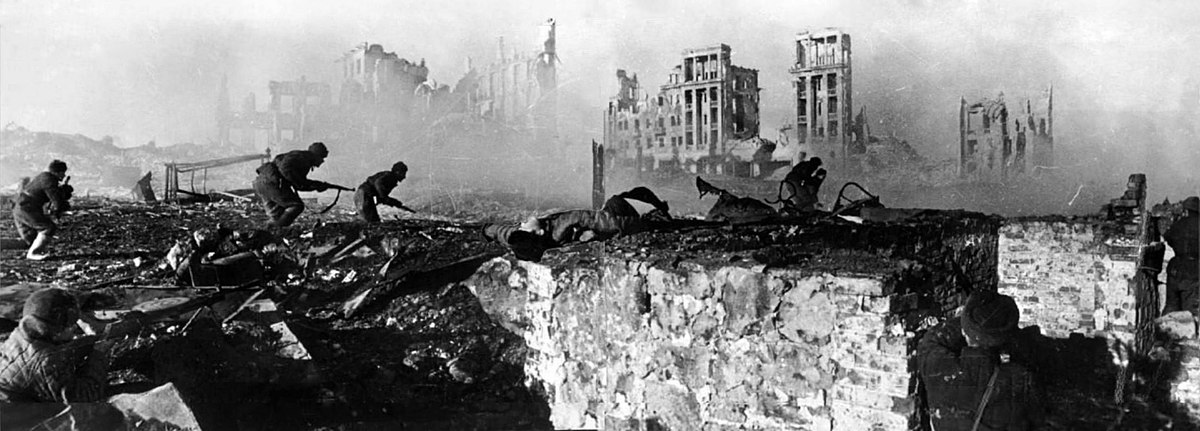
It moves through Stalingrad on the banks of the Volga, the street by street fighting and the encircled division in building 6/1, to the middle-class home of the scientist and his laboratory comrades. We are in the interrogation rooms, the death camps and the gas chambers. We follow the Führer, though the woods and Stalin is on the line. We travel with the tank corps and the retreating sagging armies. There are the Russian, the Germans, Armenians, Ukrainians and the Jews, the Bolsheviks and fascists, All the time the ghost of 1937 is eerily present casting its dark shadow over the conversations and memories and everywhere there is the relentless struggle between the big ideas and the reality of what is happening on the ground.
It is a quite beautiful and inspiring tale.
Much of the novel rotates around Victor Pavlovich, a middle-class theoretical physicist in a power struggle with his colleagues and stressed in his fraught relationships with his wife and daughter, complicated by a secret liaison. Much of his torture, however, was over the conflict between his loyalty to his work, to the purity of science and where it conflicts with the Leninist view of the nature of matter. His careless comments taken out of context, get him into trouble and are used by his enemies to ensure his downfall. In the process of administering his disciplinary case, he has to complete a massive questionnaire which seeks to garner any hint of anti-revolutionary thought or taint. Any connection or sympathy for the exiles or of the purged of 1937 will mean certain exile. When he notes the most casual of links with someone who was arrested, he is seized with a feeling of irreparable guilt and impurity. He prepares to make his confession and He recalls a meeting at which a party member, confessing his faults had said “Comrades, I am not one of us”. It was when he sensed he had lost everything that he gets the call from Stalin. “I wish you success in your work” is the one affirmation that changes everything. The actual work is not defined and only referred to obliquely “A new shadow, still faint and mute, barely perceptible, now hung over the ravaged earth, over the heads of the children and old men. No-one knew of it yet, no-one was aware of the birth of a power that belonged to the future” (page 751)
There is Grekov the crude but likeable commander of the division in the encircled house 6/1. While there was death and destruction all around he and his men take pity on an injured cat and care for it as it were a child. The radio operator is the only female in this terrible place and she senses that sooner or later one of the men will make a pass at her. She somehow senses it will be the commander, by the way he looks at her, but she so much wants it to be the young poet Seryozha. Her hopes are dashed, however, when Seryozha is sent out on a raid. The raid, for some reason is cut short and he returns early. They spend the night snuggled up together in their lice ridden great coats and boots and she is still sleeping on his shoulder when the unit reforms in the morning. The commander announces that Seryohza is to be sent back to HQ. This will surely end the promising relationship but in a twist of surprising kindness Grekov tells the radio operator that she should go back too. She is not needed there anymore. Later when the Commissar comes to relieve Grekov of his position, his unorthodox and anti-soviet tendences have become too much for the authorities, he ask after the radio operator.
“Are there any women in the building?”
“Tell me, comrade Commissar, is this an interrogation?
“Have any men under your command been taken prisoner?
“No
“Well where is that radio operator of yours?
Grekov, bit his lip and his eyebrows came together in a frown.
“The girl turned out to be a German spy.
She tried to recruit me
First I raped her then I had her shot”
He drew himself up to his full height and asked sarcastically
“Is that the kind of answer you want from me?
It’s beginning to seem as though I’ll end up in a penal battalion”
Then there is Sagaydak ruminating on his special role as a newspaper editor. “He considered that the aim of his newspaper was to educate the reader- not indiscriminately to disseminate chaotic information about all kind so probably fortuitous events. In his role as editor Sagaydak might consider it appropriate to pass over some event: a very bad harvest, an ideological inconsistent poem, a formalist painting, an outbreak of foot and mouth disease, an earthquake, or the destruction of a battleship. He might prefer to close his eyes to a terrible fire in a mine or a tidal wave that had swept thousands of people off the face of the earth. In his view these events had no meaning and he saw no reason why he should bring to the notice of readers, journalist and writers. Sometimes he would have to give his own explanation of an event: this was often boldly original and entirely contradictory to ordinary ways of thought. He himself felt that his power, his skill and experience as an editor were revealed by his ability to bring to the consciousness of his readers only those ideas that were necessary and of true educational value.”
Novikov the tank comander looks at his men and his heart is warmed:“One soldier was singing; another, his eyes half closed, was full of dire foreboding; a third was thinking about home; a forth was chewing some bread and a sausage and thinking about the sausage; a fifth, his mouth wide open, was trying to identify a bird on a tree; a sixth was worrying about whether he’d offended his mate by swearing at him the previous night; a seventh, still furious was dreaming about giving his enemy – the commander of the tank in front- a good punch on the jaw; an eight was composing a farewell poem to the autumn forest; a ninth was thinking about a girl’s breasts; a tenth was thinking about his dog sensing that she was about to be abandoned among the bunkers; an eleventh was thinking how good it would be to live in a hut in the forest drinking spring water, eating berries and going about bare foot; a twelfth was wondering whether to feign illness and have a rest in hospital; a thirteenth was remembering a fairy- tale he had heard as a child; a fourteenth was remembering the last time he had talked to his girl- he felt glad that they had now separated for ever: a fifteenth was thinking about the future- after the war he would like to run a canteen.
‘Yes’ thought Novikov, ‘They’re fine lads’ “
When Getmanov leaves for the front and has to say goodbye to his family: “He held his hand to his chest, afraid that his booming heart-beats would disturb the children. He felt a piercing ache of tenderness, anxiety and pity for them. He desperately wanted to embrace his son and daughters and kiss their sleeping faces. He was overwhelmed by a helpless, tenderness, an unreasoned love; he felt lost, weak and confused.
He wasn’t in the least worried or frightened at the thought of the new job he was about to begin. He had taken on many new jobs, and he had never any difficulty in finding the right line to follow. He knew it would be the same in the tank corps. But how could he reconcile his unshakable, iron severity with this limitless tenderness and love?
In the corridor he said goodbye, kissed his wife for the last time and put on his fur coat and cap. Then he stood and waited while the driver carried out his suitcases.“Well then” he said – and suddenly stepped up to his wife, removed his cap and embraced her once more. And this second farewell – with the cold damp air off the streets slipping in through the half-open door and blending with the warmth of the house, with the rough, tanned hide of his coat touching the sweet-scented silk of her dressing gown- this final farewell made them feel that their life, which had seemed one, had suddenly split apart. They felt desolate.”
When we think we can’t bear any more we are taken with Sofya Levinton and a young boy David, she has linked hands with, into the darkest hole of the century, yet, even here, humanity shines through. She is as a medic and could have escaped the gas chamber but chose to go with her people and with motherly instincts, though herself a virgin, took the boy’s hand and kept him beside her until he collapsed by her side.
“ Sofya felt the boy’s body subside in her arms. Once again she had fallen behind him. In mine shafts where the air becomes poisoned, it is always the little creatures, the bird’s and mice, that die first. This boy, with his slight, bird-like body, had left before her. “I’ve become a mother” she thought. That was her last thought. Her heart, however, still had life in it: it contracted, ached and felt pity for all of you, both living and dead; Sofya felt a wave of nausea. She pressed David ,now a doll, to herself; she became dead, a doll.”
But we are also on the other side with Anton Khmelkov as he expresses his disgust at his co-worker Trofima Zhucheko in his attitude to the gruesome work of closing the hermetically sealed doors. Trofima looked happy and even excited by his work marshalling the columns of prisoners from the railway.
“ What Khmelkov didn’t understand was that it wasn’t Zhuchenko’s greater guilt that made it so disturbing. What was disturbing was that Zhuchenko’s behaviour could be explained by some terrible, innate depravity – whereas he himself was still a human being. And he was dimly aware that if you wish to remain a human being under fascism, there is an easier option than survival – death.”
Towards the end of the story the German company Commander Lenard, following his ragged army in retreat, comes, in the evening, upon a group of his men hacking meat from a frozen dead horse while others in a ruined building were gathered round a fire and a blackened cauldron while a cook prodded the meat with his bayonet
“The light of the evening can reveal the essence of a moment. It can bring out its emotional and historical significance. Transforming a mere impression into a powerful image. The evening sun can endow patches of soot and mud with thousands of voices; with aching hearts we sense past joys, the irrevocability of loss, the bitterness of mistakes and the eternal appeal of hope.
It was like a scene from the Stone Age. The grenadiers, the glory of the nation, the builders of the new Germany, were no longer travelling the road to victory. Lenard looked at these men bandaged up in rags. With poetic intuition he understood that this twilight was the end of a dream.
Life must indeed conceal some strangely obtuse internal force. How was it that the dazzling energy of Hitler and the terrible power of a people moved by the most progressive of philosophies had led to the quiet banks of a frozen Volga, to these ruins, to this dirty snow, to these windows filled with the blood of the dying sun, to the quiet humility of these creatures watching over a steaming cauldron of horsemeat?”
The futility and inevitable demise of all the worlds kingdoms is finally revealed. The utter stupidly and folly of believing that by our skill our dexterity, our ideas, our wisdom our solidarity and our determination we can build a heaven on earth, is inevitably laid bare in time. It is the truth that history always teaches us and one we fail to learn. All that is left, as Grossman sees it, is the individual, their tenacious hold on hope and their modest peculiarities expressed sometimes in inexplicable acts of human kindness.
In my desert island I would want to be reminded of the beauty of the individual and our shared humanity.



 Restless Spirit