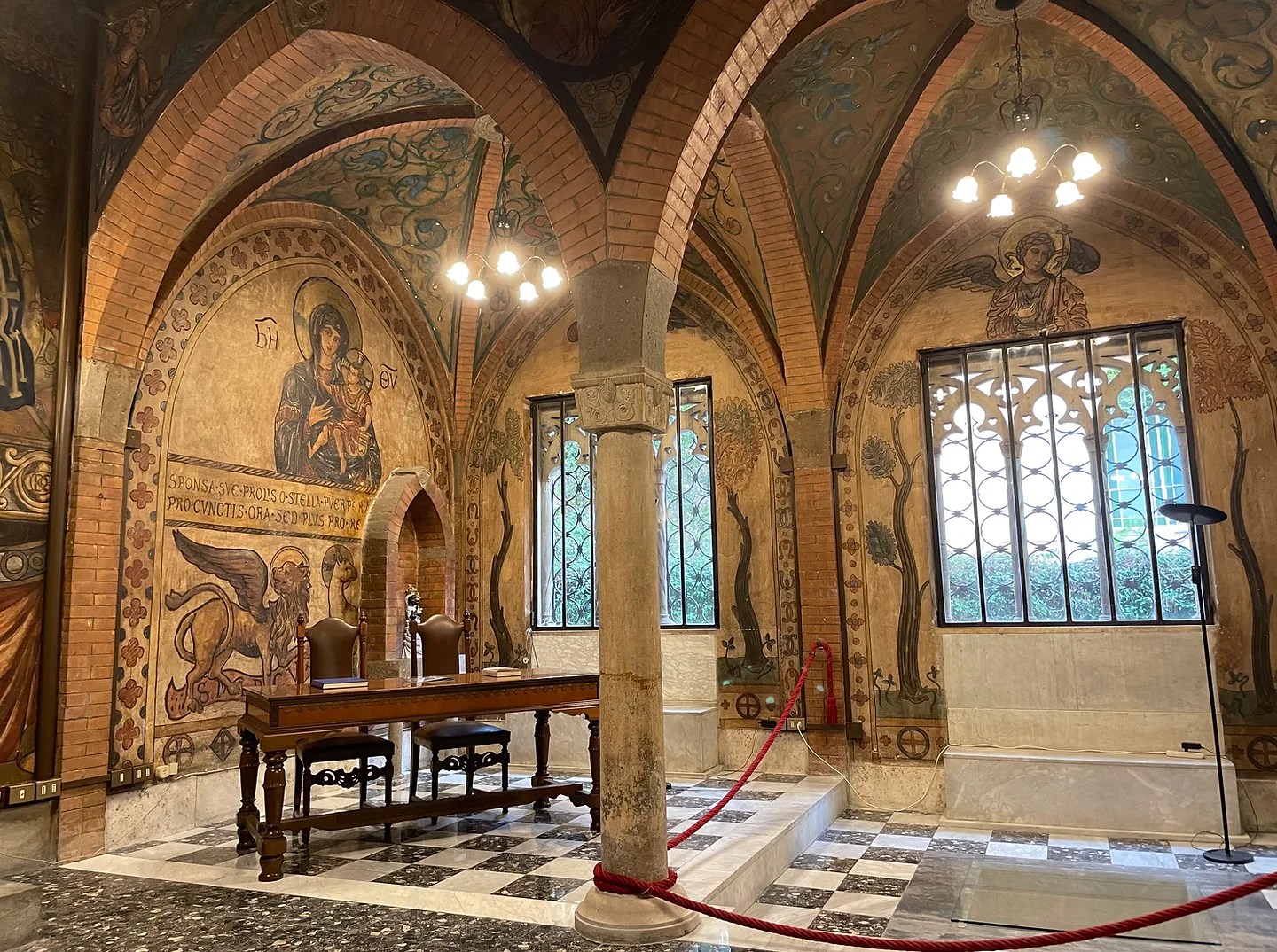
THE CHAPEL OF LORENZO

I was reading Kenneth Clark’s autobiography “The second Half”. Kenneth Clark, that is, the art historian, museum director and broadcaster and famous for the TV series “Civilisation”” I thoroughly enjoyed it. The copy I have was bought in a second hand shop and has been kept in a damp place which means I can’t get rid of its fusty smell which takes away something from the enjoyment, but I saw it through.

I like autobiographies. I like the literary form. You can learn so much about the person from what they write about themselves and often it is a different person, an almost unrecognisable person from the one the media portrays. I have found this so often the case. True, people will overstate their good qualities and play down the bad ones. They can also take liberties with the facts and tell tall stories but you don’t have to be very clever to read between the lines and hear when something is just not true or an event has been grossly embellished. People lie but you can usually tell a lie.

Kenneth Clark is a good writer. I found his “Civilisation” perfectly readable and inspiring. I didn’t watch the TV series but the book was a helpful reference and summary of western art and culture. He is careful to point out that it is not, of course, authoritative but simply a personal view. I wonder, if the reason he is so easy to read with the simple descriptions of people and places and of course art, spiced with humour and self-deprecation, was because much of his writing was given first in lecture form. The lecture would have to essentially catch and then hold the audience and he does that seemingly effortlessly in his writing.

It is a fascinating insight into how art and artists survived and were still able to produce, paintings, poems, essays, novels, exhibitions and concerts in a time of war, how money and resources were found to sustain these arts when the great thrust was for the war effort. In a war life has to go on. Artists can’t just stop being artists when there is fighting. They may have to fill shells or dig shelters but they remain artists seeing the world with that illuminating eye and making it possible for others to see too.

What is also interesting is that like fine writers he seems to be able to speak into the now in a prescient way and like Orwell or Solzhenitsyn give astonishing predictions of what was to come.

Well into the story when he is recounting the delights of his time in Italy, I came across a paragraph I was sure I had heard before. I remembered. It was in a sermon from some years back.  I also think it was referenced in something I read more recently and it made me wonder if the preacher and the writer had found the quote in another source and not directly from the book. I suspect many people do this.  It’s convenient but can be a tad lazy.  I have probably done the same myself, so I am not in a position to judge, but it’s a good principal to hold to – to read the whole thing it its context, before you cherry-pick a juicy comment.

Anyway, here is the paragraph in full:

“I lived in solitude, surrounded by books on the history of religion, which have always been my favourite reading. This may help to account for a curious episode that took place on one of my stays in the villinio. I had a religious experience. It took place in the Chapel of Lorenzo, but did not seem to be connected with the harmonious beauty of the architecture. I can only say that for a few minutes my whole being was irradiated by a kind of heavenly joy, far more intense than anything I had known before. This state of mind lasted for several months, and, wonderful though it was, it posed an awkward problem in terms of action. My life was far from blameless: I would have to reform. My family would think I was going mad, and perhaps after all, it was a delusion, for I was in every way unworthy of receiving such a flood of grace. Gradually the effect wore off, and I made no effort to retain it. I think I was right; I was too deeply embedded in the world to change course. But that I had felt ‘the finger of God’ I am quite sure, and although the memory of this experience has faded, it still helps me to understand the joys of the saints.”

Having been drawn into his story to the point where I felt as if I knew him personally, I read this passage with a deep sense of sadness. Having experienced an indescribable joy which, he is convinced is the finger of God, he chooses to turn away because he fears for the call it will make on his life. The reasons themselves are illuminating as they are tragic. What would I have to change and lose?, what would my family think? And finally, it could just be an illusion. It points up that the problem we have with believing is not primarily one of the mind or of the intellect, but of the will. It is a moral one. If I believe, if I repent and throw myself on the mercy of God, there will have to be changes, If Jesus is my Lord, he will demand everything and that’s too much. The tragedy is that it comes from an inability to see and believe that God is good and grace is a gift, specifically to the unworthy.

My hope would be that his decision was not final and that in later life he had a change of heart, and accepted the flood of grace that he experienced in that chapel of Lorenzo.
The Game is Over

There is something about the events of the past week that seems to confirm that the game is now well and truly over. It wasn’t a re-run of Saigon, or Teheran or the Bay of Pigs, though it looked very much like it. It was far worse with a hint of finality about it. I had a hunch that when the great celebrations erupted with the defeat of Donald Trump, the devil we didn’t know was going to be much worse that the one we did and so it turned out to be.

They say that we get the leaders we deserve. Well now we know.  Where is the Churchill, the De Gaulle the Mandela the Havel? There were those who said, that as far as the west was concerned, Donald Trump was our only hope. Its hard to believe, but there surely was some truth in that. Biden has simply replaced a loud mouth with a feeble one. Our own bungling buffoon styled himself on Churchill, but it was all bluff. There would be no fighting on the beeches or the landing grounds instead he chose to run, first from the illiberal mob on their diet of identity politics, then from the virus and now from the Taliban. Ahmad Massoud the only glimmer of light in the resistance is now isolated with his fighters in the Panjshir valley. The people of Hong Kong, Taiwan, Crimea, Ukraine and the Baltic states now know they are on their own. The Uighurs, Armenians and Kurds are not likely to get any help soon. We have pulled up the drawbridge and retired to our lager. But this time we are unlikely to defend even that.  Our belief in our selves has gradually collapsed after decades of self-induced self-doubt, self-loathing and crippling guilt and we are ready to throw in the towel.

If western civilisation does implode, as it could well do, and all that remains are the architectural ruins of our cathedrals and cities, the lost symphonies, plays and novels the half-remembered philosophies, sciences and poetry and the faint recollection of a now forgotten way of life, what will the world look like then?   It could be, as Churchill suggested, “the abyss of a new Dark Age made more sinister, and perhaps more protracted, by the lights of perverted science” This time that science in the control of politicians, would include the horrific might of nuclear and biological weapons and with an all-seeing all-knowing all-powerful technology. It could be a world fuelled by big pharma, big tech, big data, big-business and big-government whether as a centrally controlled totalitarian state or a worldwide Caliphate. Or it could be the demise of overgrown empires and a world scattered into small nations of little people. It’s impossible to know or second guess, but the times they are a changing, that’s for sure.

It was an act of mercy that God brought confusion on the people building their tower on Shinar plain, and he may do that again. It is certainly true that throughout history all empires, though they looked unmovable and unbeatable at the time, eventually, did fall and sometimes spectacularly so. In the Genesis account it was interesting that he didn’t destroy the tower. He confused their language so they couldn’t communicate easily.  The parallel with the comprehensive and immediate communication available through the internet is striking and if this giant suffered a complete breakdown the world would be quite different altogether. That’s a strong possibility and not all that fanciful either.

Crawford Mackenzie

This is what history looks like

It was something Douglas Murray said. He of the “The Strange Death of Europe” and “The Madness of crowds” and one of the few people who seem to have a handle on where we are.  It was in the course of an interview, when he was describing a story from Tolstoy’s “The death of Ivan Ilych” when the judge thought he was dying and remembered being on a train, convinced it was going one way, when it was always going the other way. “How on earth could something like this happen”, he was thinking, followed by the realisation that it was happening.  It seemed to sum up the way Murray wasfeeling about our present crisis. There was no end and no limit to the absurdity, the irony and the crazy happenings. The thought that “This can’t be happening. This is not what happens” quickly followed by a second thought “Yes this is what happens, this is history, this is what history looks like.” 

It was also something that David Starkey said about history. We think history changes gradually and morphs smoothly into different phases. He said it didn’t. Things slowly build up and then explode. History pivots on one small event. A bullet takes the life of a Duke and the World is catapulted into a war when million are slain. A plane flies into a tower and hundreds of thousands die in a land far away. A cartoon is published in a newspaper and gunmen are on the rampage. A mobile phone video is released and statues are thrown into the sea. History it seemed, turns on a pin and in the case of the current crisis, in a matter of a few days, over a weekend, when the nightmare of lockdown was birthed.

We have seen the build-up, for a long time now. This was best explained for me in the two most incisive studies that I have read on the subject: “Dominion” by Tom Holland which showed how we have what we have and “The strange death of Europe” which showed how we are throwing it all away. The dismantling of marriage and the dismembering of the family, the relativity of truth, the fluidity of reality, the replacing the real with the material, the worship of the gods of health and wellbeing instead of the one true God. David Robertson in “The wee flea” has at the same time consistently shown that by destroying the root we eventually destroy the fruit. In one of his more recent and devastatingly pertinent posts (https://theweeflea.com/2020/06/09/a-free-peoples-suicide-the-end-of-law-and-order-in-the-west/) he suggests that law and order itself is on the point of collapse.   

So with each day as the news become more and more bizarre, it is genuinely quite hard to believe if it is all true, if this is actually happening. Whether it is the sudden obsession with statues, the police kneeling before protestors, the laws clamping down on individual’s liberties but winking at thousands on the march. the insanity of social distancing in schools, or the prime minister mumbling about bubbles. And I was recalling a conversation with one of my siblings recently, when we were wondering about the world and the seismic changes that have taken place in recent years. Could our parents have possibly imagined that this was at all possible? No, they simply would not have believed it.  Truth be told, I would not have believed it either. I would have thought “this is not what happens” but now I realise, when I recognise the sound outside my window, the sound of our world crumbling, I realise “Yes, this is what happens”. This, it turns out, is what history looks like.

And I imagine a history class in a future era where the pupils are studying “The rise and fall of Western Civilisation”. The reasons for the fall were clearly documented and now very obvious but the curious thing is what actually tipped it over the edge. It was a tiny invisible organism that travelled from the East.

Crawford Mackenzie