
I was reading Kenneth Clark’s autobiography “The second Half”. Kenneth Clark, that is, the art historian, museum director and broadcaster and famous for the TV series “Civilisation”” I thoroughly enjoyed it. The copy I have was bought in a second hand shop and has been kept in a damp place which means I can’t get rid of its fusty smell which takes away something from the enjoyment, but I saw it through.
I like autobiographies. I like the literary form. You can learn so much about the person from what they write about themselves and often it is a different person, an almost unrecognisable person from the one the media portrays. I have found this so often the case. True, people will overstate their good qualities and play down the bad ones. They can also take liberties with the facts and tell tall stories but you don’t have to be very clever to read between the lines and hear when something is just not true or an event has been grossly embellished. People lie but you can usually tell a lie.
Kenneth Clark is a good writer. I found his “Civilisation” perfectly readable and inspiring. I didn’t watch the TV series but the book was a helpful reference and summary of western art and culture. He is careful to point out that it is not, of course, authoritative but simply a personal view. I wonder, if the reason he is so easy to read with the simple descriptions of people and places and of course art, spiced with humour and self-deprecation, was because much of his writing was given first in lecture form. The lecture would have to essentially catch and then hold the audience and he does that seemingly effortlessly in his writing.
It is a fascinating insight into how art and artists survived and were still able to produce, paintings, poems, essays, novels, exhibitions and concerts in a time of war, how money and resources were found to sustain these arts when the great thrust was for the war effort. In a war life has to go on. Artists can’t just stop being artists when there is fighting. They may have to fill shells or dig shelters but they remain artists seeing the world with that illuminating eye and making it possible for others to see too.
What is also interesting is that like fine writers he seems to be able to speak into the now in a prescient way and like Orwell or Solzhenitsyn give astonishing predictions of what was to come.
Well into the story when he is recounting the delights of his time in Italy, I came across a paragraph I was sure I had heard before. I remembered. It was in a sermon from some years back. I also think it was referenced in something I read more recently and it made me wonder if the preacher and the writer had found the quote in another source and not directly from the book. I suspect many people do this. It’s convenient but can be a tad lazy. I have probably done the same myself, so I am not in a position to judge, but it’s a good principal to hold to – to read the whole thing it its context, before you cherry-pick a juicy comment.
Anyway, here is the paragraph in full:
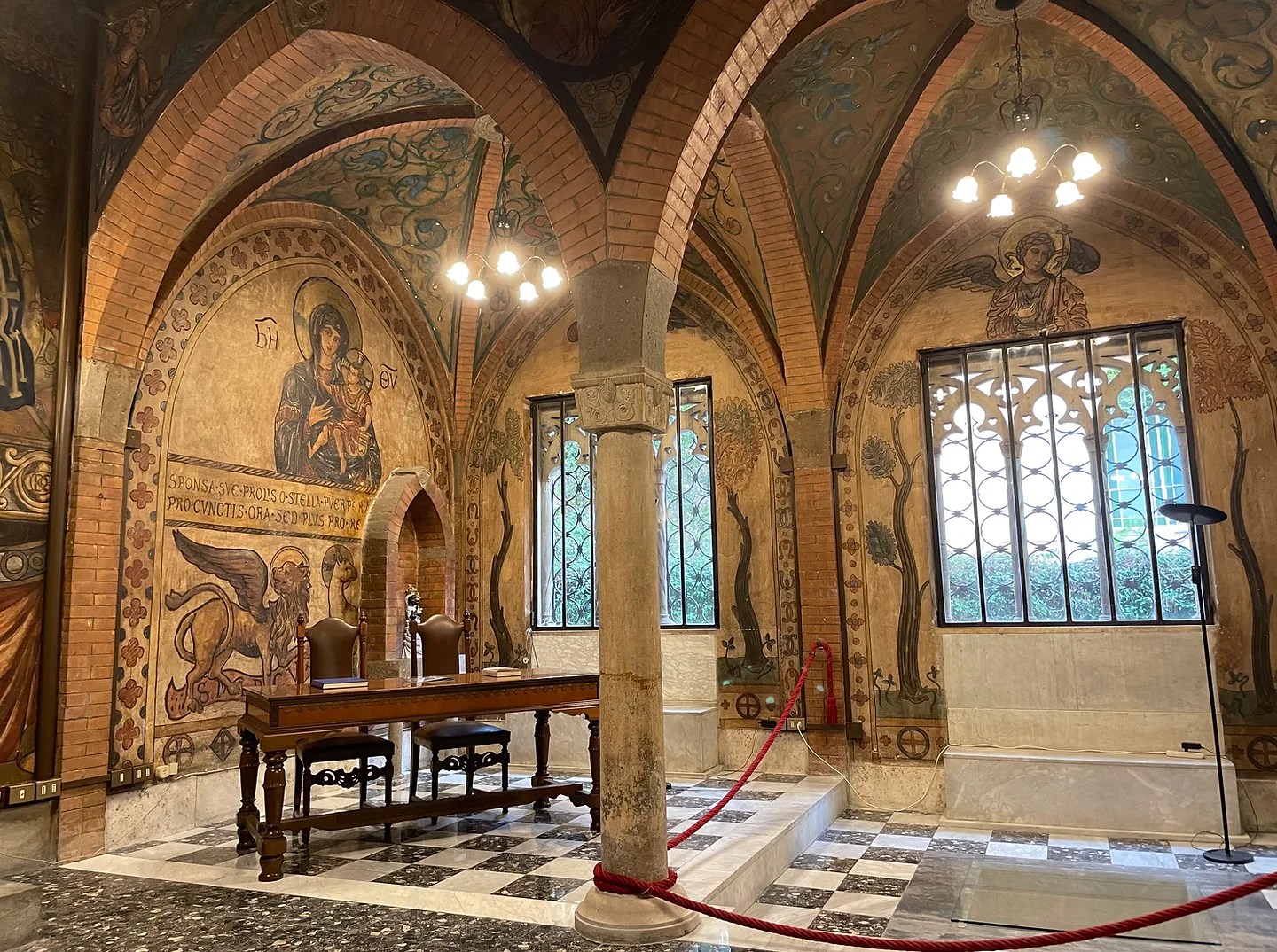
“I lived in solitude, surrounded by books on the history of religion, which have always been my favourite reading. This may help to account for a curious episode that took place on one of my stays in the villinio. I had a religious experience. It took place in the Chapel of Lorenzo, but did not seem to be connected with the harmonious beauty of the architecture. I can only say that for a few minutes my whole being was irradiated by a kind of heavenly joy, far more intense than anything I had known before. This state of mind lasted for several months, and, wonderful though it was, it posed an awkward problem in terms of action. My life was far from blameless: I would have to reform. My family would think I was going mad, and perhaps after all, it was a delusion, for I was in every way unworthy of receiving such a flood of grace. Gradually the effect wore off, and I made no effort to retain it. I think I was right; I was too deeply embedded in the world to change course. But that I had felt ‘the finger of God’ I am quite sure, and although the memory of this experience has faded, it still helps me to understand the joys of the saints.”
Having been drawn into his story to the point where I felt as if I knew him personally, I read this passage with a deep sense of sadness. Having experienced an indescribable joy which, he is convinced is the finger of God, he chooses to turn away because he fears for the call it will make on his life. The reasons themselves are illuminating as they are tragic. What would I have to change and lose?, what would my family think? And finally, it could just be an illusion. It points up that the problem we have with believing is not primarily one of the mind or of the intellect, but of the will. It is a moral one. If I believe, if I repent and throw myself on the mercy of God, there will have to be changes, If Jesus is my Lord, he will demand everything and that’s too much. The tragedy is that it comes from an inability to see and believe that God is good and grace is a gift, specifically to the unworthy.
My hope would be that his decision was not final and that in later life he had a change of heart, and accepted the flood of grace that he experienced in that chapel of Lorenzo.

