I don’t know what it is about me (honestly, I don’t try it) but I seem to be perpetually swimming against the tide. Just when everyone seems to be leaning, swaying and swinging towards a yes vote I am becoming less and less convinced.
I was so looking forward to this debate, but it has been such a dreadful disappointment. I hate the slick TV commercials, I hate the promise of Nirvana that no one can believe in. I hate the dreadful warnings and the threats. I hate the celebrity endorsements. Really, we don’t need to know how musicians, TV cooks and dancers chose to vote. We can make up our own minds. But what we do need is leadership and of a kind that we have, so far, not seen.
Somehow I naively believed that out of it all would come some clear leadership, some visionary, some prophet, someone who would grab the attention of the people and fire their imagination, someone who would point a way beyond petty kale yard parochialism to a hitherto unseen horizon, a Vaclav Havel, a Jomo Kenyatta, a Mahatma Ghandi a Nelson Mandela an Aung San Suu Kyi. But no one we have, comes anywhere near the stature of these people. Inevitably it has become little more than a playground scrap following the same old predictable lines and no one seems to be able to rise above it. Some like Jim Sillars and Gordon Brown make an effort and hint at what could be, but others have let it slide into a grubby political game promising a paradise, issuing threats and knocking chunks off each other. When people like Nicola Sturgeon says “we have everything to play for” we know it is as a game. The scary thing is that it is not a game.
So, while they are unlikely to listen, this is what I have to say.
To the Yes side: “Forget about politics and economics, monetary policy security, child care, the just and fair society that we all want etc etc. You know and we know that it might not be possible to deliver on any of these. There are no guarantees. You might not be in power to do it. Focus on nationhood, inspire us, make us believe in it, and don’t promise anything, other than that it’s going to be hard. That was what Wallace (aka Mel) and Churchill did. Whatever you do, don’t give us sweeteners. We are not fools and we see through all of that as we have done before. Promises of a better world, simply by putting a cross in the right place never convinced anyone. But if I heard a speech that said “it’s going to be pretty tough, the economy might not go well for some time, it will takes us several years to sort all the things out and get it right, we may have difficulty working out who are our friends, It will take a lot of patience, you might find yourself worse off for some years and frustrated with us because we can’t do it all at once but… but, and here’s the thing, it will be worth it.” Then I just might just be convinced.
To the no side: “Don’t say anything. Everything you have said, so far, has backfired spectacularly. You don’t have to argue for the status quo. People know what it is. The other side need to do the explaining. It’s not perfect, it’s not all good, there are lots of flaws but it works, don’t fix it.
I have been asked and pressed a number of times on facebook and other discussions, to justify why I hold to the orthodox position on homosexual practices and, in particular, what was the basis for this belief. It is not a subject I ever wanted to speak about and I have been very reluctant to make any comment. I also feel that the onus to explain and justify the moves towards the normalising of same-sex relationships should fall to those who are proposing it. In a way there is no need to justify what has been the orthodox position for centuries. It is up to others to justify why the change is either, necessary, good or the right thing to do. This explanation should not have been necessary. Still, as the push towards this momentous change in society, which will have far reaching implications, has been overwhelmingly in one direction and the voices against, with some notable exceptions, all but silenced, I feel a need to state the case as best I can. It is difficult to distil the thinking into a few words, when others have devoted whole volumes and years of study to it, but I have tried and here is what I would say.
Homophobia
At the first I have to make the clear distinction between the person and the act. I have nothing to say about the person. I have no authority or qualification to do so. My position is wholly based on the act – sexual relationships between people of the same sex. This distinction is very important and has often been conveniently blurred. It is perfectly sensible and reasonable to believe that a person’s actions are wrong and disapprove of them and yet not discriminate against them. It happens all the time. The prevailing thought, however, is that if you are unwilling to embrace same sex relationships and believe them to be fundamentally wrong, you are harbouring homophobic thoughts and attitudes. This then is the breeding ground for prejudice discrimination, hostility and eventually violence. There is also the suggestion that such an attitude can precipitate the suicide of a perceived victim. Homophobia, in this definition, is just one step up from Nazism.
Self-evidence
For me, the major explanation and authority comes from the Bible, and I know that many who do not accept the authority of the bible will be dismissive of it because of that. But my position is, however, not only based on what has been revealed in the bible, but also from what is clearly seen in nature. What I have called “self-evident” truth, although again some have objected to the use of that term. It is to do with the unarguable anatomical distinction between men and women clearly pointing to a design, and I would say to a designer. If there is a design then, in a world where we have free will, there is the possibility of a distortion, a spoiling of the designer’s intention. It seems perfectly plain. It is unnatural. It is something a child sees as obvious and doesn’t need to be taught. Even without the bible, I would take the same position that I do.
The Bible
I do believe the bible to be the word of God not just parts of it. It is our one true guide to life but more importantly it reveals God and Jesus, the son of God, to us. I also believe it is a whole and needs to be read as a whole and so I would not try and pick out a verse here and there (what could be called “proof texts”) to make a point.
The Design
The first thing is that nowhere in all of the books of the bible is there the remotest hint that homosexual sex is anything but wrong and is often condemned in the strongest of terms. No one argues with this. But the place I would start is Genesis and the creation narrative. Nothing could be clearer that God created humans as male and female deliberately. It was the climax of creation and it was only then that he rested and gave his creatures the command to carry on the work of creation from the garden into the entire world. That is enough for me. From there the design is simply clarified and reminded in the positive and the negative. It is possible, as others have done with far greater clarity than I could ever employ, to trace this design throughout the bible, book by book, emphasising its central importance as a picture of the relationship between Christ (the son of God) and the church (his bride). Paul describes this as a mystery. It is a wonder and, at the same time, something extraordinarily beautiful and lovely. Because of that, any distortion any soiling of the picture is a blasphemy against God.
Jesus
It is probably easier to start from what the advocates for the normalisation of same sex relationships claim the bible says. One of the big ones is that Jesus said nothing about it and so by default he was for it. He would have blessed a same sex union if there was one at the time in the same way that he blessed the couple at Cana by his presence. That is how the argument goes. It is of course a baseless argument. It is arguing from the negative. Jesus said nothing to contradict or supplant or nullify the moral law which condemned such practise in the strongest of terms. In the Sermon on the Mount he did not water down the moral law but he reinforced it. He said that sin starts in the heart. When it came to marriage he pointed back to the creation narrative which explained that the design was for a man and women to become one.
Leviticus
The moral law was defined in the Ten Commandments which included the seventh (or sixth) and amplified in Leviticus. So many people follow the well-trodden line set out by atheists, bishops and celebrity evangelicals who sneer and savagely mock those who hold to the orthodox view, by saying “You are hypocrites. You disregard some rules (on not eating pork, not wearing clothes made of different materials for example) while choosing to keep others (on homosexuality)”. This is the classic Jed Bartlett put down and is, of course, a great laugh. But those who say this have either not taken the trouble to read Leviticus or have deliberately misread it. It is not difficult to see there is a clear distinction between the cleanliness laws, the rules that apply to the business of approaching God , the laws that Jesus fulfilled by what he did, and the moral law which remains. The actual verse which specifically prohibits homosexual practise is not amongst verses on clothing or what not to eat, as people would have us believe, but is in a chapter devoted to the prohibition of many kinds of sexual sin and is in fact sandwiched between the law against sacrificing children and the law against sex with animals. By this logic, which the critics employ, there is no reason why we should prohibit sex with animals or the sacrificing of our children if, in the spirit some future enlightened age, it was thought the right thing to do.
Sodom
In the account, God was about to punish the city because of its many sins but we are not told explicitly what they were. The fact that homosexual rape was involved, may simply suggest how bad thing had become but we are not told. The suggestion that it was because of their inhospitality to strangers is simply unfounded, as Lot, one of the chief citizens of that town, did in fact, offer and press on the strangers, hospitality, so that obligation was fulfilled. Also the sin of inhospitality is the not the one Jude has in mind when he wrote his letter. It is specifically sexual immorality and perversion.
David and Jonathan
The suggestion that David and Jonathan had a homosexual relationship and that Ruth and Naomi were lesbians, as I have heard some say, is farcical.
Paul
It is hard to get round what Paul says about homosexual practices both in Romans, Corinthians and Timothy without somehow denigrating Paul. Some have suggested that he was speaking solely about pederasty and not about long term homosexual relationships, which he would have been ignorant of. The first position (deciding that you can’t trust Paul) pretty much writes off the most of the New Testament and I think that you either accept the authority of the bible or you don’t. The second stretches language and credibility and also makes the astonishing assumption of what Paul did and didn’t know. Any reasonable person can see what he is talking about. In Romans he is beginning his thesis on the gospel of Jesus Christ, the core of the Christian faith, by focusing on the reality of God’ anger against sin. But it is not against homosexual sin, sexual sin or other specific sins, for the matter (of which he lists many) but the act of rebellion against God in which we are all implicated. Homosexual sins and the others he lists are a result of God leaving us to it and the consequences of that rebellion. This is the necessary backcloth to the scene, before he introduces the good news in the wonder and beauty of what Christ has done for us. It needs someone better than me to explain that fully, but what you cannot deny is that Paul describes homosexual sex as unnatural and a perversion of God’s design
Conclusion
It would be heartless, in the extreme, not to recognise that so much of this is very difficult and can be hard to accept. Many have been badly hurt and speak of great pain and anguish in the way the church, society and governments have treated them over the years. Being ostracised, discriminated against and left out in the cold. An unloving, censorious attitude has often prevailed but that cannot be traced back to the bible or laid at the feet of Paul or Jesus. The bible makes quite clear that homosexual sin is just one of many, no better no worse. We are all sinners. We are all in the same boat, so there is never any ground for discrimination or thinking of ourselves as better or above another person. Paul himself shows the way when he warns his readers that they will be judged by God, if they continue in their sinful ways, he includes those who practice all kind of sins and says no one will get to heaven, but then goes on to say to his hearers, that they were all like that too but have been washed and made clean. Finally he says that he too is a sinner of the worst kind but he has been forgiven and being made a new person in Jesus. That’s the Good news. The rest is bad.
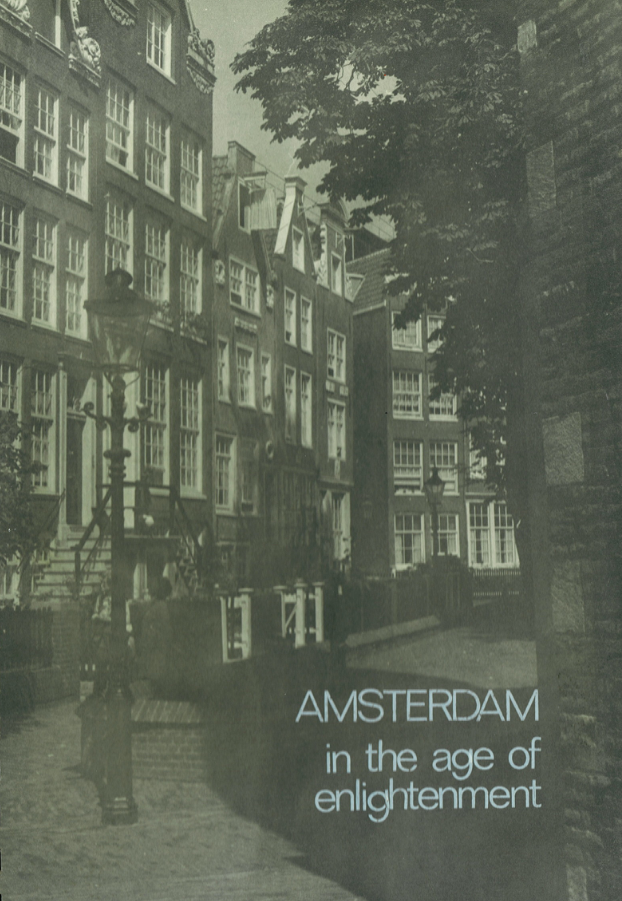
The only award I ever won in Architecture was as a student in my final year at college in 1972. It was an annual prize awarded by the Royal Incorporation of Architects in Scotland for a design completed within a day. Without any hint of false modesty, I am convinced I only won it because the competition was itself so poor and most of the others were diligently concentrating on the push towards their finals. I was cavalier enough to think that I could afford the time-off to do it. With the prize money and as newlyweds we were able to make our first trip to the continent of Europe on a student charter flight to Amsterdam. It was a city of red lights and hippies, bicycles and cafes, canal houses and neckgables, with families eating, reading and socializing on the steps down to the street in the late afternoon sun, and everywhere that delicious smell of cigar smoke. It was at once an enchanting place full of light and learning. It seemed to be the epicentre of European liberal civilisation and culture. The pretext of the visit was to investigate and write something about the planning of the old city and by a chance encounter, I was introduced to someone who gave me access to a university library and so I found enough material to write a short dissertation and thus fulfil my obligation to the awarding body. On the Sunday we went looking for a church and found the English speaking church in the centre of the Begijnhof green. It turned out to be affiliated to the Church of Scotland. After listening to a dreary sermon on butterflies and being kind to sheep we mingled over coffee in the hall. There we met a young American student called Chip Carter clutching a copy of “Europe on 5 dollars a day” who in turn introduced to us a couple from the States, on their honeymoon, doing Europe, on a good bit more than 5 dollars a day. Our new found friends exuded the super confidence that we lacked and so we tagged along with them for the rest of the day, visiting the Van Gogh museum and skulking at the back in in embarrassment, when they insisted on asking every resident for directions in very loud English. It paid off, however, and in the evening we found a tiny evangelical church in a nondescript district of the city where we were told Hans Rookmaker worshipped.
Hans Rookmaker was a professor of history of art at the Free University of Amsterdam and wrote “Modern art and the death of a culture” It was a seminal work and played a significant part in my understanding of faith, philosophy, reality, art, the modern world and their mutual relationship. It sorted out my ideas on these subjects and helped me sharpen my thoughts on how architecture fitted into the grand scheme of things. In the college studios during the sixties there was no clear way forward and a confusion of philosophies (1). Some still held to the principles of design “commodity, firmness and delight” credited to Vitruvius and the historical critical method of Reyner Banham. The modern movement had run out of steam and we were crippled by the restrictions of the “form follows function” philosophy. In this discipline, there was no room for decoration or delight. Inevitable everything had to be justified in terms of utility and cost so no curves, no awkward shapes, no expensive materials, no elaborate constructions, just follow the basic requirements of the building and beauty would automatically arise. If it didn’t, it wasn’t your fault. Among my fellow students, Brutalism still had a strong following but some of my close friends were beginning to flirt with post-modernism. While Hans Rookmaker seldom mentioned architecture, it was his analysis of the state of art in the 20c which opened a door in my mind and threw an enormous light into an otherwise murky interior. It is hard to describe how inspirational that was. Suddenly the parts belonged to the whole, God was as much interested in the means as the end and beauty meant more than utility.
The service in the drab school hall was in Dutch and mainly lost on us but we felt welcomed all the same, at home and able to share in the worship. After the service we were ushered over to meet the great man, our American friends enthusiastically holding aloft their copy of the volume for signature. “And this is Crawford – he’s from Scotland he’s read your book” The old professor, already lighting up his pipe, was bemused, didn’t want to be photographed and swiftly made a sharp exit, all the while pretending that he couldn’t speak English. The pastor, however, was more willing to interact socially and invited us to his home in an apartment far out on the edge of the city. This was a massive scheme of modern apartment blocks and setting for the notoriously famous “Blue movie”. We enjoyed a lovely evening chatting over delicious potato salad and watermelon with a crate of Amstel Pils bought from a neighbour and the air soon thick with cigar smoke. The children were playing with a brightly coloured rubber toy. In a crazy sequence of connections, it turned out to be a prop from the set of David Lean’s “Ryans daughter”, where the children tease the village idiot over the lobster he had caught and it is thrown around in the crowd. In the film it is perfectly realistic. Handling and playing with the toy you could see why. But all of the connections were beginning to take too many bizarre turns and we had had quite enough excitement for one day, so we found our way back into the city, to our little room high up in a canal house in the Jordaan district. Hans Rookmaker was to speak at a conference in Scotland some years later but he died quite suddenly and so I was never able to hear him in the flesh.
But it didn’t matter, I had his book and other writings and now more than forty years later, reading again the well-thumbed volume, I find that it has lost none of its relevance and I can feel again the thrill and excitement of a new discovery and the possibility of more.
Crawford Mackenzie
Note
1 To be fair it was not all confusion. James Macaulay’s lectures on architectural history were inspirational. Looking back was the best way of making sense of where we were, so that we could begin to chart a way forward.
“What good am I if I see but don’t say?/If I say but don’t do/If I look right through you/If I turn myself off/From the thunder in the sky/What good am I?”
“What good am I?” Bob Dylan
Whenever I wandered into writing or talking and pontificating about my ideas about my work, or on other issues that I was involved in, or just simply things that interested me, (sometimes they could be grand revolutionary ideas or amazing insights of cosmic dimensions), I was pulled back to earth and given the wise counsel, by my best friend, to back off and keep quiet. “Just do it” was the sound advice, “Leave the talking to others”. Generally I took the advice, but now and again I slipped off-piste. That’s what I am doing now. But it is not simply an indulgence. It has a purpose and is partly due to a sense of responsibility to others and to future generations. Sometimes the softly softly, woolly woolly, wobbly wobbly, approach, the “don’t upset or offend anyone” attitude is not the thing anymore and it’s time for speaking out and saying things as they are. There is a time when you shouldn’t rock the boat but that’s not when it is already titling at 45 degrees. There is a time to speak and a time to be quiet.
Once you decide to speak out there will be flak of course and worse. You will be called names and not nice ones either. People who you thought were friends can begin to sound like enemies. Others will give you a deafy and you know they don’t like what you have said. Inevitably people will find your statements threaten their position. All too soon, you will begin to wish you had not blundered into the controversy in the first place.
The point of course is that not speaking out makes you culpable. It is the equivalent of turning a blind eye. But if you see over the mountain, it is your duty to tell. If you hear the injustice, it is your duty to call on the judge. If you sense an imminent disaster, it is your duty to warn. If you know the storm is coming, it is your duty to help get folks ready.
It is never, of course, as hard as it seems. Telling the truth is easier than lying and covering and recovering your lies. There is even a joy in knowing that you can talk about things that matter without bitterness or rancour and the fear of causing offence is often groundless. It is liberating to find that true friendships are deeper than opinions.
But knowing the times, is the hardest part and for me that has to mean looking beyond myself, seeking a higher wisdom and listening to a still small voice.
In a recent article in Scottish Review1, Gary Hasson powerfully opens a lid on what is possibly the biggest problem threatening our society, yet is hardly ever spoken about. It is the festering wound and the major source of division in contemporary Scotland. It is the elephant in the room, the war we mustn’t talk about, the brother we never had. It is starkly illustrated by the sharp difference between life in the peripheral housing schemes and the leafy west ends of our cities. Yet it is possible to live out your life without ever noticing it. Maybe you have to be in a prison waiting room, be searched and have your arm stamped or live in a burned out close which has become a shooting gallery, or see a gang fight explode at close quarters, or be routinely insulted and humiliated by some wearied official behind a grill, or just had to learn to accept tenth rate service from medics, educationists, and councillors just because they can get away with it. It sounds like something that every politician should be agitating for but I do not believe it is within the gift of politicians to fix even there was the will. I don’t believe it is to do with money or a solution could be bought. I don’t think the psychology and sociology and educational theorists have the whole answer either. Neither Darwin, nor Marx nor Freud, “Three most crashing bores of the Western world”2come anywhere near. The problem lies much deeper. On one side is the arrogance, greed, pride and indifference or simply obliviousness of those who have the power the wealth and the wit to be sorted, on the other an almost total lack of self-esteem, self-worth and self-respect of those on the other side of the tracks. Apart from the odd outburst, the odd riot, the odd march, there is a resigned acceptance that this is just the way it is. It all became very clear to me early on in my work with the Mains of Fintry Urban Ministry Trust and it is not new. Nick Davies wrote about it in 1997 “Dark Heart, the shocking truth about hidden Britain”3. The book was, and is, a desperately depressing insight into the underbelly of urban life in the late 20c, but he was simply an investigative journalist and had no real answer. The crippling lack of self-worth and the sense of being trapped with no way out is deeply ingrained in the psyche. It is reinforced with every attempt by those with the resources, time, skill and money to help. “You are only helping because you can and we can’t” Even the acknowledgement of gifts, the positive strokes, the affirming comments are taken as yet another nail in the coffin “You are only saying that to make us think we are good when we know and you know we are rubbish” It is seen as yet another patronising put-down. Our Kosovar friend made an interesting comment on this. When volunteers and NCO’s came to her country to help rebuild the nation, after the war, they were treated with disdain and suspicion. “They must have done something really bad to be sent to a dump like this” was what they said. It was only later that she saw the thing differently.
So what is the answer?
I have only one: one solution, one way, one truth, one life- Jesus. If God was prepared to become one of us and go through unbelievable pain and suffering and die for me then I must be worth it and that changes everything.
But it is also not just a theory. I have seen it happen. I have seen people find God and become Christians and find their lives being transformed. They were no longer cowed and subservient but, without turning their back on the traditions, families and cultures, they stood tall with dignity. I have seen it in both individuals and in communities in the east end of Glasgow, in the north end of Dundee, in the pueblos Jovenes in Lima and in the Quechan communities in the Sierra of Peru. It was something that even an atheist like Matthew Parris recognised, after visiting Africa in 2008 “Now a confirmed atheist, I’ve become convinced of the enormous contribution that Christian evangelism makes in Africa: sharply distinct from the work of secular NGOs, government projects and international aid efforts. These alone will not do. Education and training alone will not do. In Africa Christianity changes people’s hearts. It brings a spiritual transformation. The rebirth is real. The change is good…..The Christians were always different. Far from having cowed or confined its converts, their faith appeared to have liberated and relaxed them. There was liveliness, a curiosity, an engagement with the world, a directness in their dealings with others – that seemed to be missing in traditional African life”. 4
So, for me, the hope for our nation does not lie with politicians, civil servants and the ruling classes, nor with the educationalists, sociologists and social scientists, nor with the economists, entrepreneurs and traders in money, nor with the artists, poets, musicians and architects, nor with the entertainers, celebrities and comedians but, strangely as it may seem, with the humble preacher, who faithfully and carefully studies the bible and brings out its truth and majesty in words that people can understand. In this simple act the whole of life, for the individual and the community, can be transformed and the great divide breached.
2 William Golding: “Marx, Darwin and Freud are the three most crashing bores of the Western World. Simplistic popularization of their ideas has thrust our world into a mental straitjacket from which we can only escape by the most anarchic violence.”
3 Nick Davies: Dark Heart, the shocking truth about hidden Britain, 1997, Vantage
The overnight bus from Lima was an experience I would try and avoid, if I could. We drove along the coastal plain on a muggy hot night, stopping to pick up passengers and sellers of choclo, oranges and bottled drinks, on the way, before beginning the long climb up into the sierra. It was a continual zigzag. On the upper floor we were constantly thrown from side to side which put an end to any idea of sleep. All windows were tightly closed and condensation from the heaving bodies dripped down the glass. A cockroach was trying to get into a bag of vegetables. Some passengers had already been sick and the worryingly thin sick bags were sliding around the floor. I was hoping that one didn’t burst just at my feet and I was praying that the driver would not fall asleep at the wheel. It was a long nine hours before the glimmering light of dawn eventually brought relief and the appearance of small farms and dwellings in the hills, now dotted with eucalyptus; cactus and pampas grass lightened the spirit. Then suddenly, we were there, over the hill and looking down on Ayacucho, spread out in the valley below us just coming to life and waking up to a new day.
I had a number of places on my wish list to visit during my trip but this was the one at the top. There were a number of reasons why this was so. It was here in 1824 that the battle of Ayacucho was fought and the victory that not only secured Peru’s independence from Spanish rule but signalled the end of the colonist’s power in South America. Simon Bolivar credited with the victory, changed the name of the city from Huammango to Ayacucho “the corner of the dead” or “field of blood” as a tribute to the many who died on the battlefield. It was in this city in the late 1960’s that the Sendero Luminoso was born under the inspiration of their charismatic leader, Abimael Guzmán. The “Shining Path”, was a Maoist guerrilla insurgent organisation representing pure communism, whose aim was to destroy the existing bourgeois state and replace it with a dictatorship of the proletariat which would in turn precipitate a world revolution. The brutal war between the rebels and the government force, that continued throughout the 80’s and early 90’s , resulted in thousands of deaths. Many innocents were caught in the crossfire. After the murder of one of their lieutenants, the Shining Path took revenge and massacred a whole village including old people, children and pregnant women. Guzman was unrepentant. “We responded with devastating action, neither we nor they have forgotten it, because they got an answer they didn’t possibly imagine, to be sure. lucanamarca, More than 80 were annihilated, that is the truth…. The main point to make is that we are a hard nut to crack and we are ready for anything , anything” The Christian church was a specific target for the terrorists. They refused to take the side of the revolutionaries and suffered terribly as a result. Many congregations were slaughtered and pastors killed. One of those was Rómulo Sauñe Quicaña. He came from a rural community and it is possible that he was descendant from the Inca royal household. He heard about Jesus as a teenager and gave his life to serving his Lord as a pastor among the Quechua people introducing new hymns in the Quechua language, using traditional instruments. As a gifted linguist, he assisted with the translating of the bible into Quechua. The effects of this work were truly revolutionary. The Quechan Christians now had a confidence and assurance in their faith that the Maoists with their dehumanising philosophy could not match. When you know that you are loved by God, being sold the idea that you are an economic unit as part of the proletariat mass holds no attraction. Because Rómulo Sauñe and others refused to bow the knee to the ideology of the Shining Path or to their methods, he was hated. Coming home from visiting a local church in 1992 his bus was stopped at a road block and he and four companions were murdered. Two weeks later Guzmán was captured in an apartment above a dance studio in a fashionable suburb in Lima and the war was effectively over.
In 1987, at the height of the conflict, the Ayacucho Quechuan bible was first published but because of the upheaval and migration over the years, this had to be fully revised and republished. It was dedicated in May 2013 . Those who were there at the dedication describe it as a very moving scene, when massed choirs approached the city square from four corners and thousands joined the celebration, among them, many who had lost family members in the war and who had come through great suffering. I wanted to see the site of the ancient battle. I wanted to walk down those streets. I wanted to be in that square.
Arriving at the bus station that morning my thoughts, however, were not so much with the history and the events that unfolded in this place but with how dreadful I felt. This was brought on partly by the overnight journey and partly on account of the altitude. I was told that when you arrive at altitude the first thing you should do is nothing: no lifting, no walking and no work, just rest, for half an hour or so to allow your lungs to become accustomed to the thinness of the air. I wanted just to sit, but my companion was insistent that we find a hotel first of all. So we took a taxi to the city and called on a few dubious establishments. Each was regarded, by my companion, as too expensive so we searched for other equally disreputable places. Finally she settled on one. It was very tawdry, lacking linen, towels, soap, toilet paper in fact just about everything you would expect in a hotel, apart, that is, for a bed and a remote control for the TV. I was past caring. It was somewhere to rest. I threw myself on the bed and passed out for an hour or so while my companion went looking for a friend she knew. When she returned she had found somewhere better so we paid off the man behind the grill and left. The other hotel was luxury by comparison. But there was something more. The place had an atmosphere. It was hard to describe. Perhaps it was the little things that make up the whole, perhaps it was the way the staff went about their business, perhaps it was just fancy, but it felt a good place to be. My weariness had quickly evaporated and had been replaced with a surprising sense of well being and excitement at new discoveries. I was introduced to the owner, a man in his early seventies cheerful, warm and friendly and later, to his daughter. She ran a small clinic from some small rooms within the hotel and was the first and only person that I met on my trip who spoke English. She was Quechuan and was fluent in four languages. She studied in Brazil and the UK but her life’s work was as a medic among the desperately poor villages that surrounded Ayacucho. For seven years she had worked to provide proper sanitation in this region and was able to witness the astonishing improvements to health, particularly amongst children. Previously there was a very high level of infant and child mortality due to contaminated water supply. We had just met, but I felt I had known her all my life and I had this strange conviction that I had come here for a purpose. She spoke about a clinic she ran in a town outside the city and asked if I would like to see it. It was in Quinua, the site of the battle and a place we had actually planned to visit. Immediately we went looking for a combi bus to take us there.
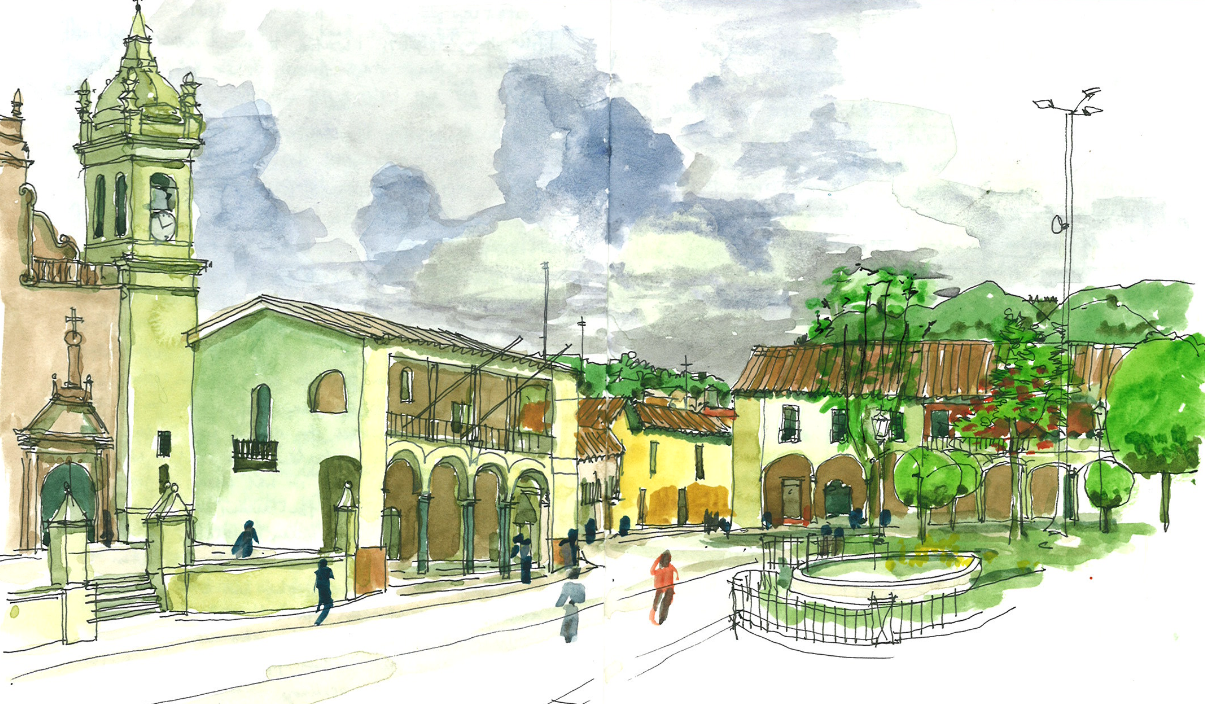
The village is about an hour and half by combi and much higher up in the mountains (3,300m). Above the village is a large impressive plateau. You can stand here and look out across the valley, down to the city with the Andes circling around and that wonderful gasping sense of space and scale and beauty and the crystal clearness of the air like the purest water you drink or the finest wine. It had all the beauty we associate with the Scottish highlands but on a far far grander scale. At the edge of the plateau is a rather ugly obelisk, a memorial to the battle that was fought on that field. Inside there is a small museum telling the story of how the loyalists in red were defeated by the rebels in blue with the help of the local rural population wielding pitchforks and axes. A young boy acted as our guide and explained the significance of the various artefacts. After some hours the sky began to darken and we knew that rain was about to fall. This was the rainy season after all. We made our way back down to the village and reached the market just before the clouds burst open and heavy rain descended, loading the thin tarpaulin roofing sheets and scattering waterfalls in arbitrary directions. Lunch of cuy (guinea pig) rice and beans was followed by a look at the work of the artisans and their famous pottery.
The clinic is in the centre of the village: a single storey building, up from the road, typically concrete and bricks, and incomplete with reinforcing rods stretching to the sky. Our friend was in the middle of a consultation, so we took a seat in the waiting room. It was the same room and we could hear the discussion that was going on, although busy with our own activities, my companion checking on facebook and me scribbling notes. Quite suddenly, the conversation stopped and there was silence. I looked up. There were three medics, the patient and a relative around the table. All heads were bowed and there was prayer for the situation with the words, I heard many times, “nothing is impossible to God” When I remarked on this to my companion afterwards she was surprised. “Would medics in the UK not pray for their patients?”
Most of the building construction I had seen, apart, that is, from the major public building and the malls, was shambolic, unfinished and in a permanent state of disrepair. The clinic was no different but here the situation was much worse. The actual construction was poor. It wasn’t working. Two columns, hastily inserted in one of the rooms to save the concrete roof from collapsing, bore testimony to this. The junctions between the various parts of the building allowed water to drip down the walls of every room with dark damp stains turning green. Amongst the faded health posters and basic facilities it was a most depressing scene. On the concrete roof in among the debris of water tanks and make shift solar panels, we talked about the work. The need for the clinic was obvious. It was the only one. The government did not have the resources to provide anything here and so it was left to voluntary agencies to run and support this work. It often boiled down to knocking on doors to find someone who would help. The people themselves were desperately poor. Added to this was the spectre of domestic violence and the migration of young people to the cities often leaving the old people to die in desperate conditions with poor shelter. This was the summer and it felt quite cold. I shuddered to think what a winter would be like in these open concrete dwellings with tin roofs and no insulation. While our friend was describing the terrible conditions of these people and their basic needs, she broke down. I felt so helpless. I was a passing visitor a fleeting stranger. What could I do? I wanted to get out my height rod and measure up. I wanted to draw up sketch proposals for accommodation and improvements to the building. I wanted to get the materials, gather some workers, pick up my tools and get started right away. All I could do was to show some sympathy, buy some gifts from the craft shop and leave.
On the final leg of my journey home, all the experiences and memories were cluttering up my mind. They were too many: too many people, too many situations, too many memories to make any coherent and consistent sense of what it all could mean. As the miles and time and climate and language passed and moved into more familiar territory, the idea of helping with the clinic seemed nothing more than the craziest of ideas, an interesting interlude, a story to tell. The realistic possibility of it becoming a serious project, one that I could be part of, seemed more and more fanciful. After all it was in a remote part of a country in the southern hemisphere, on the other side of the world, it was three languages removed, it was among a different people and in a completely different culture. I had learned too much about the disasters that happen when people with misguided zeal blunder into situations to help and leave, having made it so much worse. Yet something niggled and it still does.
I came to see the place of so many memories but left with a memory of a cry of desperate need. One that would not go away.
When I started this weblog, this subject was one I didn’t want to be writing about. It was one controversy I was happy to avoid. If I had to, I would try and skirt round it as best I could and leave it to the reader to work out where I stood, but things have changed. I feel continually pressed, corned and nagged into coming out and making clear what I believe is the truth of it.
I never liked and still don’t like talking about sex. It is something so precious and intimate and delicate, too much talk crushes the flower and smudges the image. At school you knew that the boys who were always talking about it were not doing it. But with the relentless battering from the media, from self-appointed pundits, celebrity clerics and experts, in almost every minute of every day, from almost every angle, having the thing shoved into your face with virtually no escape, and possibility of respite, there comes a time when you have to say “Enough is enough”. I can’t be silent any longer. I have been bullied and intimidated for too long. I am wearied to distraction at the constant bleatings of those who claim to speak for others, for those who are hurting because they are not able to find sexual fulfilment in the way that they want. Yes I know and don’t doubt that people are hurting, that always will be, but when you think of the world of suffering people out there, the people who have to face the rest of their lives with crushing disability, with unbearable loss, with unbelievable deprivation, or simply the desperate human longing for a partner or soul mate or for a child, a longing that will never be fulfilled, it barely registers on the scale.
So where am I?
I believe in God, who created this world and who keeps it going. I believe he has communicated with us and speaks to us. I believe he has been doing that from the beginning of time in different ways but especially by coming and being one of us. I believe he speaks to us: to me, now, today. I believe that all we need to know of him can be found in the Bible, if we listen to his voice speaking through it and allow his Spirit to make it clear. I believe that it contains the only truly good news, the only truly accurate assessment of our condition and situation and the only real and genuine hope.
In it the pattern: the design, the beauty of the relationship between man and women is clearly shown. It is a picture of his love for us. It is something so holy that any variant, anything less, any spoiling of that picture, he abhors. That is why idolatry, adultery, fornication, homosexual, bestial and incestual practices are condemned. It is the spoiling of the picture, like the misuse of his name, or the abuse of his children. That is the offence.
That is where I am, this is where I stand and that is why I will not be celebrating.
Tomorrow morning I will be joining the long queue, shuffling through the cattle pens, waiting for inspection before committing myself to the belly of a giant silver bird on a long haul flight across the sea. When I have travelled before, it has been to the east to Europe, Israel, Nepal and China, or south to Zambia. This time I am flying across the mighty Atlantic to the western edge of the “New world”, to Peru. It was an idea half conceived more than 40 years ago and inspired by a friend who on completion of his studies began his life’s work of translating the bible into indigenous languages of the Andes, principally into Quechua the ancient language of the Incas. It, of course, begs the question “Why would you devote your life to translating a book into a relatively obscure language?” But to ask the question, itself, misses the point, or rather two:
The first is that the bible is not a book but contains all that we need to know about God, ourselves and the cosmos, the starting point for all other explorations. It is the “Word of God”. It communicates what God has to say about who he is and who we are. It is not, in one sense, easy to understand, but like a giant picture with extremely fuzzy edges, (read some of what is said in Genesis and in Revelations for example) when you focus on the centre: moving from all the people to one people, to one person, to one life of 30 years, and specifically, to three days at the centre of history, then its cosmic relevance is revealed.
The second is that, while it is bedded in the culture and language of the period, in which it was written, it transcends these. While it is rooted in real time in history, it speaks to all time. While it begins in the specific geography of the Mediterranean lands, its impact reaches across the globe. While it was inscribed in Hebrew and Greek, it is read and understood in thousands of languages. It is not difficult to see the significance for a Quechua speaker in the high Andes, being able to read the bible for the first time in his own language rather than in the language of the foreigner or possible oppressor, in the same way that native Gaelic speakers were able to do the same in the early ninety century in Scotland. The pragmatist would say “why bother? If you want to read the bible, learn English or Spanish or Latin or Greek”, but that of courses misses the point. God speaks in words and pictures we can understand. God is speaking and he speaks to me, right into my situation, now, in my mother tongue.
But I have other reasons for travelling. My early fascination with the Incas made me scour the library for every book I could find on the subject and I poured over John Hemming’s “The Conquest of the Incas” I even had a strong feeling to travel and work in Peru and made pathetic attempts to learn Spanish, through a linguaphone course, which had to be donated to the library after a few months. Years later a young Peruvian man from the barrios in Lima came to stay in our home. He had volunteered a year of his life to help in the local church and community and it was not long before everyone, young, old and in between, took him to their hearts and thought the world of him. He brought and gave so much it would be hard to put into words what we learned from him. When he left he was sorely missed and he still is. As we parted at the airport on a grey Edinburgh day, I expressed the hope that sometime soon I would be able to come over and visit. Now several years later that hope is being fulfilled.
As I make my final preparations: thinking about the ancient Incas, their incredible story and anticipating seeing the amazing sites at Arequipa, Titicaca Cuzco, Ayacucho and Machu Picchu, thinking about the long awaited reunion with my friend, meeting his family and church and seeing something of his life in Lima and thinking of the stories we will share, I can’t help feeling that the story which will eclipse them all will be the one about bringing Gods word to all peoples.
I love this time of year. Despite all that has been done to neutralise it , commercialise it, emasculate it and turn it into one long meaningless party, only interrupted by bells, all the effort to make it yet another frolicking hyped up winter festival, played out on the Capital’s streets or on TV, for unashamed commercial gain, it is still special. It is still significant. It still means something, connecting us, as it does, to an ancient drama that stretches back through history. It is to do with the ordering of time. It is to do with the fact that time doesn’t just pass in an endless dribble but has been, and is, ordered into minutes and hours and days and seasons and years and decades and millennium. We get something of the majestic beauty of this from the creation narrative in Geneses, when, out of seeming chaos, God created order: earth and sky, light and darkness, land and sea, rocks and plants, fish birds and animals, times and seasons and us at the centre of it. His verdict on all they had done was that it was good and good, and very good.
And so for me Hogmanay is like taking a rest on a long hill climb, finding a smooth rock to sit on, a sandwich and flask of coffee from the bag, and with the legs hanging free, gazing back down the slope and pondering where and how we have come this far. Taking the space and time to reflect: to identify the difficult terrain that was so hard to negotiate, the seemingly endless bog we had to get through somehow, the unprotected windswept ridge when we felt so isolated and alone, the weary slope when we wondered why we had bothered to come at all. At the same time: looking back on the pleasant path by the burn with the surprising warmth of the sun, and the richness of the colours and scent springing up from the soil and the kindness of travelling companions. And somehow at the same time thinking about the way ahead, looking upwards, considering and wondering what might lie beyond the first outcrop and how long it will take till we reach the summit.
So for me it is a time to pause: to look back with genuine gratitude and to look forward, knowing that whatever it will be, it will be for good and good and very good.