Political Will

tollcross

I have never been political. I have never joined a party, made a donation or been on a march. My political experience has been limited to a venture in a local action group agitating for an environmental improvement in a bleak district in the east end of Glasgow more than 40 years ago. I joined the group, took on a committee role, initiated public meetings, but after serial infighting, walkouts and continual constitutional crises, I realised that it wasn’t for me. So, politics has always been little more than a spectator sport and generally a pretty dull one at that. I never got around to cheering the home team or shouting at the opposition. It is not that I was, or am, indifferent to the issues it is just that I could never connect with the mechanism or saw that particular route as being a realistic way of effecting change or making a difference.  Deep down I always felt that real power and real influence lay somewhere else. The forces to change things were not with politicians.

It was not that I despised politicians. Rather, I  held them in high regard. My sympathies were more likely to be with the government in power at any given time, because I recognised they were effectively public servants and as such, deserved some measure of respect.  It was not a position I ever envied and the job seemed an almost impossible one. I hated when people so easily rubbished, castigated and abused these civil servants.  They could be called names and insulted like no other group. I remember the abuse heaped upon Harold Wilson and upon Ted Heath in their respective terms and I felt the abuse that Margaret Thatcher suffered was sometimes nothing short of shameful. In many cases, I felt the ire was directed against her especially because she was a woman.  The fact that people held parties, sung “the witches dead” and danced on her grave,  long after she had relinquished power and had any influence, showed how low it had all become. I was astonished, too, how quickly Tony Blair took on her mantle, and became the villain almost overnight. The people who cheered him in, cursed him out in a very short time. I am almost certain that, had Alex Salmond won independence for Scotland and stayed to be the country’s leader, it would not be long before he too would have suffered the same fate. Knocking the person in power is the easiest game in the book, and we keep playing it.

So it is inevitable that I am pretty sceptical about the new body politic, the new grass root engagement, the rainbow coalition, the enthusiasm for on-line activism and the involvement of the young.  I am sure it is a good thing, maybe good will come of it, I hope so, but I have this sneaky feeling that in the long run it won’t actually make much difference. I hope I am wrong. I also wonder how long this extraordinary energy and mobilisation will last when it comes to the hard graft of working things out in practice and the nitty gritty of concessions and compromises. You only have to take a look at the diverse and contradictory interests represented by the 45 to see the mountains of concession and compromises that will be needed, to get even the most basic of changes through. Even Bevin had to make deals with the BMA to bring the NHS to birth. He had to “stuff their mouths with gold” to bring them on board. All of that takes skill and patience, determination, persistence and hard work and I am not sure if the wave of optimism will carry it through. Again I hope I am wrong.

Now, I know that making any sceptical noise or expressing any doubt or for a moment challenging  the credibility of the cause will be seen as outright disloyalty if not heresy and treason but the thing is, time alone will tell.  Time will tell if, what we have witnessed is the birth of a new body politic, when nothing will be the same again and great changes will be made that will affect the lives of our all our citizens and be a catalyst for similar changes throughout the world or, whether, it will simply be a riotous explosion of optimism that will fizzle out just as quickly as it has begun.

Crawford Mackenzie

SADNESS, ANGER AND SHAME

lost

The desperate plight of the people on the Sinjar mountains, as they await their fate, remind us again, if we ever need reminding, that we still have no idea what we can do to save and rescue the vulnerable peoples of the world who find themselves at the mercy of ruthless savages;  bloodthirsty bullies  who shamelessly and brutally pursue their defenceless victims , forcing them from their homes and off their land and brutally murdering their men women and children, in the most gruesome ways, in an insatiable genocidal fury.   We just don’t know what to do. We have no clear idea how to respond. We are caught without a coherent plan. Our hand to mouth efforts are limited to a few attempts to knock out some guns and drop some food parcels from the sky.  All we can do is impotently watch as the homes are blown to pieces, the children slaughtered and the families starve on the mountainside.  We have lost the will to intervene and the enemy knows it.  It makes me so sad, makes me so angry and so terribly ashamed.  If I met one of Yazidis now, and they looked me in the eye, what would I say? “I am sorry, but we didn’t want to get involved. It’s not our struggle. We have made so many messes before, we feel it’s better to stay home. we will send some tents..”  It is almost certain, if you can read anything into world affairs and understand anything of history, that when our parliament decided not to get involved in Syria, the signal was given. Every scheming warlord knew then that this was the time to advance. It wasn’t just that the western powers were looking the other way, but they had washed their hands and effectively thrown in the towel.

It all comes, I believe from a single fatal failure to understand the human condition and the reality of evil. It is based on the hopeless delusion that evil somehow will ultimately capitulate when faced with good.

But what can I, as one single person, do? I know what I would like to do. I would like to sign up tomorrow and get on a plane and be out there on the ground and do everything and anything I could to save these people. I would take up arms, if necessary, to do it. 20 years ago I wanted to do the same for the people in Sarajevo but they wouldn’t accept 45 year old recruits then and they won’t accept a 65yr old one now. That is pure fantasy. But, yes, I do know what I can do. I can make representations and petitions to the one who holds all the power and the ultimate ruler of the earth. I can cry to him for mercy for these people. I can call on him in Jesus name and I will do that, today and, with other Christians together, tomorrow.

Crawford Mackenzie

Unclear Nuclear

nuclear

I have never been on an anti-nuclear march. I have never been on a protest march of any kind, for that matter, and expect I never will. Not that the issues don’t concern me. They do. But I have never felt, for me, joining a protest march or sit-in, was either a relevant or effective way of making a point and of influencing opinions and decisions. The issue of Nuclear Weapons, a big thing in many people’s mind with the possibility of an independent Scotland, presents a particularly vexing dilemma

You don’t need to have much imagination to grasp the unspeakable horror that would be unleashed in the event of a nuclear conflict. I have read the books and watched films. One of my closest friends comes from Nagasaki. I have a very vivid imagination and these images and records have been indelibly printed in my mind so that they won’t go away.  Because of the scale, the might, the inevitable indiscriminate nature of the beast, no cause could ever be important enough to justify their use. And if you have no intention of using them how can you ever justify having them?  That the other side have similar weapons is, for me, no argument either. I would accept facing a major nuclear assault on my own nation, my own people, my own family, with all the horror that that would entail and still refuse to respond in kind. But then, nothing is ever that simple. Or is it?

When you look at the issue dispassionately, (if you can) a curios but relevant fact comes into play. While millions of people (2-3 million) have been killed in wars since 1945 with bombs, missiles, rockets, shells, kalashnikovs and machetes not one single person has died as a result of a nuclear weapon being used in anger. This is an astonishing statistic and despite current East/West jumpiness and the possibility of a terrorist group laying hands on the goods there is nothing to suggest that these weapons are ever likely to be used. Many would even suggest that the presence of these weapons has, in fact, kept us from all-out war over this period.  If that is so, and it is a big if, then the argument shifts from morality to money. Maintaining a nuclear arsenal, or being covered by a nuclear umbrella, when there is never the intention of using either, does seem quite insane.  It can only be regarded as a foolish and obscene waste of money, time and expertise, resources that would much better be employed in more worthy causes.

But to the dismay, no doubt, of many of my friends and family, I am still not convinced that the campaign for nuclear disarmament is a necessary element in the pursuit of world peace. At the end of the day, a nuclear missile is an inanimate object and of itself has no moral character. It is certainly a weapon and the vilest kind. (Although I expect evil minds can and will produce even worse). The person behind the weapon is, on the other hand, a moral being, capable of distinguishing between right and wrong. In a way it doesn’t matter if they are pushing a button, or firing a shell, dropping a bomb or wielding a machete, the end result is the same. The difference is only in method and scale.

So the campaign that I want to be involved and committed to is for the changing of hearts and the resistance of evil. This is essentially a work of God and of His Holy Spirit but I believe that Jesus has called his followers to be part of and instruments of, that work. This, for me, is the most relevant and most effective way of engaging in this struggle.  The struggle: the campaign, the fight and the battle, which is not against people, or governments, or political parties or societies, or nations, but against the spiritual powers of darkness.

Crawford Mackenzie


The Fishing Net

guitarist

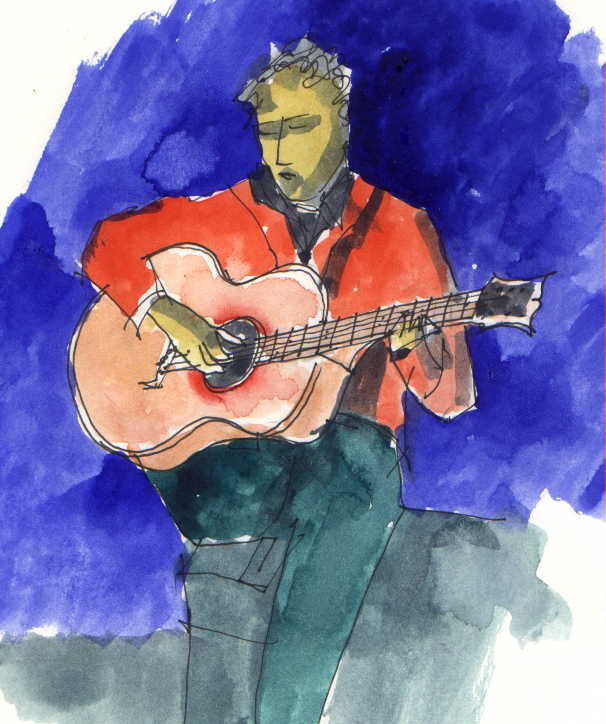
When I arrived in Aberdeen in the autumn of 1967, to begin my studies at the School of Architecture, the first thing I did with my student grant, after paying my dig money, was to buy a guitar. It was nylon string bottom of the range Tatra classic from Bruce Millers in George Street.  At the same time I became involved in a Friday night coffee bar run from the basement of the Salvation Army Citadel at the west end of Castle street. You entered through a small door on a side street, where the North Sea wind hurled its way up into town, and down a flight of stairs to a brightly painted room with a small stage and mic and a counter at the other end serving hot milky coffee, Coke and Fanta. The café was called “The fishing net” a reference to Jesus’s commission to Peter “I will make you a fisher of men”. It was decorated with paintings of fish, seaweed, brightly colourer nets and fishing tackle. During the evening a small folk trio or solo artist would play and sing and someone would speak with a message. It was run by a number of churches in the city with the aim of making connections with young folk on the streets on a Friday evening. , They were invited in, befriended and engaged in conversation.  I had only been going for a few weeks when one of the leaders asked me to play and sing on the following Friday. With foolish naivety, I accepted, completely oblivious to the fact that I had no material and had never sung, far less played guitar, in public before.  Hastily I scratched a couple of songs together, one which had a remarkable and not unconscious resemblance to the Kinks “Sunny afternoon” and the other to the Beatles “a day in a life” The third was a spiritual. I practised hard but as the day grew nearer became more and more aware of my foolishness. I remember the night very clearly, walking across to the stage with guitar over shoulder shaking like a leaf, thinking “I can’t do this” and praying “lord if you really want me to do this, let it be you who does it”. It is a prayer I have found myself praying each time I have been asked to sing, since. The noisy room was suddenly stilled and as I ham fistedly clunked my way through the songs I had this strange experience as if standing outside myself looking on as someone else took over, carrying the message to the hearers.

Once finished and with the waves of relief pouring over me I relaxed at a table and fell into a discussion with a slightly inebriated leather clad rocker. He wasn’t interested in the songs but wanted to argue about the existence of God.  I was helpless and could offer no good explanation or original thought.  We were soon joined by two others, one clutching a battered bible. Suddenly there was clarity and rational in the discussion and I sat back with dropped jaw listening to the discussion amazed at the command of our new friend. (the one doing the talking) He had understanding and ability to communicate the cosmic realities of creation and redemption and the wonder of the gospel in spell bounding clarity. It was only after he left that I learned that he was already well known in student and church groups, the president of the Christian Union in the University and later a significant figure in Reformed Christian circles both in Scotland and the USA, highly regarded for his teaching, writing and editorial work.  So it was a surprise,  that our lives should cross again some 45+years later, when we both joined with our families, in our new church setting. It was an added and unexpected delight to hear him preach. While some preachers become old and tired and tread well-worn predicable paths and others have spoken for a specific time and place, his preaching carried refreshing  timeless authority, vitality and relevance.   Now endowed with the richness of truth distilled slowly through the years it was presented with crystal clarity, much as it was, around the table, in the basement café, all these years ago.

Crawford mackenzie

Why I still go to church

black watch

The questions comes up, of course, because so many of my friends, my family, people I love and care about, folk I admire and respect, don’t.  Some flirted with church in their formative years but got bored of the petty politics, struggled with the institution, were turned off by the back biting and hypocrisy, felt excluded, marginalised, betrayed, and overwhelmed with the sheer absurdity of belief that they left for the sake of their own sanity.  I find I share an awful lot in common with them and have a fair bit of sympathy with their position.  I sometimes wonder why I never joined them.  But I haven’t and I won’t and I can’t. Because….

Because the church is much more. The bonds are stronger than friendship.  The ties are thicker than blood. It is bigger than family.  The local church might seem like a collection of misfits and oddballs, rough diamonds and smoothies, saints and martyrs (“the martyrs being the ones who have to put up with the saints”*), people we get along with and people we don’t.  It is made of people of different age groups, different cultural backgrounds sometimes speaking different languages, people who don’t share the same outlook, standards, interests. All of this must point to the fact that something else is going on here.  That something else is God.  It is God’s church and so he does the choosing. He brings us together. He does the deciding. He does the planning.  He does the perfecting. It is his business and he does it and will do it in his way and in his time.

Because we live in a world that is full of fantasy and illusion, false God’s and paper kings, soaked through with a powerful pervasive philosophy that says that what we see and hear and can touch is the real world. It bombards our thoughts, bends our minds and coerces us into believing this is true. So we need to find ourselves somewhere else where we can be brought into the real world.  Where we can regularly make contact with what is really important. With what is more important than life or death. And that somewhere else is the church. That is why the call to worship “We are here to worship God” is pivotal. It is a call away from the false realities to the true reality and of his purpose of salvation and redemption and glory. In his presence the other world with its great show, its charms, its promise, its money, its power, seems so pathetic, so foolish, so small and so sad.

Because, in church, I am reminded of where my true identity lies.  It is not in being a man, a father, a grandparent, an architect, a dabbler in painting, music and DIY, a Scot, a European a White Anglo Saxon Protestant Christian.   My identity is not in my interests, my family, my roots, my sexual orientation, my ability or disability, or in  my race. My identity is in Christ.  I don’t need to wonder “Who am I?”  But I need that regular reminder of this knowledge which is found in the strange setting of a group of ordinary people meeting together, bowed in worship before the one true God.  I need to know again that I am a sinner, who has been accepted by God because of Jesus, with nothing to bring but empty hands accepting his grace.

That’s why I still go to church.

Crawford Mackenzie

* Quoted by Eugene Peterson in “The Wisdom of Each other”   Zondervan

The Failure of Men (looking for a model)

Since early days I had an interest and love of songs, song writing and the songwriters art. From David’s psalms where the tunes have been lost, to Bob Dylan, who epitomises the pinnacle in contemporary song writing and whose work has so far not yet been eclipsed.  Many people have written good songs but few have produced consistently good material. Many of the singer songwriters I have admired have been women. From the soft and lyrical, country voices caressing words to the biting snarl of pent up rage. Singer songwriters like:  Sinéad O’Connor, Nanci Griffith, Mary Chapin Carpenter, Pat Benetar, Bebe,  Souad Massi, Coco Mbassi, Suzanne Vega, Charlott Dipande and others .  Many of these write and perform songs which often display their deep dissatisfaction with the men in their lives and with men in general. Sometimes it is wistful disappointment in “He never will need me” to the savage “Malo malo malo eres ”. I was always curios why I, as a man, should be drawn to this material.  Why would I choose to hear my gender mocked and savagely ridiculed?  Why would I be drawn in the way that some men are drawn to the strand of pornography which show men being humiliated by women in feminine dominant sadomasochism scenarios .  It took me some time to realise that I shared in this frustration in this disappointment with men and this inevitably meant with myself. I too was frustrated with the way we were and how far we fell short of what we should or could be.  But to have a sense of disappointment you must have a standard or a model you can aspire to. You must have a vision of something better.  What was it?

I had many male models to admire friends and colleagues and leaders in society and in the world. I had three older brothers who I looked up to and through whom I learned: the desire for exploration and finding out, the beauty of hard work and order and doing things well, the constant pushing beyond the obvious of what we were told to the other side of the argument, the cynics art of lifting the lid on pretentions and self-authority and, I had my father.  On the long walk homes from Cleadale in the dark after visiting a home with tea and scones he would tell stories, or round the Raeburn in a morning, when there was time, he would read from the bible and excite us with tales of David or Paul.  It was in the way he told the stories that I knew that he admired these men in their courage and commitment, despite all their obvious flaws.  In the same way as he was excited and drawn to the lives of these men, I was most affected not as much by what my father said, as by what he did. His commitment was all the way. Once set on the path He was never half hearted. Even when he insisted on praying publicly and giving thanks to God for a meal in a crowded fish and chip shop, to the embarrassment of his children,you could not but admire someone who was not afraid of ridicule or shame in the eyes of others.  He was not as the Scottish Paraphrase puts it “ashamed to own my lord or to defend his cause”.  I often sung that in church uncomfortably thinking that I would be a little ashamed at times. He didn’t ever seem to be. Later I discovered the character Job, specifically; when he describes the kind of role he had in his community. Reading this through a 21st century lens, with our twisted sense of humility, it might seem a little arrogant, but pride would have been furthest from him when he longed for the days past that had been taken from him so cruelly:

“When I went to the gate of the city
    and took my seat in the public square,
 the young men saw me and stepped aside
    and the old men rose to their feet;
 the chief men refrained from speaking
    and covered their mouths with their hands;
 the voices of the nobles were hushed,
    and their tongues stuck to the roof of their mouths.
 Whoever heard me spoke well of me,
    and those who saw me commended me,
 because I rescued the poor who cried for help,
    and the fatherless who had none to assist them.
The one who was dying blessed me;
    I made the widow’s heart sing.
 I put on righteousness as my clothing;
    justice was my robe and my turban.
 I was eyes to the blind
    and feet to the lame.
 I was a father to the needy;
    I took up the case of the stranger.
 I broke the fangs of the wicked
    and snatched the victims from their teeth.

Here I thought was an example, a model to follow. The respect he had was not because of his position or his wealth or his skills of gifts but because he rescued the poor cared for the orphans and promised the dying man that he would look after his widow. He took up the case of those who couldn’t and if this required boldness and firmness and necessary force against the wicked who caused the suffering he would not hesitate.  He was neither a macho misogynist nor a soft in the middle new man. His was a life to emulate. Here was model to follow.

Crawford Mackenzie

Desert Island Youtubes


I wonder if Roy Plomley  could have possibly imagined, when he devised his radio programme in 1942, that it would continue for 70 plus years and become a British institution. While LPs replaced gramophone records which, in turn, were replaced with CDs and MP3s the format of the programme has remained unchanged with an endless list of musicians, artist, writers, politicians, comedians and celebrities, all willing to share their life story in the context of a selection of music. I will never be a guest, so leaving out the life story and the potted psychology; this is my fantasy list of records, but, with a twist. When I land on this desert Island I have been able to salvage a pen drive with 8 YouTube videos and a solar operated device to play them on. This is my selection:

1 The Kinks  “You really got me” https://www.youtube.com/watch?v=-2GmzyeeXnQ  As a young teenager I missed out on Elvis, Buddy Holly, Bill Haley, Jelly Lee Lewis and all the other early rockers. I couldn’t get fired up by Cliff Richard and even the early Beatles passed me bye.  I hated the adulation they received and when I was asked to give a talk in 2nd year English class, chose my dislike for the Beatles as the subject, explaining how I found their music simple, their words childish and how I much preferred to listen to Beethoven and Brahms on the radio. The teacher humorously offered me armed protection so that I could leave the room without being molested. But it was the Kinks who really got me.  I remember that lunchtime in the school gym where the prefects were allowed a record player and one of the singles, that the boys produced, touched a rhythmical nerve. It was that da-di-di-da-di—– da and the vocal a split second ahead of the riff.  I remember walking down the long corridor to class afterwards with the beat still thumbing away in my head, never to be forgotten.

2 Joe Cocker “Summer in the City” https://www.youtube.com/watch?v=6Hxz6qJi-9kWhen the Loving Spoonful first came on the scene it was summer. It always seemed to be summer. There was something magically light and funny and joyful about their songs. It fitted with the long summer days outside on the grass, during exam breaks, or wrapped around the sports ground as other strained every muscle on the field. It was the expectation of a long holiday and the songs fitted the mood perfectly. None more so that ”Daydream”  https://www.youtube.com/watch?v=z9afV7h-XkU&list=RDBU8COHUrGi0&index=0 which John Sebastian could play solo without losing much from the sound of the full band. Summer in the city had an altogether different feel. The summer had moved from suburbia to the heart of the city, sticky and hot with the promise of the cool evening and endless parties. John Sebastian was interested in how Aaron Copeland used the orchestra to create city sounds and he decided to use real recordings of street traffic. This was taken one step further in the video made for Joe cocker’s version.

3 Bob Dylan  “Knocking on heaven’s door” https://www.youtube.com/watch?v=-jPg2M1UYgUDespite its popularity with every strumming busker and street musician, for me  “Knocking on heaven’s door” has never been one of Bob Dylan’s greatest songs, by a long shot, but this performance with Tom Petty is very special.  The whole sense of the live sound is captured with a magnificent harmonica introduction almost interrupted with Stan lynch premature roll on the drums which Dylan stays with an outstretched hand. Benmont Tench does some fine work on the piano, but it is a whole.

4 Peter Paul and Mary  Early Morning Rain”  https://www.youtube.com/watch?v=0OCnHNk2Hac  Mary Travis, who like so many gifted singers, has sadly gone from us, provided the spark and tension to an otherwise plain Peter and Paul.  While Peter Yarrow and Paul Stookey provide the solid base of the songs with tight clinical guitar work, flawless vocals and harmonies, it is Mary Travis who is the wild card. Standing often on the edge, to the side, she creeps into stir the song and creates an unnerving tension that is riveting. She moves dances and sings like an exotic bird with harmonies that makes your hair stand on end. This comes over so well in the video recordings of a “Tonight in person”. These include the republican “Rising of the moon”   https://www.youtube.com/watch?v=2Q_xacXFwq0  (long before the troubles) and the light hearted gospel Jane Jane https://www.youtube.com/watch?v=zgPjgQBHEeA. But it is Gordon Lightfoot’s “early morning rain” which for me is the pinnacle.   The song, itself, meant a lot to me, reminding me, as it did, of the time I missed the plane home from Glasgow Airport in the summer of 1967.    The line “she’ll be flying o’er my home in about three hours’ time” makes me choke a little.  Listening to how these three played together, recently, made me aware that our set up with “The Weather’s Hand” was much like this and perhaps there was something subconsciously going on there.

Bert Jansch “Blues run the Game”  https://www.youtube.com/watch?v=4MO_Xxq3LVw&list=RDtpBxDDwbzBk The first LP I purchased was Bert Jansh’s debut album recorded in 1965, on a reel to reel tape recorder with a borrowed guitar for which he was paid £100. I had to borrow a record player to listen to it. I could not believe that what I was hearing came from a single guitar, there seemed to be so much going on at the same time and I have spent a good part of 40+years trying to emulate the style. I saw Bert once live at a concert at the Lemon Tree and he was his characteristically unassuming self, on a simple stage, plugging in his guitar and fixing the microphone like he was a complete novice. Yet most guitarists will say that they owe most to him. He was shy about the limelight and said that he would rather be propping up some bar somewhere. Sadly he got that wish, drink all but destroyed him and possibly led to his premature death.  This is just one example of many.

6 Karen Matheson and  Paul Brady “Ae Fond Kiss”     https://www.youtube.com/watch?v=bWzXTebD5X0 The transatlantic sessions produced some wonderful collaborations from musicians across the world and the filming of these, catches that wonderful sense of the players simply getting together in someone’s living room playing so beautifully and sensitively. To my mind some of these are almost perfect: Mary Black on Richard Thompson’s “farwell farewell” https://www.youtube.com/watch?v=B-tiGvMqpU8, with Michelle Wright, Iris DeMent and  Mairead Ni Mhaonaigh on “Will the circle be unbroken”https://www.youtube.com/watch?v=KB1-1zuDGJ0, but my favourite highlight is Karen Matheson and Paul Brady on Burn’s “Aye fond Kiss”. I was never a fan of Burns and hated this song as I associated it with the stilted formalised style of Kenneth McKellar and more recently Fiona Kennedy and Susan Boyle. The Corries tried to make it more folky, but that was less than convincing.  Micheal Marra, Dougie MacLean and Eddi Reader have added their own twist to it, to lots of acclaim, but they come nowhere near the authenticity of what Karen Matehson and Paul Brady’s do with the song. The balance and restraint of Donald Shaw’s piano, Aly Bain’s fiddle pulling it away and just a touch on Gerry Douglas steel guitar. The way the key descends and ascends to suit the voices matches the theme perfectly especially when they come together in harmony for the last two verses. When Paul Brady comes in with the whistle, behind the line, you know you are in on something special. It all sounds like it has just fallen together which belies the mastery of the musicians. The singing is so convincing you would think they were the lovers who the song was about.

7 Nanci Griffith “If these old walls could speak” https://www.youtube.com/watch?v=x44bwDKn0sg A friend introduced me to Nanci Griffith as the face of new country and her album “little love affairs”.  I was immediately a fan.  It was the combination of her song writing craft and her singing, in the way that she could caress the words as well as deliver them with a snarl that caught me.  I have had most of her albums and watched her in concert a number of times. She has the great gift of inhabiting a song, often material by others. Her versions of Julie Gold’s “From a distance”, which she made her own, and Stephen Foster’s “Hard times” are among some of the finest. But the song which haunts me is Amy Grants’ “If these walls could speak” (if you can ignore the strange and untypical fashion statement)

8 Marilyn Marshall “ Front Line Believer” https://www.youtube.com/watch?v=dmuLFfNLeHs Marilyn recorded this, possibly one of her finest songs, in the last album by The Weavers Hand in1999. She had been moved by the stories she was reading of the Andean Christians who were caught in the crossfire during the civil war in Peru during the time of the “Shining Path” in the 80s and 90s. In this time pastors were specifically targeted and many were murdered. Sometime whole church congregations were massacred in the course of the revolutionary’s brutal aims. Christians in the Ayacucho province lived in constant fear, waiting on a knock on the door, in the dark of the night and this song captures this grim reality and the futility of the movement which was unable to see “The light of true salvation”   

Crawford Mackenzie

I am not ashamed

cell

Sin is a troublesome word. Like so many words in our vocabulary its meaning changes over time it mutates and takes on other baggage and selective nuances so that it can mean quite different things to different people.  Preachers and communicators of the bible often struggle with this and try hard to find a new word or words that would resonant better with the original meaning. Rebellion is one, missing the mark and being messed up, are others. The problem, of course, is the word itself and the idea it imparts. It is offensive. It is the implicit suggestion that there is something wrong with us – whoever we are. That cuts to the core of our self.  It is a blasphemy against the ego.  It is strange that there is such a revulsion against this approach when we are very relaxed about using the same approach with other more acceptable wrongs.  The first step on the recovery from drug addiction, alcoholism, sexual offending, or any socially recognised disorder, is to admit it.  No one has any problem with that. Yet we have enormous difficulty in owning up to this core problem.  Preachers, who have tried to avoid the issue for fear of coming over too censorious or self-righteous, or worried that it presents too bleak and pessimistic a view of humanity, have not helped either.  The focusing on nice things like the celebration of love and positive affirmative strokes, to the ignoring of this essential truth in the Christian faith, has been disastrous.  Because acknowledging the reality of sin is one of the most liberating and essential parts of the good news.  Now we understand that there is a reason for the way things are. And that must be good to know. Pretending that there isn’t a problem or that it is one that with enough willpower and the right conditions we can overcome is pure fantasy. The Gospel, on the other hand, exposes the problem and reveals the solution. But of course it is not the small slightly naughty unimportant thing that it is so often made out to be. It is not just about making bad decisions or errors of judgement it is deadly serious, more than deadly serious. Sin at its core is a vile, corrupting and corrosive thing. It is not good. It is destructive and left to its own will continue to degenerate and destroy all and everything in its path, everything that is good. It contaminates everything and seeps through the personal, the social and the institutional. It is that bad. It is that serious.

This, of course, begs the question, if it is that bad why has it not destroyed good already after all it has had plenty of time to do that and yet good still seems to survive.   Many, I suspect, would believe that it is because humanity is essentially good, that evil with all its manifestations is a temporary blip and that in time this unfortunate character trait will be resigned to history.  But, to hold on to this view must take extraordinary faith and a remarkably optimistic view of human nature without any real evidence to support it.   The reason, I believe, good continues to survive, is because ultimately it is to do with God. He is good and merciful  and he has put in place at certain times restrictions so that we do not yet destroy ourselves -The angels with the flaming swords at the garden, the confusing of the languages and scattering of the people on Shinar’s plane, the flood and other events throughout history. He also chose a man and a family and a people to be witness of him and tell the world. He gave them the law in the Ten Commandments and other regulations to help them in their approach to him and in how they relate to each other. Finally he promised and sent his son, who would be the one who would reconcile people to himself and once and for all deal with the problem of sin.

Last night I was sitting with the small group of internationals, who meet each week in our home. They come from countries in all parts of the world, with backgrounds in all types and shades of faith. It is a precious moment in the week.  After sharing a meal, we spend the time reading, studying and discussing the bible. We had just begun to read through Paul’s letter to the church in Rome and it is hard to describe the sense of joy and liberation as we touched base with the cosmic reality of the Gospel of Jesus Christ.  The dawning of this truth is like a massive door being opened to let light flood into a stale and dingy room and we could understand why Paul was able to say “I am not ashamed of the Gospel for it is the power of God for the salvation of everyone who believes”.

Crawford Mackenzie

It works, don’t fix it

I don’t know what it is about me (honestly, I don’t try it) but I seem to be perpetually swimming against the tide. Just when everyone seems to be leaning, swaying and swinging towards a yes vote I am becoming less and less convinced.

I was so looking forward to this debate, but it has been such a dreadful disappointment. I hate the slick TV commercials, I hate the promise of Nirvana that no one can believe in. I hate the dreadful warnings and the threats. I hate the celebrity endorsements.  Really, we don’t need to know how musicians, TV cooks   and dancers chose to vote. We can make up our own minds. But what we do need is leadership and of a kind that we have, so far, not seen.

Somehow I naively believed that out of it all would come some clear leadership, some visionary, some prophet, someone who would grab the attention of the people and fire their imagination, someone who would point a way beyond petty kale yard parochialism to a hitherto unseen horizon, a Vaclav Havel, a Jomo Kenyatta, a Mahatma Ghandi a Nelson Mandela an Aung San Suu Kyi. But no one we have, comes anywhere near the stature of these people. Inevitably it has become little more than a playground scrap following the same old predictable lines and no one seems to be able to rise above it. Some like Jim Sillars and Gordon Brown make an effort and hint at what could be, but others have let it slide into a grubby political game promising a paradise, issuing threats and knocking chunks off each other. When people like Nicola Sturgeon says “we have everything to play for” we know it is as a game.  The scary thing is that it is not a game.

So, while they are unlikely to listen, this is what I have to say.

To the Yes side: “Forget about politics and economics, monetary policy security, child care, the just and fair society that we all want etc etc.  You know and we know that it might not be possible to deliver on any of these. There are no guarantees. You might not be in power to do it. Focus on nationhood, inspire us, make us believe in it, and don’t promise anything, other than that it’s going to be hard. That was what Wallace (aka Mel) and Churchill did. Whatever you do, don’t give us sweeteners. We are not fools and we see through all of that as we have done before. Promises of a better world, simply by putting a cross in the right place never convinced anyone. But if I heard a speech that said “it’s going to be pretty tough, the economy might not go well for some time, it will takes us several years to sort all the things out and get it right, we may have difficulty working out who are our friends, It will take a lot of patience, you might find yourself worse off for some years and frustrated with us because we can’t do it all at once but… but, and here’s the thing,  it will be worth it.” Then I just might just be convinced.

To the no side: “Don’t say anything. Everything you have said, so far, has backfired spectacularly.  You don’t have to argue for the status quo. People know what it is. The other side need to do the explaining. It’s not perfect, it’s not all good, there are lots of flaws but it works, don’t fix it.

Crawford Mackenzie

His hand

his hand title

His hand could have held on

to all the wonders of heaven

the glory and good things we can hardly imagine…

But it didn’t

His hand let go of all of that and gave it up

to come down and to be one of us

His hand was a baby’s hand with tiny fingers

and tiny fingernails needing trimming

His hand held his mother’s hand till he could walk

His hand followed his father’s hand in working with wood

with saw and plane and nail and chisel

His hand turned wood and turned water into wine

His hand commanded the sea to be still

His hand touched diseased skin and it was healed

His hand touched tongues so they could speak

ears so they could hear

eyes so they could see

His hand took a dead girl’s hand,

lifted her up and brought her back to life

His hand was placed on the heads of children

while adults fumed in the background

and he blessed them saying  “let them come to me”

His hand broke bread and said “this is my body… for you”

His hand was taken, bound and pinned with nails to a timber scaffold

while his life ebbed away from him

Yet… on the morning

His hand pointed to the fishermen on the lake “try the other side”

His hand cooked fish for breakfast

His hand had the marks of nails that Thomas felt

His hand

And now… his hand is offered to you and me

“Take my hand” he says “Be forgiven, come and follow me”