Carers, Wasters and Losers

Lessons from the elephant herd

Image

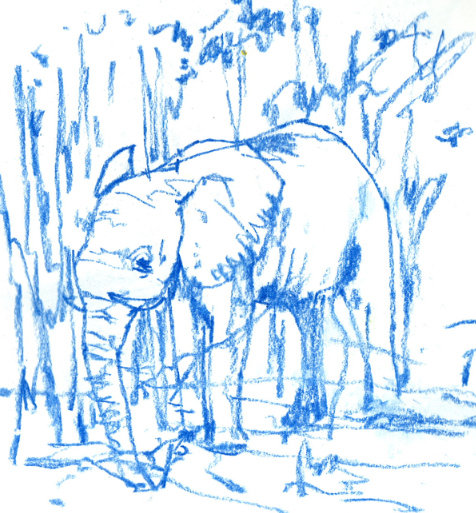
We were travelling the short distance form the ferry which had taken us across the Zambezi from Zambia on our way to the game park in Botswana, when our driver and guide suddenly brought the Landrover to a stop.  He had spotted a lone elephant at the side of the road and swung the vehicle as near as he could without startling the animal.  He need not have bothered. The elephant was fully absorbed in the business of grazing on the grass and small trees and quite unconcerned at his audience of wild life enthusiast leaning out of their seats in the high Landrover with hats, sunglasses and cameras clicking.  “This is an adult male” said our guide and he went to explain how, in common with other wild animals there were three groupings: the first group, the breeding herd, which consisted of the young , females and one significant male, the second group which he termed the “bachelor herd” which was made up of males who were kicked out of the breeding herd at puberty, and the third group which was not a group as such but consisted of the males who did not fit in or were kicked out of the “bachelor group” and who wandered on their own through the bush.  We watched this lonely looking creature with his dusty skin and deep sad eyes pull and munch at the long grass for some time. “This is a lone male” said our guide “He is a loser!”

The rest of the day was spent exploring the game reserve with many close encounters with, kudus, impalas warthogs, water buffalo, elegant antelopes, sinister crocodiles, sad hippos, numerous brightly coloured birds, majestic giraffes and the purposeful elephant breeding herd making their way through the bush in well remembered tracks.  What could not leave my mind was the thought of how the three groupings seem to mirror groupings that exist in society, and  in some measure, in the church. Here was a fascinating insight into clearly defined and differing roles.

We have the “Carers”, the breeding herd,  who are by far the largest and most influential group.  Their principal concern is with the care, protection and nurture of the young.  This demands the greatest priority, resources, time and money. This is necessarily so, as this group protects the future of the species.  The first responsibility of any grouping is just that, the care, protection and nurture of those who will come on after to continue the line.  Within the organisation of the church this is the dominant theme; children, young people and families.

Inevitably this means that there are those who do not fit in to this programme. They have no particular skill to offer and no emotional pull or burden to allow them to participate in this work. These are the “Wasters”.  They may not be described as such, or even spoken of as such, but deep within the psyche is a feeling that, as they don’t have a role with caring, they are in some senses irrelevant.  Perhaps they can find some non caring function on the edge of things but that only reinforces the feeling that they are on the outside.  The result is that they find their home and their fulfilment with the “ Bachelor herd” in sports activities, drinking, and work particularly in the heavy industries ,the miners and shipbuilders of previous years, trade unions and the armed forces. Here they find a common bond and a very deep loyalty to each other. Jackie Bird’s diary of her time with Scottish troops in Camp Bastion illustrates this very clearly. She spoke of the fierce loyalty that the troops had, not for their country, nor for their commander but to each other. In the past these would have been the ones who created the wealth, protected and defended, came to the rescue in disasters and emergencies and often with bare hands and physical strength brought the supplies, made the repairs, restored the peace. In a time of relative ease and calm, when military adventures are despised and when heavy industries have been degraded, their role is diminished. In the church it is almost non-existent.

Despite their complimentary and co dependant roles the carers and the wasters regard each other with a degree of mutual disdain. But there is another group the “Losers” who don’t fit with either “Breeding herd” or the “Bachelor herd”.  They are not club people have no affinity either with the macho world of sport, machines and militarism (usually of men) or with the homely world of the “Carers” . They wander through life on their own. They may have partners and families and they make take part in activities but that is not where there soul lies.  It is in the other world of solitude, of ideas, of beyond.  The “Carers” pity them and think they are lonely. The “Wasters” despise them and think them pathetic. Strangely they may not actually be unhappy and the sad look in their faces often belies a stout contentment.  They wander around on the fringe of society and while not strangers to the church, never seem to have found their potential there and sit on the edge

In our 21st century western smugness, it is easy to be lulled into an illusory sense that we have reached a plateau of civilisation and progress where we no longer need armies or miners or shipbuilders and that the “Wasters” should be given some soft toys to play with, fight with paintballs and vent off steam running naked through the woods. There is no place for the “Wasters” here.

It is also very easy to be lulled into a false sense of security and belief that things will go on just as they have done before.  The worst disasters happen elsewhere and are eventually tamed by television.  Even the most complicate international event will be explained once John Simpson gets to the scene. In this illusory world secured by health and safety, glossed by celebrity and covered by insurance, there is no place for a prophet of doom or a prophet of any kind for that matter. We know the future and there is no role for someone who sees over the hill and round the bend. There is no place for the “Losers”  here.

But the point is that in a healthy society each must have a part to play and in the Church every individual has a gift to bring to the work of the kingdom. Without the “Carers” there will be no future generation.  Without the “Wasters “there will be nothing left after the marauders, bullies and earthquakes have had their way. Without the “Losers” there would be no vision and where there is no vision the people perish.

Crawford Mackenzie

Everlasting Arms

Recently we were at wedding of a good friend. We had known her since she was quite young and it was a special joy to watch her grow and become the person that she is today. We shared many things over the years, including the playing and singing of songs together in a church band and it seemed fitting that I should write something for her and her husband on their special day.  It was not a specifically wedding song and strangely it has been most appreciated by those coming to terms with bereavement and loss. So for celebration or loss and for it’s worth you can find it at http://www.youtube.com/watch?v=O4FXdR6-D98&feature=youtube_gdata

EVERLASTING ARMS

There is a bond so strong and sure

Through changing times it will endure

No one on earth can every break

No power in hell can separate

There is a hope I know is true

It keeps me sane and pulls me through

Just like the sun shines on my face

I feel the warmth of his embrace

And when the storms are all around

When faith is weak hope almost is gone

He will protect me from all harm

For underneath are the everlasting arms

There is a friend and I know he’s there

He lifts me up and hears my prayer

When I fail to see or understand

Yet still he holds me in his hand

And when the storms are all around

My faith is weak my hope is gone

He’ll  keep me safe from life’s alarms

For underneath are the everlasting arms

There is a place where I belong

That knows no tears or pain or wrong

Where death is dead and night is day

Where sin and sorrow are washed away

And I long to be there in that place

To hear my name and see his face

But until then I will fear no harm

For underneath are the everlasting arms

Crawford Mackenzie ©2013 Tollcross Songs

Whatever it is, it is not rocket science

English is a very beautiful language but it is also a very powerful one.  In many ways it almost dominates the world, though the English speaking people (those for whom it is their mother tongue) are a relative minority.  It is also changing and evolving all the time and this process keeps accelerating and seems unstoppable.  New words are added to the dictionary every year, others are dropped and become anachronisms.  Nouns become adjectives (relation – relational) and verbs become nouns (transition – to transition). Sometimes the meaning changes to the opposite of the original meaning (wicked). Often politics changes the name to change the attitude (same sex marriage – equal marriage, spare room subsidy – bedroom tax) once the new name has been accepted the argument is won. It has all been said before, of course. It was in 1945 that George Orwell wrote his essay “Politics and the English language” and it has lost none of its relevance today.

Now and again you come across examples that in their passion for gobbledygook and meaninglessness, take the breath away. Here are four that came across my path recently.  1) Is a Wikipedia entry on Alan Hirsch, a contemporary Christian writer, 2) is my memory of what one individual said at a recent meeting. I was so captivated by the number of idioms strung together in a meaningless stream, I just had to write them down afterwards. 3) is Sir Humphrey from a transcript of BBC’s “Yes Prime Minister” and 4) is the instructions on who should sign a Building Standards Completion Certificate form.

1

Probably Hirsch’s most distinctive contribution was to articulate what can be called a phenomenology of apostolic movements. By probing the question of what comes together to create exponential, high impact, multiplication movements, he came up with the concept of what he calls ‘Apostolic Genius’ which is defined as “a unique energy and force saturating phenomenal Jesus movements.” Hirsch defines it elsewhere as “the built-in life force and guiding mechanism of God’s people. As to its phenomenology, it is made up of the symphonious interplay between six core elements, or “mDNA”.

2

Frankly there has clearly been a series of systematic and systemic failures and a litany of abuse that beggars belief. We have been avoiding the elephant in the room for too long and so we need to grasp the nettle and bite the bullet and carry out wholesale root and branch reforms, bringing forward a whole raft of measures and putting in place a series of robust safeguards with clear blue water between them. It will not be a silver bullet but we need to be singing off the same hymn sheet because the devil is in the detail. Now I would hold my hand up and be the first to admit that we don’t need to teach grannies how to suck eggs and we don’t want to re-invent the wheel, but it’s not rocket science.

3

“Its not fair with trident we could obliterate the whole of eastern Europe”

“But we don’t want to obliterate the whole of Eastern Europe

  It’s a deterrent

  It’s a bluff I probably wouldn’t use it”

“Yes but they don’t know you probably wouldn’t use it”

“They probably do”

“Yes they probably know that you probably wouldn’t but they can’t certainly know”

“They probably certainly know that I probably wouldn’t”

“Yes but even though they probably certainly know that you probably wouldn’t, they don’t certainly know that, although you probably wouldn’t, there is no probability that you certainly would”

4

The completion certificate must be submitted by the relevant person as defined by the Building (Scotland) Act 2003, that is –(a) Where the work was carried out, or the conversion made, otherwise than on behalf of another person, the person who carried out the work or made the conversion (b) Where the work was carried out, or the conversion made, by a person on behalf of another person, that other person (c) If the owner of the building does not fall within paragraph (a) or (b) and the person required by these paragraphs to submit the completion certificate has failed to do so, the owner.

All of the four, except one, are serious pieces and here is the question, which is also a serious one: Is it possible that that the English language will continue to change and evolve in an increasing rate and to such a point, where it becomes impossible to stay ahead or understand and then it becomes useless for communication and in future years become a dead language?

What do you think?

Crawford Mackenzie

Ham bone and clouty dumpling

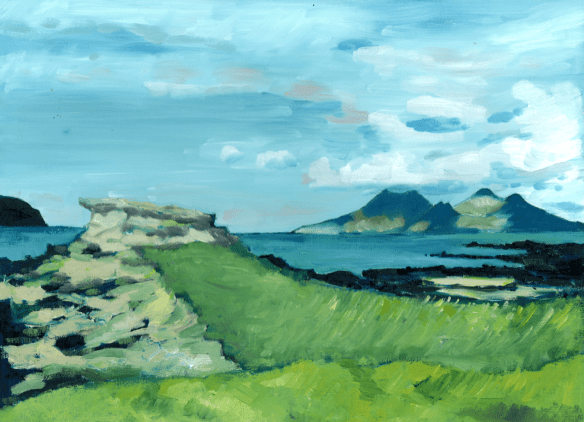
This summer I made a trip to the island which was my home throughout most of my childhood. It was an inspiring suggestion by my sister and on her persistent promptings, my siblings and I with other family members made a sort of pilgrimage to “our” Island Eigg, which is part of the small isles just south of sky and off the coast of Morar.  Though I was there for less than 48 hours, the mountains of memories that resurfaced in that time, were so tightly packed in, it would take some time to unfold them, lay them out and to properly record them in words or pictures. We left the island more than 50 years ago and while much had changed over that time the surprising and startling thing was how much had stayed the same and how much was instantly recognisable. There were memories of school days and playing, of feeding hens and collecting milk, services on Sundays and boat journeys between the islands, target practice with air rifles, rabbits and fishing for trout, constant walks, heather fires, adventures and discoveries along cliffs, across beaches, through woods and in caves and each brought to the surface by a turn in the road: the wet of the bracken, the sound of the burn, the hazels under the cliff, the smell of the sea, the warm summer wind across the machair, and the ever present Squrr, a strange volcanic plug, a single rock towering and dominating the island from almost every angle. Like a cat, she would sit upright inspecting those who were arriving and leaving the peir with a slightly threatening  air, from Gruilin she would be ready to pounce while from Howlin, on the north, laid out in her full length wanting just to be left alone to purr herself to sleep.  It was and is a truly magical place.

Before the magic spell was broken and we moved to the city we had to leave the large manse for a small cottage in the north of the island.  The manse was a rambling three story house that could easily have been the house that Robert Louis Stevenson had in mind in the opening chapter of “Kidnapped” Most of it was unfurnished and empty but it did have hot and cold running water and calor gas to provide light to some rooms. The cottage by contrast was tiny with no sanitation, save for a dry toilet in a shed outside and water from a tap in a field 50 yards away, collected in a cracked enamel pail.  The change in circumstances was as stark as it was significant. The neighbours in our previous locality were the doctor, the factor, the estate manager, other significant worthies and the laird himself.  He was an absent landlord and for most of the time he was just that; absent.  Now we were living with the common folk in their crofts dotted about the glen under the lee of the cleadale cliffs. At one time we were living with the nobility in a relatively charmed existence serving the community, now were among the ordinary people. At one time we were the ones who were generously offering our help now we were the ones receiving it, as on a dismal wet November Sunday, when, having walked back the miles from church, cold and soaked to the skin we were met at the door by our nearest neighbour bringing an enormous pot of lentil soup with a large ham bone and a steaming clouty dumpling. Later our mother had said that it was the time spent in the cottage that was among the happiest spent on the island. For the first time, it was if she felt she belonged.

It took me some time to finally identify the cottage. It was just off the road with a path down to the beach at laig now refurbished and with a large extension but unmistakable, all the same. Later with the sun breaking shadows over on Rhum and the wild grass dancing across the field, I replayed the scene of 50 years ago in my mind and I realised then that it had far greater impact on me and then I could possibly have imagined.

Crawford Mackenzie

Who do you think you are?

One of the most difficult tasks in starting to write a blog is the whole business of preparing a profile, writing an “about me” page, describing who I am, what my background is, my family my experience my interests etc.  It is an impossible task.  It is like writing your own obituary but fortunately that is for someone else if they can be bothered. My pastor of recent years often began a tribute during a funeral service with the words “How can you sum up the life of one person?” And the answer is you can’t. It is impossible. Obituaries and tributes, memorial services and the like, always seem to me to be such poor pieces. They are never enough. They cannot ever adequately give true worth and proper value to the person who has gone and they sound so final.  The life has past, now we move on.  It is cut and dried and even when people say they believe in life after death, it is as if there is none. It is as if heaven is a non-life where the person has no role other than to sleep forever. There is something in that attitude that screams out at the soul “It cannot be true”

Yet it is hard to avoid the enormous pressure to summarise distil and define, a person so that they can be categorised in much the way that music is classified, in genres.  If you like this, then you will like that. If you think like her, then you will be like them. It is particularly sad when people feel they have to define themselves and find their identity in something like their profession or their race or their class or in something as mean as their sexual orientation.  For me, when I think about who I am, when I consider where my identity lies, I know that  it is not in being a man, a father, a grandparent, nor is it in being an architect, a dabbler in painting, music and DIY, nor is it in being a Scot, a European a White Anglo Saxon Protestant Christian.   My identity is not in my interests, my family, my roots, my sexual orientation, my ability or disability, or in my race. My identity is in Jesus Christ. That is who I am, someone who God has created and someone who knows and has experienced the reality of his love through Jesus Christ. That’s the bottom line and all the rest are peripheral and secondary. They may have influenced me, they may have shaped me in some way and made me something of what I am, but they are not me and they do not define me.

Forgive me then if you find my “about me” page a little  cryptic.

Crawford Mackenzie

To a suicide bomber

Peshawar, Pakistan 22nd  September 2013

Another suicide bombing, another church, another group of worshipers men women and children, another 75 dead and 120 injured, another round of condemnation, another pledge to fight the terrorists and win and just another incident that barely makes the pages of the morning’s newspaper. It is now just one of these things, the suffering is far away, the reality is dim, the unanswered question “where was God?” is put to bed and we get on with life. But sometimes you can’t.

This from a previous outrage:

TO A SUICIDE BOMBER

“o yes …I am afraid”

To you suicide bomber who I will never meet/I have but one thing to say though I know you won’t hear me now/I too, like you, believe in commitment /It can’t be halfhearted /It has to be all the way/I too, like you, believe in spiritual things/The material world will pass away/What is seen is temporary/What is unseen will last forever/I too, like you, stand dismayed at what I see/At times disgusted with our seedy western ways/I too, you like, you believe in life after death/When our brief short stint is passed/Then will be eternity/Where no sacrifice will ever be too great /Or can compare with the glory that is to come/I too, like you, believe in God /He is one, /All powerful /All merciful/But I fear /I fear /I fear /For you/When I think of how you will stand before him now/And how you will answer /When he hears the blood of the /The women men and children/The babies and the children yet unborn/Crying out from the ground and the underground/And I know/It would be better much better for you then/That a giant boulder was hung around your neck /And you were drowned in the deepest part of the sea

July 2006